

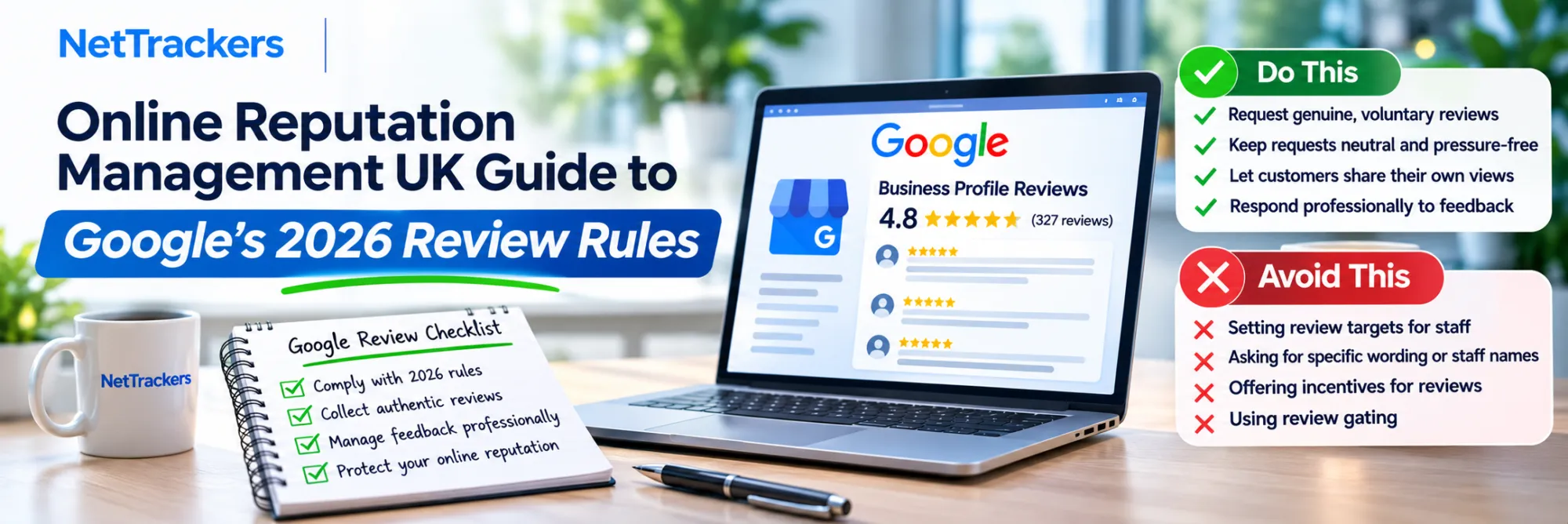

Google reviews play an important role in how customers evaluate businesses, compare service providers and make purchasing decisions. However, Google’s 2026 review policy changes have introduced stricter expectations for how businesses collect customer feedback. Practices such as employee review quotas, scripted requests and pressure to leave reviews can put business profiles at risk. An effective online reputation management UK strategy must prioritise authentic customer experiences, transparent review collection and compliance with platform policies.
How Online Reputation Management UK Services Help Businesses Follow Google’s Review Rules
Professional online reputation management UK services help businesses monitor customer feedback, identify suspicious reviews and establish compliant reputation management processes. Google’s updated policies place greater emphasis on preventing rating manipulation and biased review collection. Businesses must ensure that customers can express their genuine opinions without incentives, pressure or instructions about what to write. This approach protects both customer trust and long-term business credibility.
What Changed in Google’s Review Policy in 2026?
Google strengthened its review solicitation rules in 2026, with April updates explicitly addressing employee review quotas and requests for specific review content.
Businesses should pay particular attention to the following restrictions:
Asking employees to collect a specific number of reviews.
Requesting reviews that mention particular staff members.
Pressuring customers to leave feedback before leaving the premises.
Asking customers to include predetermined wording.
Offering incentives in exchange for reviews.
Selectively requesting positive feedback.
These restrictions aim to ensure that reviews reflect genuine, independent customer experiences rather than business-directed marketing activities.
1. Stop Setting Review Targets for Employees
Businesses have traditionally encouraged employees to collect a certain number of Google reviews each week or month. Some organisations have also introduced competitions or performance bonuses based on review collection.
Google’s updated policy explicitly prohibits businesses from directing staff to solicit predetermined review quantities.
Instead of measuring employee performance through review numbers, businesses should focus on service quality, customer satisfaction and effective complaint resolution.
Employees can still explain how customers may voluntarily leave feedback without being assigned review collection quotas.
2. Avoid Asking Customers to Mention Staff Members
Asking customers to mention a particular employee in their Google review is another practice businesses should reconsider.
Customers remain free to describe their genuine experiences, including mentioning an employee voluntarily where appropriate. However, businesses should not direct customers to include specific names, keywords or promotional statements.
For example, avoid requests such as:
Mention our receptionist by name.
Include the words “best dentist in London”.
Leave a five-star review about your appointment.
Allow customers to decide independently what information they wish to share.
3. Remove Incentives From Review Collection
Google prohibits offering financial or other benefits in exchange for customer reviews.
Prohibited incentives include discounts, complimentary treatments, gift cards, competition entries and other rewards linked to submitting feedback.
Businesses must also avoid offering compensation in exchange for changing or removing negative reviews.
A genuine review should reflect the customer’s experience rather than their expectation of receiving a benefit.
4. Avoid Review Gating
Review gating occurs when businesses selectively direct satisfied customers towards public review platforms while discouraging dissatisfied customers from posting feedback.
For example, a business might use a customer satisfaction survey that sends only customers with high ratings to its Google review page.
This creates a biased representation of customer experiences and conflicts with Google’s review policies.
Businesses should provide genuine customers with a fair opportunity to leave feedback regardless of whether their experience was positive or negative.
5. Use Neutral and Voluntary Review Requests
Google still allows businesses to request authentic customer reviews. The important distinction is that requests must remain voluntary, unbiased and free from pressure.
A suitable review request might read:
“Thank you for choosing our business. If you would like to share your experience, we welcome your honest feedback on Google.”
Businesses can include review links in follow-up emails, receipts or customer communications. QR codes may also be used, provided customers are not pressured to submit feedback while on the premises.
6. Understand UK Fake Review Legislation
Google’s policies are separate from UK consumer protection law. Businesses must consider both when developing reputation management strategies.
Under the Digital Markets, Competition and Consumers Act 2024, new provisions concerning fake reviews came into force on 6 April 2025.
These provisions address practices including commissioning fake reviews, submitting fabricated feedback and publishing misleading review information. Businesses that publish consumer reviews must also take reasonable and proportionate measures to prevent and remove prohibited material.
In March 2026, the Competition and Markets Authority announced investigations into five businesses over suspected misleading review practices.
An ethical online reputation management UK strategy should therefore address legal obligations alongside individual platform requirements.
7. Respond Professionally to Negative Reviews
Negative reviews are not automatically violations of Google’s policies. Genuine criticism should generally be addressed through professional communication rather than removal requests.
When responding:
Acknowledge the customer’s concerns.
Avoid aggressive or defensive language.
Protect confidential customer information.
Offer an appropriate private communication channel.
Investigate recurring service complaints.
Avoid pressuring customers to change their ratings.
Constructive responses demonstrate accountability and show prospective customers how your business handles problems.
8. Report Fake or Policy-Violating Reviews Correctly
Businesses can report reviews that appear to violate Google’s content policies through the Google Business Profile Reviews Management Tool.
Potential grounds for reporting include fabricated experiences, harassment, conflicts of interest and prohibited promotional content.
If Google rejects a removal request, businesses may be eligible to submit a one-time appeal.
However, removal is not guaranteed. Google will not remove a genuine negative review simply because it damages a business’s reputation.
What Happens if Your Business Breaks Google’s Review Rules?
Google may take enforcement action against businesses involved in prohibited review practices.
Potential consequences include:
Removal of policy-violating reviews.
Temporary restrictions on receiving new reviews.
Temporary removal of existing reviews or ratings from public display.
Public warnings on affected business profiles.
These consequences can undermine customer confidence and disrupt reputation-building activities.
Businesses should regularly audit their review collection procedures, automated email templates and employee training materials to identify potential compliance issues.
Frequently Asked Questions
Can businesses still ask customers for Google reviews in 2026?
Yes. Businesses can request genuine, voluntary feedback without incentives, pressure, selective solicitation or instructions about specific review content.
Are Google review QR codes still allowed?
Yes. QR codes can provide convenient access to review pages. However, customers must remain free to decide whether and when to submit feedback.
Can Google remove a genuine negative review?
Generally, Google only removes reviews that violate its policies. Negative opinions based on genuine customer experiences are not sufficient grounds for removal.
Can businesses ask customers to leave five-star reviews?
No. Businesses should request honest feedback without specifying a desired rating or influencing the customer’s opinion.
Does online reputation management improve local SEO?
Authentic reviews and credible online recognition can support local search prominence and customer confidence. However, reputation management does not guarantee higher rankings.
Conclusion
Google’s 2026 review rules reinforce the importance of authentic customer feedback, fair review collection and transparent business practices. Businesses that continue using staff quotas, scripted reviews or incentives risk damaging their online credibility and facing platform restrictions.
NetTrackers provides online reputation management UK solutions covering reputation audits, review monitoring, professional response management, brand monitoring and legitimate content removal requests.
Request a confidential reputation audit from NetTrackers to identify potential review policy violations and develop a sustainable reputation management strategy.
Call: +44 20 4572 4940




Join the conversation