

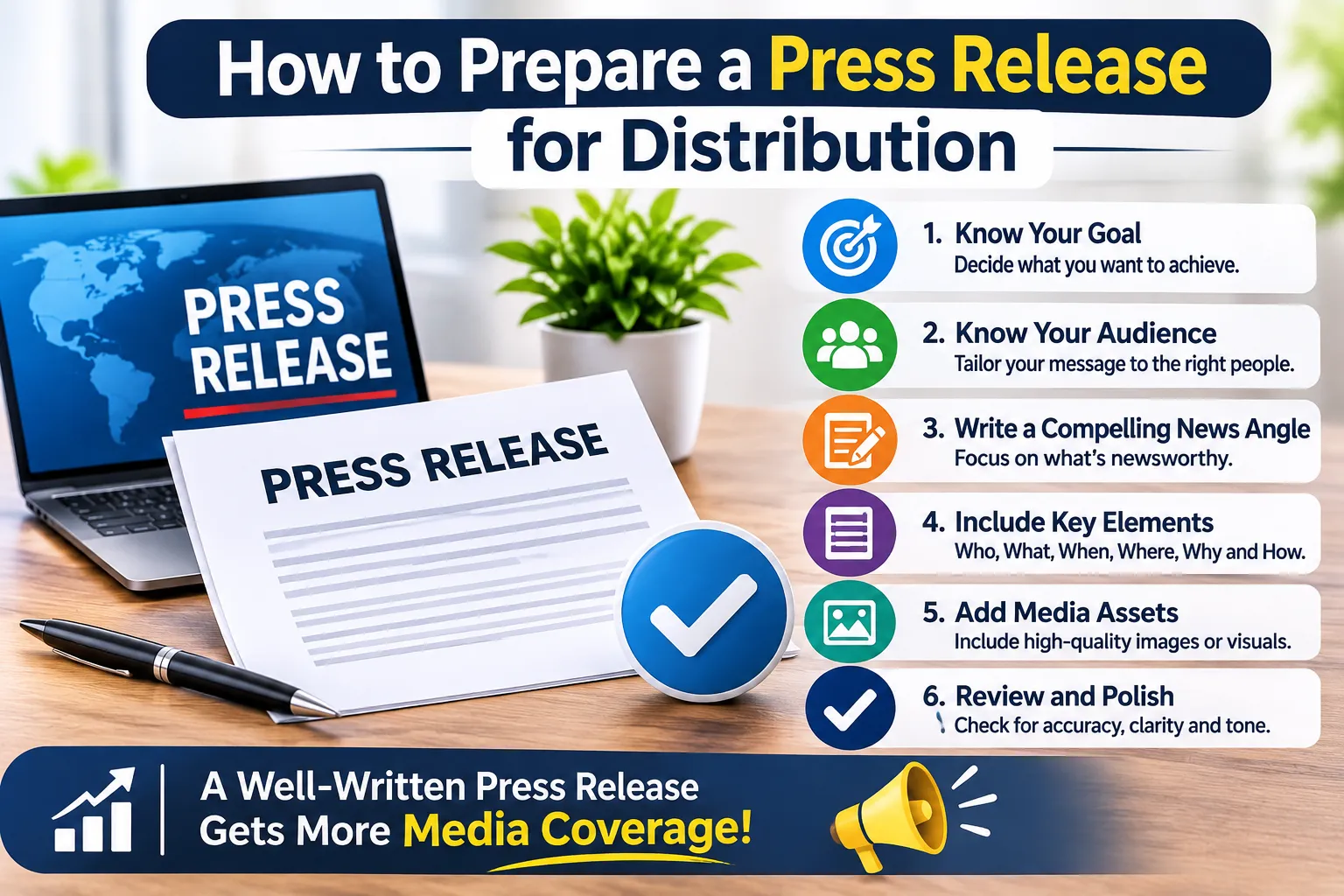

A press release can be well written and still run into trouble at the last step. A missing dateline, a broken link, an unapproved quote or an image that is too large can delay publication or cause a provider to send the release back. Preparing a release for distribution means getting every detail ready before you submit, so the process goes smoothly and the news reaches the right people on time.
This guide walks through how to prepare a press release for distribution in the United States, from checking the news value to submitting the final package. It is written for small business owners, founders and communications staff who handle announcements without a large PR team.
What “Prepared for Distribution” Means
A release is ready for distribution when:
- The news is clear and verified
- The format follows the standard structure
- Every name, number, date and quote has been checked and approved
- Images, links and contact details are ready
- You have chosen where and how to send it
- You have a plan for what happens afterward
Think of it as a pre-flight check. A few minutes before takeoff can prevent problems in the air.
Step 1: Confirm There Is Real News
Start by asking whether the announcement is useful to people outside your company. Good examples include launches, funding, partnerships, leadership changes, new locations, research findings and milestones. If the “news” is a routine update or a promotion, a blog post or email may fit better. If you are unsure how a release differs from other formats, see this explanation of press release vs. news article.
Step 2: Check the Structure
Most U.S. releases follow the same order. Confirm that yours includes:
- A release line. “FOR IMMEDIATE RELEASE” at the top, or an embargo line if one applies.
- A clear headline. State the main news in one line, ideally 10 to 15 words.
- A dateline. City, state and date at the start of the first paragraph.
- An opening paragraph. Who, what, when, where and why in two or three sentences.
- Body paragraphs. Short paragraphs with facts, numbers and background.
- A quote. A named person who says something specific.
- A boilerplate. A short “About” paragraph, two to four sentences.
- Contact details. A real person, phone number and email address.
- An end mark. “###” below the last line.
Aim for 300 to 500 words. Use a neutral tone and write in the third person, except inside quotes.
Step 3: Verify Every Fact
Accuracy protects your credibility. Go through the release line by line:
- Names and titles. Check spelling and job titles.
- Dates, times and locations. Confirm each one.
- Numbers. Compare figures with the original source.
- Claims. Remove or support anything you cannot prove, such as “the best” or “the first.”
- Links. Open each link and make sure it works.
Ask someone who did not write the release to read it. A fresh reader often spots errors that the writer misses.
Step 4: Get Approvals
Before you submit, make sure everyone named in the release has approved what is said about them, especially quotes. Also confirm that the release is cleared internally. For releases that involve financial results, health claims, legal matters or forward-looking statements, have qualified counsel review it. A distribution service delivers your words. It does not check whether they are legally sound.
Step 5: Prepare Your Assets
Gather the extras before you start the submission form:
- A logo or photo. Use a high-resolution image you have the right to use, with a short caption.
- A link to more information. A page on your website with details, such as a product page or press page.
- Supporting files. A fact sheet or report, if useful.
- Contact details. A person who can answer questions quickly.
Check file sizes and formats against the provider’s rules. Large or unusual files are a common cause of delays.
Step 6: Choose Links Carefully
Use few links, usually one to three, and make sure each one helps the reader. Use descriptive anchor text, such as “product details” or your company name, instead of repeating the same keyword. Links in distributed releases are often marked nofollow, so their main value is helping readers, not boosting rankings. Search engines also warn against using press releases only to build links.
Step 7: Decide Where to Send It
This is where press release distribution USA options come in. Think about who needs to know and where they are.
- Local or regional. For openings, hiring and community news.
- National. For product launches, funding and news that matters across the country.
- International. For expansion and global announcements.
- Industry-targeted. For trade and sector news.
Sending a small local story to a national network wastes money, and the reverse may miss your audience. This guide on choosing between local, national and international distribution can help you decide. You can also combine distribution with personal emails to a few relevant reporters, which often adds more value than a larger network.
Step 8: Compare Providers and Costs
If you use a distribution service, compare what each package includes. Ask about:
- Reach and network description
- Word limit and fees for extra words
- Images and video
- Editorial review
- Report and release page
- Turnaround and scheduling
- Refund and rejection terms
Providers price in different ways, including flat fees, tiered pricing, memberships and custom quotes. As a rough planning range, simple flat-rate packages are often in the low-to-mid hundreds of dollars per release, while larger national or international services can cost more. These are estimates, not quotes, so confirm current prices directly. For more detail, read how press release pricing works and how to choose a press release distribution service.
It also helps to read the rules before you submit. Some providers, such as Vertex Newswire, publish their editorial guidelines, which show what is checked before distribution and can help you fix common problems in advance. For a longer checklist of what to look for, see what to look for in a press release distribution service.
Step 9: Plan the Timing
Allow time for review, formatting and distribution. Many providers list a typical turnaround, so submit well before your target time. For timing, many senders prefer midweek mornings in the main audience’s time zone, and they avoid major holidays and big news days. Public companies and regulated announcements may have timing rules, so coordinate with legal counsel. If timing is important, ask whether scheduling is available and whether it costs extra.
Step 10: Submit and Save Your Records
When you fill out the submission form:
- Copy the final, approved text.
- Check each field for typos.
- Choose the right category.
- Preview the release before submitting.
- Save a copy of the final version and any confirmation.
For a walkthrough of the process, see this guide on how to submit a press release and this one on submitting a press release online.
After Distribution
The work does not end when the release goes live.
- Check the live pages. Make sure the text, images and links display correctly. If you find a mistake, contact the provider promptly.
- Save the report and links. They are your record of what was delivered.
- Share the release. Post it on your website, email list and social accounts.
- Follow up. Send a short, personal note to a few relevant reporters, and follow up only once.
- Measure results. Track reporter replies, traffic and inquiries over a few weeks.
Remember that distribution does not guarantee coverage. Distribution means the release was sent. Publication means a website posted it. Pickup means a journalist wrote about it.
A Final Pre-Distribution Checklist
- The news is real and useful.
- The structure follows the standard format.
- Every fact, name, date and quote is verified and approved.
- Legal review is done where needed.
- Images, links and contact details are ready.
- Links are few and helpful.
- Reach and provider are chosen, with costs and terms understood.
- Timing is planned.
- A follow-up plan is ready.
Conclusion
Preparing a press release for distribution is mostly about avoiding preventable problems. Confirm the news, check the structure, verify and approve every detail, gather your assets, choose links carefully and match your reach to your audience. Compare providers by what each package includes, read the rules before you submit and plan your timing and follow-up. With careful preparation, your announcement is far more likely to be published accurately and to reach the people it was meant for.



Join the conversation