
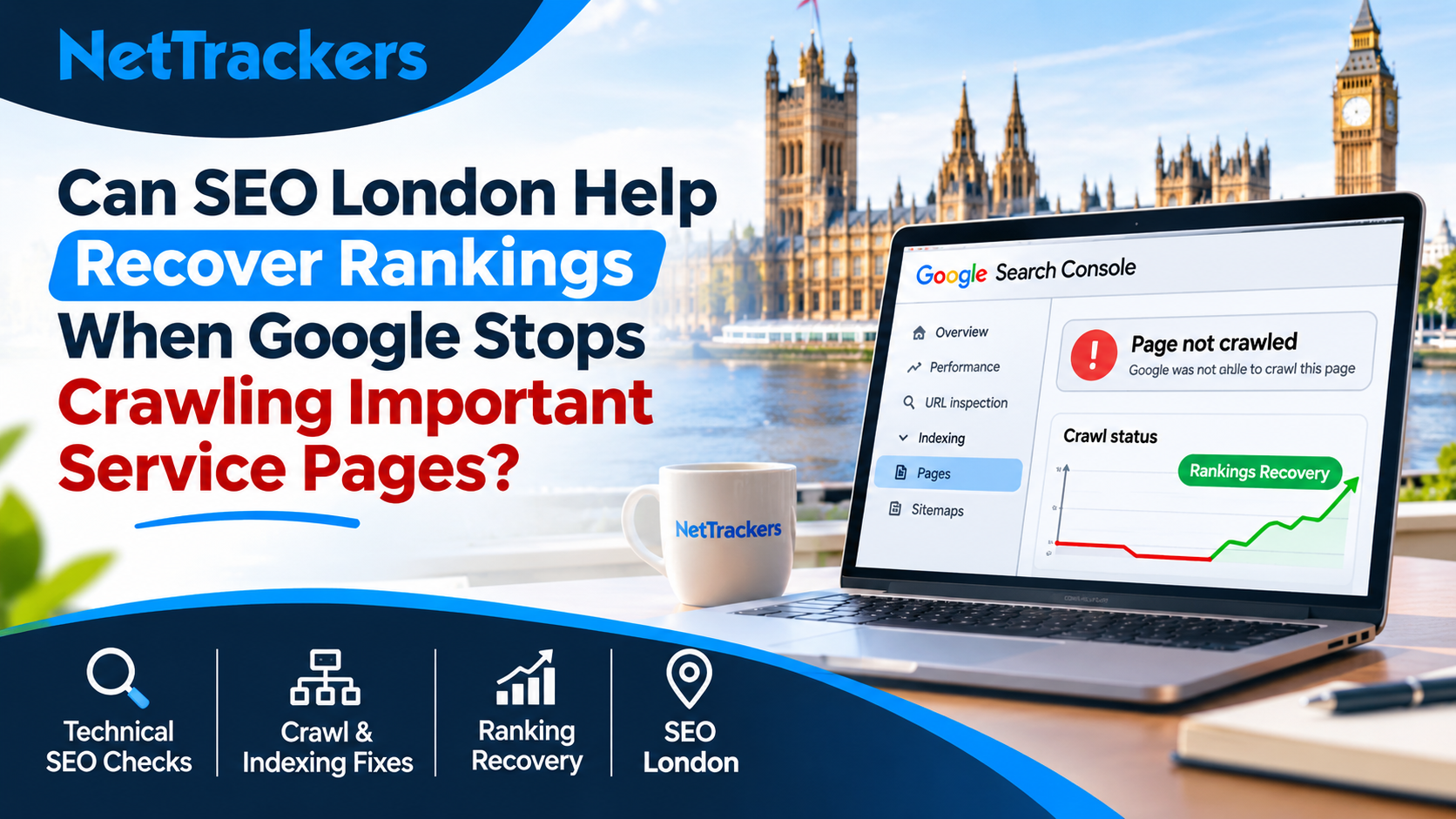

SEO
London support can help a business diagnose why important service
pages receive little attention from Google, but reduced crawling does not
automatically explain falling rankings. First establish whether Google can
discover a URL, access it, index it and consider it relevant. Those are four
different questions, and each requires different evidence. For a London
business relying on enquiries from its service pages, an incorrect diagnosis
can waste weeks of content or technical work.
Why Might Google Crawl Important Service Pages Less
Frequently?
Google does not visit every URL at the same
frequency. A page might be discovered but visited rarely because it has few
meaningful internal links, overlaps with other pages, changes infrequently or
sits in a large collection of low-value URLs. Technical barriers matter too:
blocked resources, unstable servers, redirect chains and unexpected response
codes can prevent efficient access. None of these signs proves that crawl
frequency alone is suppressing a ranking.
Start with the business-critical pages
rather than a site-wide crawl count. For each page, inspect its canonical URL,
status code, current internal links and the information shown in Google Search
Console. A service page that was never discovered needs different work from one
that is indexed but not competitive. If Google has selected another canonical,
investigate duplication and inconsistent signals before publishing yet another
version of the page.
How Can Crawl Reports Reveal Technical SEO Problems?
A crawler report is useful when it connects
a specific symptom to a URL and an action. Search Console can distinguish
discovered pages, crawled pages and indexed pages, although its reporting is
not a real-time log of every Googlebot visit. Server logs, when available,
provide another view of requests and errors. Compare these sources rather than
assuming a third-party crawler reproduces Google’s exact behaviour.
Look for patterns across the pages that
matter commercially. A single temporary server error is not equivalent to
persistent failures across service URLs. Review redirects after migrations,
accidental noindex directives, robots exclusions, broken internal links and
pages that unexpectedly canonicalise elsewhere. Record evidence before changes;
otherwise a later improvement or deterioration cannot be attributed confidently
to the intervention.
Can SEO London Help Identify Weak Internal Linking?
SEO London work should test whether
priority service pages are easy to reach through the site’s actual navigation
and relevant contextual links. A URL in an XML sitemap is not necessarily
prominent in the site architecture. If a service is mentioned only on a distant
blog post, visitors and search engines may struggle to understand how it fits
into the business’s offer.
Map the route from the homepage and
relevant category pages to each priority landing page. Give links descriptive,
natural anchor text and place them where users are genuinely exploring that
service. A programme of organic SEO services should account for crawl
access, content quality and conversion intent together. Link-building alone
cannot repair a page returning a server error or pointing its canonical at the
wrong URL.
Which Technical Issues Should Businesses Fix First?
Fix issues according to their effect on
important pages, not by the number of warnings a tool displays. An inaccessible
money page normally deserves attention ahead of a cosmetic warning on an old
archive. A practical order is to confirm page availability, remove unintended
indexing barriers, correct canonical and redirect mistakes, and then improve
discovery through internal links and useful content.
An AI
SEO agency may also review how clearly service information is
presented for retrieval and citation, but this should not displace foundational
access checks. Similarly, a content marketing agency London might recommend
stronger supporting explanations only after it is clear the service page can be
crawled and indexed. Quality content and technical accessibility solve
different parts of the visibility problem.
When Should a London Business Request a Technical SEO
Audit?
Request an audit when important commercial
URLs remain absent from the index, when a migration coincides with a measurable
visibility loss, or when reports show recurring errors that the team cannot
reconcile. An SEO consultant London should explain what is observed, what
remains uncertain and which tests will distinguish competing causes. Beware of
anyone who promises that requesting another crawl will restore rankings.
Ask for a page-level audit with an issue
register, evidence, owners and a recheck date. The free
SEO audit UK route can provide a starting point, provided the
resulting recommendations are prioritised against business outcomes.
NetTrackers can then help distinguish technical repairs from content and
search-intent improvements, rather than treating all declines as a crawling
emergency.
Common mistakes to avoid
·
Treating crawl frequency,
indexation and ranking as interchangeable metrics.
·
Changing robots directives
without testing which URLs will be affected.
·
Creating extra duplicate
service pages instead of strengthening one clear landing page.
·
Reporting site-wide warnings
without identifying the affected lead-generating URLs.
Key takeaways
Prioritise page-level evidence. First prove
access and indexability, then improve internal discovery and search relevance.
Measure qualified enquiries alongside rankings.
Frequently asked questions
Does a low crawl rate always cause lower rankings?
No. Crawl frequency is not a ranking score.
Investigate whether the page is accessible, indexed, relevant and competitive
before assigning a cause.
Can an XML sitemap fix an unindexed service page?
A sitemap can help with discovery, but it
does not guarantee crawling or indexation. Accessibility, canonicalisation and
content quality still matter.
Should every service have its own landing page?
Create a dedicated page when the service
has distinct search intent and genuinely useful information. Avoid
near-duplicate pages targeting minor wording variations.
What should an SEO technical audit deliver?
It should identify affected URLs,
supporting evidence, issue severity, recommended fixes and a way to verify
whether each fix worked.
Conclusion
A useful SEO recovery plan begins with the
specific problem, reliable evidence and clear priorities. Avoid indiscriminate
content changes or ranking guarantees. For a page-by-page investigation,
request a technical SEO assessment from NetTrackers on +44 20 4572 4940.
Related NetTrackers resources: content marketing agency London




Join the conversation