
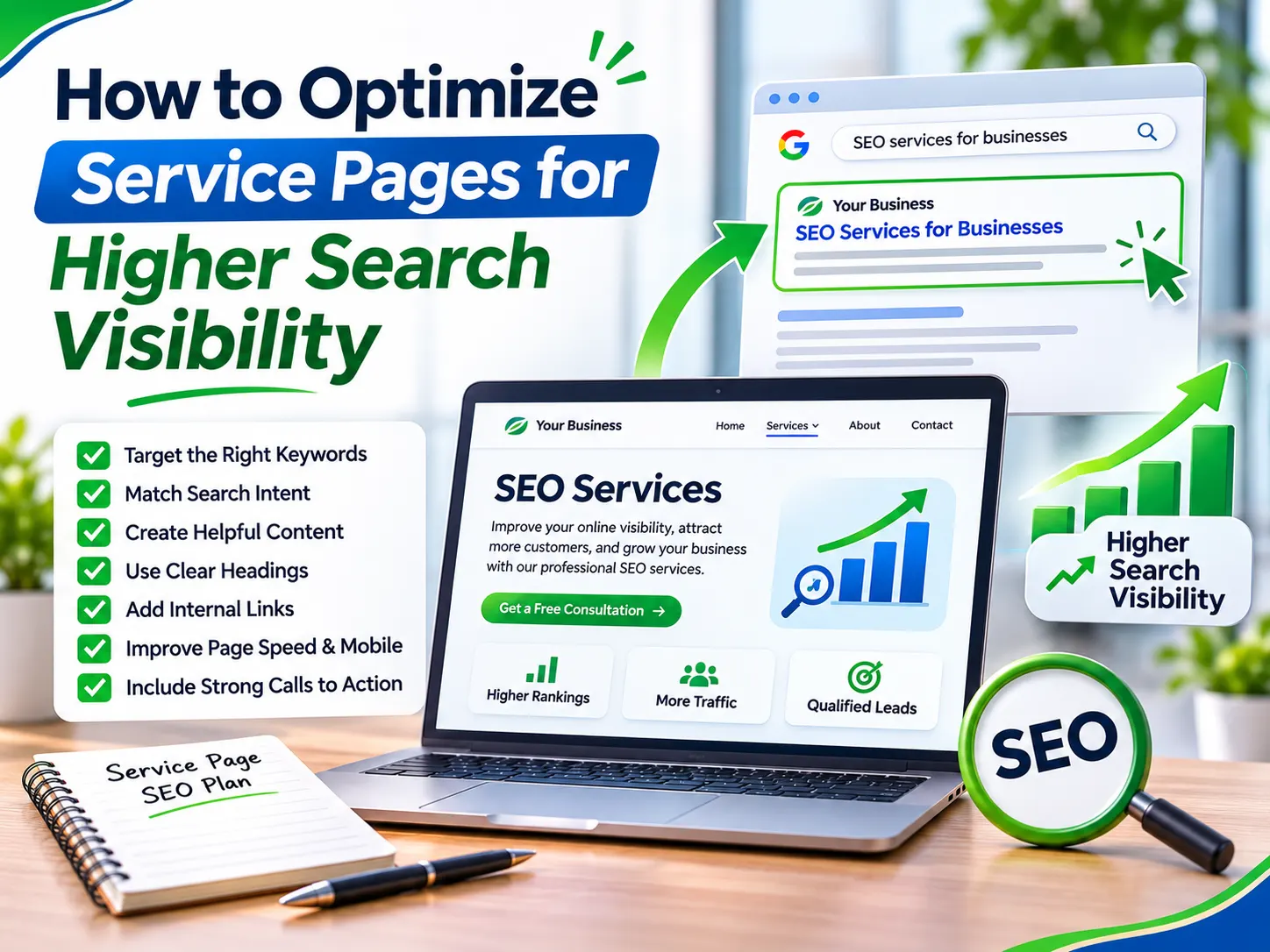

Every business wants its website to appear in Google search results when potential customers look for relevant services. However, simply creating a service page does not guarantee that people will find it. With many businesses competing for online attention, service pages need proper search engine optimization (SEO) to attract relevant visitors and generate customer inquiries. A well-optimized service page helps search engines understand what your business offers while providing visitors with the information they need to make decisions. From keyword research and content structure to website speed and internal linking, several factors influence how effectively a service page performs in organic search.
Whether you run a small local company or manage a growing business, improving your service pages can create more opportunities to reach potential customers. In this guide, we will explain how to optimize service pages for higher search visibility, improve user experience, and turn relevant website traffic into valuable leads.
What Is Service Page Optimization in SEO?
Service page optimization is the process of improving individual website pages that describe the services a business provides. The goal is to make these pages more relevant to search queries, easier for search engines to understand, and more useful for potential customers. Unlike blog articles, which often focus on answering informational questions, service pages usually target users who are researching professional solutions or considering hiring a company.
For example, a digital marketing agency may have separate pages for SEO services, social media marketing, website optimization, and paid advertising. Each page should explain the specific service, address customer needs, and provide clear information about the next steps. An effective service page combines SEO best practices with customer-focused content. It should answer important questions, explain the service clearly, and make it easy for visitors to contact the business. When properly optimized, service pages can improve organic search visibility and support lead generation without relying entirely on paid advertisements.
Why Optimized Service Pages Are Important for Business Growth
Service pages are among the most commercially important parts of a business website. They help visitors understand what a company offers and whether its services match their requirements. When someone searches for a specific service, they may already be considering hiring a provider. Appearing in relevant search results creates an opportunity to connect with these potential customers.
For example, a person searching for “professional SEO services for small businesses” is likely looking for a company that can help improve website visibility. A detailed and relevant service page can provide the information needed to evaluate available options. Optimized service pages also support better website navigation. Visitors can move from general business information to specific services without searching through unrelated content.
However, higher rankings alone should not be the only objective. A successful service page should also generate meaningful actions, such as consultation requests, contact form submissions, and customer inquiries. By combining search visibility with a positive user experience, businesses can make their service pages valuable assets within their digital marketing strategies.
1. Conduct Keyword Research for Each Service Page
Keyword research is one of the first steps in optimizing a service page. It helps businesses identify the words and phrases potential customers use when searching for particular services. Many businesses make the mistake of using broad keywords that do not clearly represent their offerings. Although broad keywords may receive significant search volume, they can attract visitors who are not interested in hiring a service provider.
For example, a company offering SEO services may target the general keyword “marketing.” However, this keyword covers many unrelated topics. A more specific phrase, such as “SEO services for small businesses,” may better represent the company’s offerings and attract visitors with stronger commercial intent.
Choose Keywords That Match Your Services
Each important service page should focus on a primary keyword that accurately describes the service. You can also include relevant secondary keywords and natural variations that help explain the topic.
For example, an SEO service page might naturally discuss website optimization, on-page SEO, technical SEO, keyword research, and organic search performance.
However, these terms should only appear where they support the content. Keyword research tools can help businesses understand estimated search volume, competition, and related search queries. The goal is not simply to select popular keywords but to identify searches that connect customer needs with your services.
Avoid Targeting the Same Keyword Across Multiple Pages
Keyword cannibalization can occur when several pages target the same search intent and compete for similar queries without offering sufficiently distinct value.
For example, a business may publish multiple service pages with nearly identical content targeting the same SEO service keyword. This can create confusion about which page should be prioritized for a particular search. To reduce unnecessary overlap, assign clear keyword targets and purposes to individual pages. If two services address different customer needs, explain those differences through unique content rather than repeating the same descriptions. A well-organized keyword strategy helps businesses create focused service pages that address specific search intentions.
2. Understand Search Intent Before Writing Service Page Content
Search intent refers to the reason someone enters a query into a search engine. Understanding search intent is essential because not every keyword indicates that someone wants to hire a company.
For example, someone searching for “what is technical SEO” may want an educational explanation. In comparison, someone searching for “technical SEO services” may be looking for professional assistance. Although both searches involve the same subject, they require different types of content. A service page should generally address commercial or transactional intent by helping visitors understand the service and evaluate whether it meets their needs.
Match Your Content With Customer Expectations
Before writing a service page, review the types of results appearing for your target keyword. If Google mainly displays professional service providers, the query likely has a strong commercial component. Consider what information potential customers need before contacting a company. They may want to understand the services included, how the process works, expected outcomes, pricing factors, or the types of businesses served. Your service page should address these concerns naturally. Avoid filling the page with unrelated information simply to increase its length. When content matches search intent, visitors are more likely to find useful answers and consider taking the next step.
3. Create Clear and Compelling Title Tags and Meta Descriptions
Title tags and meta descriptions help communicate the purpose of a webpage in search results. A title tag provides a page title that Google may use when displaying the result. A meta description offers a short summary that Google may use as the search snippet. Although Google can generate different titles or snippets based on the search query, writing clear metadata helps communicate the relevance of your page. Some businesses use generic titles such as “Services” or “What We Offer” for important pages. These titles may not clearly explain which service the page describes.
Write SEO-Friendly Title Tags
A service page title should clearly identify the main service and, where appropriate, include a relevant business or location detail.
For example, a page offering social media marketing could use a descriptive title such as “Social Media Marketing Services for Small Businesses.” The title should communicate the page’s purpose without unnecessary keyword repetition. Keep titles concise and readable rather than forcing them into an exact character limit.
Create Meta Descriptions That Encourage Relevant Clicks
A useful meta description explains what visitors can expect from the page. It may highlight the service, its benefits, and an appropriate next step.
For example, a digital marketing service page could mention online visibility, targeted marketing strategies, or opportunities to generate customer inquiries. Meta descriptions are not a direct Google ranking factor, but they can influence how users understand search results. Avoid exaggerated promises, misleading claims, and descriptions that do not match the actual page content.
4. Use a Clear Heading Structure on Service Pages
Headings help organize website content and make it easier for visitors to understand. They also provide contextual information that can help search engines interpret the subject and structure of a page. A service page should use a clear main heading, followed by relevant subheadings that explain different aspects of the service.
For example, a website offering digital marketing services may include sections explaining what the service involves, its benefits, the working process, and common customer questions. Each heading should introduce useful information rather than exist only as a place to insert keywords.
Create a Strong H1 Heading
The H1 heading should clearly describe the main subject of the page. For example, “Professional SEO Services for Small Businesses” directly communicates what the page offers. Avoid creating multiple competing main headings that make the page structure confusing. Although Google can process pages with more than one H1, using a clear primary heading is generally helpful for organization and accessibility.
Organize Content With Relevant H2 and H3 Headings
Use H2 headings for major sections and H3 headings when a topic requires additional explanation.
For example, a service page may include an H2 section about SEO services and an H3 section explaining technical SEO or on-page optimization. Headings should follow a logical order and reflect the content beneath them. Avoid forcing exact-match keywords into every heading. Natural, descriptive headings improve readability and help visitors quickly locate relevant information.
5. Write Helpful and Customer-Focused Service Page Content
Content quality is one of the most important parts of service page optimization. However, many businesses create service pages that only repeat promotional statements without explaining what they actually offer. Phrases such as “we provide the best services” or “our company delivers excellent results” offer limited value unless they are supported by meaningful information. Potential customers want to understand how a service works, what problems it addresses, and whether the provider is suitable for their requirements.
Explain Your Services Clearly
Start by describing the service in simple language. Explain what the service includes and why someone might need it.
For example, an SEO service page could describe keyword research, technical website improvements, content optimization, and ongoing performance monitoring. Each description should help customers understand the service rather than overwhelm them with unnecessary terminology. If your company serves particular industries or business types, include that information where relevant. Specific, accurate details make your content more useful and can help differentiate the page from competing websites.
Address Customer Questions and Concerns
Potential customers often have questions before contacting a service provider. They may want to know how long a project takes, what affects the cost, what the working process involves, or whether the service is appropriate for their business. Answering these questions helps visitors make informed decisions.
For example, an SEO service page can explain that organic search improvements often require ongoing work and that results depend on factors such as website condition and competition. Transparent information helps establish realistic expectations. Avoid making promises that cannot be guaranteed, such as claiming every website will reach the first position on Google. Helpful and accurate content creates a stronger foundation for customer trust.
6. Improve Internal Linking Between Related Website Pages
Internal links connect pages within the same website. They help visitors discover related information and allow search engines to understand how different pages fit together. Many businesses publish service pages and blog articles without connecting them through relevant internal links. This can make important pages more difficult to discover and reduce opportunities to guide visitors toward useful information.
Connect Relevant Blog Articles to Service Pages
Blog content often attracts users who are searching for educational information. A visitor may discover an article explaining common SEO mistakes before deciding whether professional help is necessary. If the article naturally links to a relevant SEO service page, the visitor can explore available solutions without leaving the website.
Similarly, a blog post about social media marketing strategies can link to a page describing professional social media marketing services. These connections help businesses guide visitors through different stages of their decision-making journey.
Use Descriptive Anchor Text
Anchor text is the clickable text used within a link. Instead of using generic phrases such as “click here,” choose wording that explains what the linked page contains.
For example, “professional SEO services” provides more context than an unrelated phrase. However, avoid repeatedly using the same exact-match anchor text throughout your website. Internal links should be relevant, natural, and useful to readers.
A thoughtful internal linking strategy helps organize website content and supports better navigation.
7. Optimize Service Pages for Mobile Devices and Website Speed
Website performance plays an important role in user experience. Potential customers may visit your service pages from smartphones, tablets, laptops, or desktop computers. If the website loads slowly or does not display properly on smaller screens, visitors may struggle to access important information.
For example, a customer searching for a local service on a mobile phone may leave the website if the contact form is difficult to complete. Google primarily uses the mobile version of website content for indexing, making mobile accessibility especially important.
Make Your Service Pages Mobile-Friendly
Use a responsive design that adjusts to different screen sizes. Text should remain readable, images should fit properly, and navigation should be easy to use.
Important buttons, including contact and quotation requests, should be accessible on mobile devices. Keep forms simple and avoid asking for unnecessary information. Mobile usability helps businesses provide a consistent experience across devices.
Improve Page Loading Performance
Slow-loading service pages can frustrate users and create unnecessary barriers to engagement. Common performance problems include oversized images, excessive scripts, inefficient code, and poor hosting configurations. Google PageSpeed Insights can help identify opportunities to improve loading performance and Core Web Vitals. These performance measurements provide useful information about loading speed, responsiveness, and visual stability. Although strong performance scores do not guarantee higher rankings, improving website usability can support both customer experience and overall website quality.
8. Add Trust Signals That Support Customer Confidence
When potential customers visit a service page, they often evaluate whether the business is reliable and capable of meeting their needs. Trust signals provide information that can help visitors make this decision. These may include genuine customer testimonials, relevant case studies, professional qualifications, completed project examples, or accurate business details.
For example, a digital marketing agency may explain how its services have supported client objectives through documented case studies. However, businesses should avoid publishing fabricated testimonials, misleading performance statistics, or unsupported claims.
Use Genuine Testimonials and Reviews
Customer reviews can help potential clients understand previous experiences with a business. Relevant testimonials may address communication, service quality, reliability, or other aspects of the customer experience.
Whenever possible, use authentic feedback and obtain any necessary permission before displaying customer information. Reviews should support the content rather than interrupt the page with excessive promotional material.
Demonstrate Relevant Experience
Businesses can strengthen credibility by explaining their experience and working process.
For example, a service provider may describe its approach to project planning, communication, or performance reporting. Relevant examples can help customers understand how the company operates. Clear and accurate information is generally more useful than exaggerated statements about being the best provider in an industry.
9. Use Local SEO to Improve Service Visibility in Target Areas
Local SEO is particularly important for businesses that provide services within specific cities or geographic areas. Potential customers often include location-related terms when searching for services.
For example, someone may search for an SEO agency in their city or a professional cleaning company serving a particular neighborhood. Businesses that operate in defined service areas can use local optimization to improve geographic relevance.
Include Accurate Location Information
If your business serves a specific location, explain that service area naturally within the page content. You may include relevant city names, service availability information, and accurate business contact details.
However, avoid repeating location keywords excessively or adding cities where your business does not actually operate. Local information should help customers understand whether your services are available to them.
Connect Service Pages With Your Google Business Profile
An accurate Google Business Profile can support local search visibility for eligible businesses. Ensure that the business name, contact details, categories, and service information are accurate. Relevant website pages should provide consistent information about the services offered. Businesses can also maintain genuine customer reviews and update business information when necessary. Local SEO works best when website content and business listings provide accurate, consistent information to potential customers.
10. Add Clear Calls to Action for Better Lead Generation
A service page should not only explain what a company offers. It should also help interested visitors understand what to do next. A call to action, commonly known as a CTA, encourages users to complete a specific step. For service-based businesses, this may involve requesting a quote, scheduling a consultation, completing a contact form, or calling the company. Without clear calls to action, visitors may understand the service but leave without contacting the business.
Place Calls to Action Where They Are Useful
A CTA can appear near the beginning of the page, after important service information, or toward the conclusion. However, it should not interrupt the reading experience unnecessarily.
For example, someone reviewing SEO services may appreciate an option to request a website audit or discuss their marketing requirements. The wording should be clear and appropriate to the service. Instead of using vague language, explain what action the visitor can take.
Make Contact Forms Simple
Long and complicated contact forms can discourage potential customers from submitting inquiries. Ask for the information needed to understand the customer’s request and respond appropriately. For example, a basic service inquiry form may request a name, contact information, and a short description of the required service. Ensure that the form works properly across desktop and mobile devices. A simple and accessible contact process can help turn relevant website traffic into meaningful business opportunities.
11. Use Structured Data Where It Adds Value
Structured data is a standardized format that helps search engines understand information on a webpage. Businesses can use schema markup to describe relevant details about their organization, services, and website content.
For example, Organization or LocalBusiness structured data may help communicate accurate business information.
Service-related structured data can also describe particular offerings. However, adding schema markup does not automatically improve rankings or guarantee special search appearances.
Implement Accurate and Relevant Schema Markup
Structured data should reflect the information that visitors can find on the page. Avoid adding misleading business information, fabricated reviews, or markup for content that does not exist. Use appropriate schema types based on the actual purpose of the page. Google’s Rich Results Test can help check markup intended for supported rich result features, while Schema Markup Validator can help evaluate broader schema syntax. Structured data works best as a supporting element within a broader SEO strategy rather than a replacement for helpful content and technical optimization.
12. Monitor Service Page Performance and Make Improvements
Service page optimization is not a one-time activity. Search behavior changes, competitors update their websites, and customer expectations evolve. Businesses should regularly review important service pages to identify opportunities for improvement. Monitoring performance helps determine whether optimization efforts are increasing search visibility and supporting business objectives.
Track Organic Search Performance
Google Search Console provides information about search impressions, clicks, queries, and average search positions. Businesses can use these reports to identify which keywords bring visitors to specific service pages.
For example, a page may appear frequently in search results but receive relatively few clicks. This could indicate an opportunity to review its title, relevance, or how it appears in search results. However, performance changes should be evaluated in context because search demand and competition can also influence results.
Measure Leads and Conversions
Website traffic alone does not determine whether a service page is successful. Businesses should also measure valuable actions, such as inquiry submissions, consultation requests, and relevant phone calls where tracking is available. Google Analytics 4 can help track configured website events and conversions.
For example, a service page receiving fewer visitors but generating more qualified inquiries may provide greater business value than a page attracting unrelated traffic. Reviewing traffic and conversion performance together helps businesses prioritize meaningful improvements.
How Professional SEO Services Help Improve Service Pages
Optimizing service pages involves multiple areas of digital marketing, including keyword research, technical SEO, content development, website usability, and conversion optimization. For businesses managing several services or targeting competitive markets, maintaining effective service pages can become challenging. Professional SEO support can help identify content gaps, technical problems, and opportunities to improve relevance. An SEO audit may reveal that important service pages target the wrong keywords, contain insufficient information, or have issues that make them difficult for search engines to access. Addressing these problems requires a coordinated approach rather than simply adding more keywords.
Smart Leading provides SEO and digital marketing services that help businesses improve their online presence and strengthen website visibility. Through keyword research, on-page SEO, technical optimization, content strategy, and digital marketing planning, Smart Leading supports businesses looking to attract relevant traffic and generate more customer inquiries. A well-planned optimization strategy connects search visibility with business objectives. Instead of focusing only on rankings, businesses can develop service pages that help customers understand available solutions and take appropriate action.
Common Service Page SEO Mistakes Businesses Should Avoid
Even businesses that invest in website optimization can experience limited results when their service pages contain common mistakes. One frequent problem is creating several pages with nearly identical content. Each service page should provide unique information that reflects the specific offering. Another mistake is focusing too heavily on keywords while ignoring customer questions. Repeating the same terms does not replace useful explanations. Some businesses also use generic page titles and headings that fail to communicate what the service involves.
Poor internal linking can make importan t pages difficult to discover, while slow loading and weak mobile usability can discourage visitors.Another major issue is missing or unclear calls to action. Even relevant traffic may not generate inquiries if customers cannot easily find contact information.
Businesses should also avoid creating location pages for areas they do not genuinely serve or making unsupported promises about service results. Regular SEO audits and content reviews can help identify these problems and guide practical improvements.
How to Build a Long-Term Service Page Optimization Strategy
Successful service page optimization requires consistent planning and improvement. Start by identifying your most important services and determining which pages support your primary business goals. Conduct keyword research to understand how potential customers search for these services.
Next, review existing page content and determine whether it answers important customer questions. Improve headings, metadata, internal links, and service explanations where necessary. Make sure the pages work properly on mobile devices and provide accessible contact options. Technical SEO reviews should also confirm that important service pages can be crawled and indexed.
Once improvements are implemented, monitor search performance and conversions over time. Avoid making unnecessary changes based on short-term ranking fluctuations. Instead, use reliable data to identify content gaps, technical issues, and opportunities to better address customer needs. A long-term approach helps businesses maintain useful service pages and adapt to changing search conditions.
Conclusion
Optimizing service pages for higher search visibility is an important part of building a successful business website. When service pages are properly structured, technically accessible, and focused on customer needs, they create more opportunities to attract relevant organic traffic.
Effective optimization involves keyword research, search intent analysis, helpful content, internal linking, mobile usability, and clear calls to action. Trust signals and accurate business information also help potential customers evaluate available services.
However, achieving higher rankings should not be the only objective. Businesses should focus on attracting qualified visitors and making it easy for them to request information or contact the company.
By regularly reviewing service page performance and improving the customer experience, businesses can strengthen their online presence and support sustainable lead generation.
Frequently Asked Questions
How long does it take for an optimized service page to rank on Google?
Ranking improvements vary based on competition, website authority, content quality, and technical performance. Some pages improve within weeks, while competitive service keywords may require several months of ongoing optimization.
How many keywords should a service page target?
A service page should primarily target one clear search intent and a relevant main keyword. Related secondary keywords can be included naturally when they support the service description.
What makes a service page SEO-friendly?
An SEO-friendly service page includes relevant keywords, helpful content, clear headings, appropriate metadata, internal links, mobile usability, and accessible contact options while addressing the needs of potential customers.



Join the conversation