
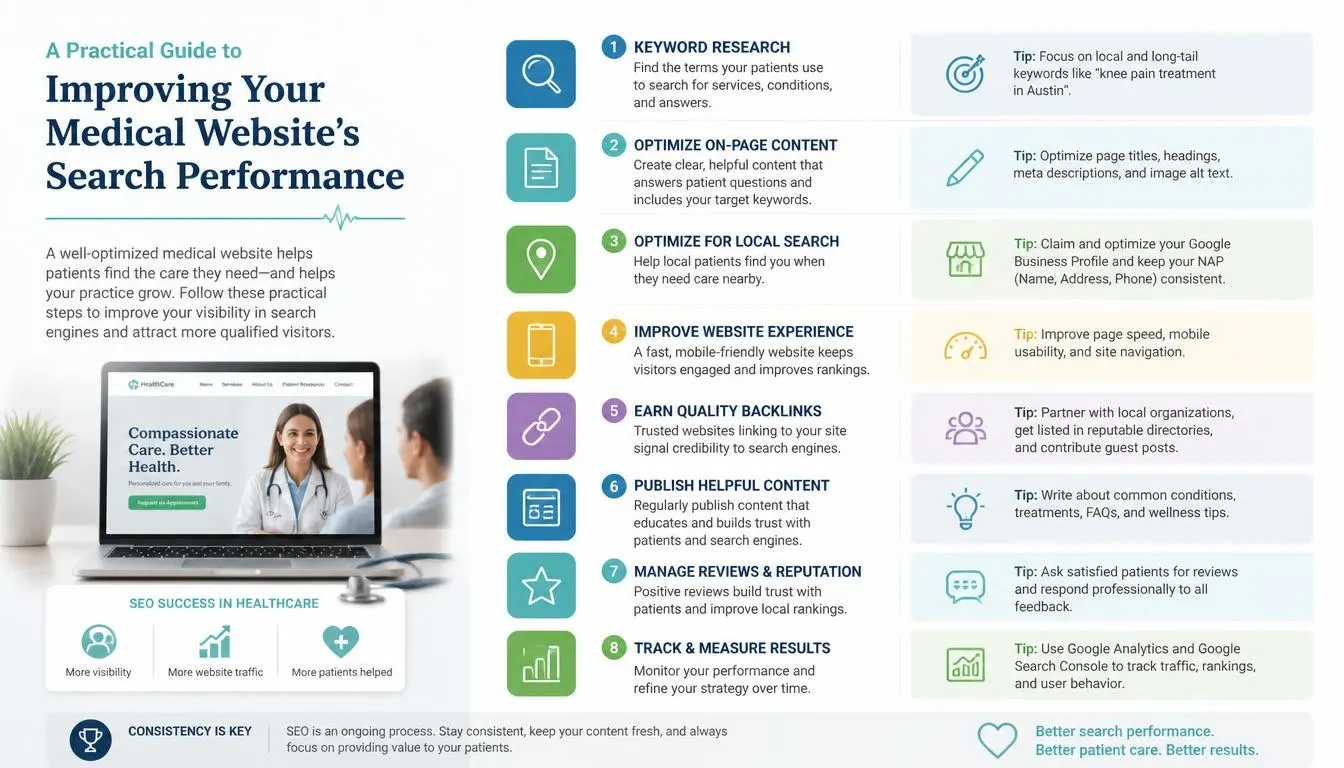

In today’s digital-first world, patients often turn to search engines before deciding which doctor to consult, hospital to visit, or healthcare service to trust. Whether someone is looking for a nearby dental clinic, researching treatment options, or comparing healthcare providers, their journey frequently begins with a simple online search. This makes a strong search presence essential for medical practices that want to reach more patients and build lasting credibility.
However, improving a medical website’s search performance involves much more than adding a few keywords to web pages. Healthcare websites operate in a competitive and sensitive industry where accuracy, credibility, user experience, and patient trust play an important role. Search engines also evaluate healthcare-related content carefully because inaccurate medical information can influence people’s health decisions.
A well-optimized medical website should make it easy for search engines to understand its content while helping visitors find reliable information and relevant healthcare services. From technical improvements and informative content to local visibility and website speed, several factors contribute to better search performance.
This practical guide explores the most important strategies healthcare providers can use to improve their website’s visibility, attract relevant visitors, and create a better online experience for potential patients.
1. Understand What Patients Are Searching For
The first step toward improving your medical website’s search performance is understanding what your potential patients are looking for online.
Patients rarely search using complicated medical terminology. Instead, they often use simple, problem-focused phrases that describe their symptoms, concerns, or desired services. Understanding these search patterns is an essential part of SEO for Healthcare Services, as it helps medical providers identify relevant keywords and create content that matches patients’ search intent.
For example, someone experiencing persistent back pain might search for:
- Best orthopedic doctor near me
- Back pain treatment options
- When should I visit a spine specialist?
- Physiotherapy for lower back pain
- Causes of chronic back discomfort
Understanding these search patterns helps healthcare providers create content that addresses actual patient concerns.
How to identify relevant search queries:
- Use keyword research tools: Platforms such as Google Keyword Planner, Ahrefs, and Semrush can help identify relevant search terms, search volumes, and keyword competition.
- Explore Google’s autocomplete suggestions: Start typing healthcare-related queries into Google and observe the suggestions that appear.
- Review Google’s People Also Ask section: These questions provide useful insights into what patients want to understand.
- Analyze patient enquiries: Frequently asked questions received through phone calls, emails, and consultations can inspire valuable website content.
- Study competitor websites: Examine the topics and service pages published by other healthcare providers to identify content opportunities.
Instead of targeting only broad terms such as “cardiologist” or “skin specialist,” consider incorporating more specific searches related to services, conditions, treatments, and geographical areas.
This approach helps attract visitors who are more likely to be interested in your healthcare services.
2. Create Dedicated Pages for Every Major Medical Service
One common mistake healthcare websites make is placing all their treatments and services on a single webpage.
Although this may seem convenient, it limits the website’s ability to target different search queries effectively. A patient searching for dental implants has different requirements from someone looking for orthodontic treatment.
Creating dedicated service pages gives each healthcare offering an opportunity to appear in relevant search results.
For example, a dental clinic could develop separate pages for:
- Dental implants
- Teeth whitening
- Root canal treatment
- Orthodontic treatment
- Cosmetic dentistry
- Pediatric dental care
Each service page should provide meaningful information about the treatment, its potential benefits, who may need it, and what patients can expect during the process.
A well-structured service page should include:
A descriptive page title: Clearly explain the service and, where relevant, its location.
An informative introduction: Briefly describe the treatment and the patient concerns it addresses.
Detailed service information: Explain the procedure, consultation process, and relevant considerations using accurate medical language.
Doctor or specialist information: Introduce the healthcare professional responsible for providing the service.
Frequently asked questions: Answer common patient questions to make the page more useful.
A clear call to action: Encourage visitors to contact the clinic, request an appointment, or learn more.
Avoid creating multiple pages with nearly identical content simply to target different keyword variations. Every page should offer distinct and useful information.
3. Prioritize High-Quality, Medically Accurate Content
Content plays an important role in helping healthcare websites establish relevance and credibility.
However, medical content requires greater responsibility than content published in many other industries. People often use healthcare information to make decisions about their well-being, so accuracy and reliability should always come first.
Search engines consider healthcare-related information particularly sensitive because it falls within the broader category of Your Money or Your Life (YMYL) content.
This means medical websites should demonstrate strong experience, expertise, authoritativeness, and trustworthiness (E-E-A-T).
To strengthen your website’s content quality, consider the following practices:
- Publish articles reviewed by qualified healthcare professionals.
- Include accurate information supported by reputable medical sources.
- Avoid exaggerated treatment claims or guaranteed health outcomes.
- Update older articles when medical guidelines or recommendations change.
- Explain complicated medical concepts in language patients can understand.
- Clearly distinguish general educational information from personalized medical advice.
For example, rather than publishing a short article titled “Benefits of Physiotherapy,” create a comprehensive resource explaining how physiotherapy may help with different conditions, what patients can expect during treatment, and when professional assessment may be appropriate.
The goal should be to answer patient questions thoroughly rather than simply increase the number of published articles.
4. Optimize Page Titles and Meta Descriptions
Page titles and meta descriptions are important elements of on-page optimization.
The page title helps search engines and users understand what a webpage is about. The meta description provides a short summary that may appear beneath the title in search results.
Well-written titles can help improve the relevance and appeal of your website’s search listings.
For example:
Weak title: Home | ABC Medical Clinic
Improved title: Family Healthcare Services in Mohali | ABC Medical Clinic
Similarly, avoid writing generic meta descriptions that provide little information.
Weak description: Visit our website to learn about our medical services.
Improved description: Explore patient-focused healthcare services, experienced medical professionals, and appointment options at ABC Medical Clinic in Mohali.
Follow these recommendations when writing page titles and meta descriptions:
- Make every title unique and descriptive.
- Include the primary topic naturally.
- Mention the location when it is relevant to the service.
- Write compelling descriptions that accurately represent the webpage.
- Avoid keyword stuffing.
- Keep titles concise enough to reduce the likelihood of truncation in search results.
Google may generate its own title links and snippets based on page content, so optimized metadata does not guarantee that your exact wording will always appear.
Nevertheless, clear and relevant metadata helps communicate the purpose of each webpage.
5. Improve Your Website’s Loading Speed
Website speed directly affects the user experience. Visitors may leave a medical website if pages take too long to load, particularly when they are trying to find important information or book an appointment.
A slow website can also create usability problems on mobile devices, where internet connectivity and device performance may vary.
Improving loading speed should therefore be an important part of your website optimization strategy.
Start by evaluating your website through Google’s PageSpeed Insights. This tool provides performance information for both mobile and desktop experiences.
Pay particular attention to Google’s Core Web Vitals:
- Largest Contentful Paint (LCP): Measures how quickly the main content becomes visible. A good target is 2.5 seconds or less.
- Interaction to Next Paint (INP): Measures responsiveness to user interactions. A good target is 200 milliseconds or less.
- Cumulative Layout Shift (CLS): Measures unexpected layout movement. A good target is 0.1 or less.
Some practical ways to improve website speed include:
- Compressing large images without sacrificing unnecessary quality.
- Using modern image formats such as WebP or AVIF.
- Enabling browser caching.
- Reducing unnecessary JavaScript and CSS.
- Using reliable website hosting.
- Implementing a content delivery network (CDN).
- Removing unnecessary plugins and third-party scripts.
Remember that speed optimization should not come at the expense of usability. Appointment forms, navigation menus, and essential patient information must remain accessible.
6. Make Your Medical Website Mobile-Friendly
Many patients use smartphones to search for nearby doctors, compare clinics, check consultation hours, and contact healthcare providers.
If your website does not work properly on mobile devices, you may lose potential patients before they even explore your services.
Google primarily uses the mobile version of website content for indexing and ranking. Therefore, providing a consistent mobile experience is essential.
A mobile-friendly healthcare website should have:
- Responsive page layouts that adjust to different screen sizes.
- Readable text without requiring users to zoom.
- Buttons and links that are easy to tap.
- Simple navigation menus.
- Fast-loading images and content.
- Easy-to-use appointment enquiry forms.
- Clearly visible phone numbers and contact information.
Consider a patient who visits your website while searching for an emergency dental consultation. If the phone number is difficult to find or the appointment form is difficult to complete, the visitor may choose another clinic.
Small improvements in mobile usability can make a meaningful difference to the overall patient experience.
7. Strengthen Local Search Visibility
For hospitals, clinics, diagnostic centres, and independent medical practitioners, local visibility is particularly important.
Patients frequently search for healthcare services within their city or neighbourhood. Queries such as “pediatrician near me” or “best dental clinic in Mohali” demonstrate strong local intent.
To improve your local presence, start by optimizing your Google Business Profile.
Make sure your business profile contains:
- Correct clinic or hospital name.
- Accurate address and location details.
- Updated phone number.
- Appropriate business categories.
- Current consultation hours.
- Website URL.
- Relevant healthcare services.
- High-quality photographs of your facility.
Consistency is equally important. Your clinic’s name, address, and phone number should match across your website, business profile, and other reputable online directories.
You should also create location-specific pages when your healthcare organization serves multiple areas.
For example, a hospital with branches in Mohali and Chandigarh may benefit from separate location pages containing accurate branch information, available specialties, contact details, and directions.
Avoid publishing multiple location pages with identical content and only changing city names. Each page should provide genuinely useful information about the specific facility.
8. Build Trust Through Doctor Profiles and Medical Credentials
Patients want to know who will be responsible for their healthcare before scheduling an appointment.
For this reason, doctor profiles are valuable additions to medical websites.
A detailed doctor profile provides an opportunity to demonstrate professional qualifications, clinical experience, areas of specialization, and relevant credentials.
An effective profile should include:
- Doctor’s full professional name.
- Educational qualifications.
- Medical registrations and certifications, where appropriate.
- Areas of specialization.
- Relevant professional experience.
- Hospital or clinic affiliations.
- Languages spoken.
- Professional photograph.
- Appointment information.
You can also include information about the medical team, healthcare facility, and treatment approach.
Make sure all credentials and professional claims are accurate and verifiable.
Adding a qualified medical reviewer to educational articles can further strengthen their credibility. Include the reviewer’s name, qualifications, and review date where appropriate.
These details help visitors evaluate the reliability of the information they are reading.
9. Use Internal Linking to Improve Website Navigation
Internal linking means connecting one webpage on your website to another relevant webpage.
It helps visitors discover additional information while allowing search engines to understand the relationships between different pages.
For example, a blog post about managing knee discomfort may link to:
- Your orthopedic services page.
- A page introducing your orthopedic specialist.
- An article about knee replacement surgery.
- Your appointment booking page.
This creates a logical content journey that guides visitors from general information toward relevant healthcare services.
Follow these internal linking practices:
- Link to related service pages from educational articles.
- Use descriptive anchor text instead of generic phrases such as “click here.”
- Connect related blog posts with relevant supporting content.
- Link important pages from your main navigation.
- Avoid excessive links that interrupt the reading experience.
Internal links should always provide additional value to the reader. Avoid adding links simply to increase the number of links on a page.
10. Implement Relevant Structured Data
Structured data helps search engines understand specific information about your website and its content.
It uses standardized formats, commonly JSON-LD, to communicate details such as business information, organizational identity, and webpage content.
For healthcare websites, relevant schema types may include:
- Organization: Provides information about the healthcare organization.
- MedicalOrganization: Describes a medical organization.
- Physician: Provides information about a medical professional.
- LocalBusiness: Helps describe relevant local business details.
- MedicalWebPage: Identifies webpages containing medical information.
- BreadcrumbList: Helps explain the website’s page hierarchy.
For example, structured data can communicate information about a hospital’s name, address, contact details, and official website.
However, structured data must accurately reflect the content visible on your website. Do not use misleading markup or add information that cannot be verified.
Also remember that implementing schema does not guarantee rich search results or higher rankings.
You can validate structured data using Google’s Rich Results Test and Schema.org’s validator.
11. Earn Relevant and Authoritative Backlinks
Backlinks are links from external websites pointing toward your website.
They can help search engines discover your content and understand its relationship with other websites.
However, not all backlinks provide equal value. Links from relevant, trustworthy, and authoritative websites are generally more desirable than links from unrelated or low-quality sources.
Healthcare organizations can develop a sustainable backlink strategy through legitimate relationship-building and useful content creation.
Some effective approaches include:
- Publishing expert contributions on reputable healthcare publications.
- Collaborating with recognized medical associations.
- Participating in relevant healthcare events and educational initiatives.
- Sharing original research or informative healthcare resources.
- Building relationships with established medical professionals and organizations.
- Getting listed in legitimate healthcare directories.
For example, a hospital publishing a detailed patient education guide may attract links from relevant healthcare organizations, medical blogs, and educational websites.
Avoid purchasing large quantities of low-quality backlinks or participating in link schemes. Such tactics can create search visibility risks and damage your website’s reputation.
Focus on earning links because your content provides genuine value.
12. Create a Helpful Healthcare Blog
A healthcare blog can help your website target informational searches that may not be covered by individual service pages.
Many people search online to understand symptoms, treatment options, preventive measures, and general health concerns.
Publishing useful articles allows healthcare providers to address these questions while introducing readers to relevant medical services.
Some content ideas include:
- When Should You Consult a Cardiologist for Heart-Related Concerns?
- Common Signs That May Indicate the Need for a Dental Checkup
- Understanding the Different Types of Physiotherapy Treatments
- What Patients Should Know Before Scheduling Cataract Surgery
- How Regular Health Screenings Support Preventive Care
- Questions to Ask Your Doctor During Your First Consultation
When developing blog content, prioritize topics that are relevant to your specialties and patient needs.
A good healthcare blog should not be treated as a keyword publishing machine. Each article should answer a genuine question, provide accurate information, and offer a useful next step.
You can also organize articles into categories such as preventive care, specialist advice, treatment education, and patient wellness.
This makes your blog easier to navigate and helps establish a clear topical structure.
13. Improve Website Security and Patient Data Protection
Security is an essential part of maintaining a trustworthy medical website.
Healthcare websites may collect sensitive information through appointment forms, enquiry forms, and patient portals. Protecting this information should be a priority.
Start by ensuring that your website uses HTTPS with a valid SSL/TLS certificate.
Additional security measures include:
- Keeping your website platform and plugins updated.
- Using strong administrator passwords.
- Enabling multi-factor authentication.
- Restricting unnecessary administrative access.
- Maintaining regular website backups.
- Using secure hosting environments.
- Protecting forms against spam and unauthorized access.
- Following applicable healthcare privacy and data protection requirements.
If your website collects medical information, ensure that the relevant forms, storage systems, and third-party services meet the applicable privacy and security standards.
Security improvements protect patients and contribute to the overall reliability of your digital presence.
14. Track Your Website Performance and Make Regular Improvements
Search optimization is an ongoing process. Publishing content and implementing technical changes is not enough; you must regularly evaluate whether those improvements are delivering results.
Two essential tools for monitoring website performance are Google Search Console and Google Analytics 4.
Google Search Console helps you understand how your website performs in Google Search.
You can use it to monitor:
- Search impressions.
- Search clicks.
- Average search position.
- Click-through rates.
- Indexing issues.
- Mobile usability-related issues where reported.
- Search queries bringing visitors to your website.
Google Analytics 4 provides additional insights into website visitor behaviour.
You can use it to evaluate:
- Website traffic sources.
- Most visited pages.
- Visitor engagement.
- Appointment enquiry interactions.
- Contact button clicks.
- Important conversion events.
For healthcare organizations, measuring meaningful actions is particularly important.
Instead of focusing only on total website traffic, monitor whether visitors are exploring relevant services, contacting your clinic, or completing appointment enquiries.
Review your performance regularly and identify pages that need improvement. Some pages may require updated information, clearer headings, better internal links, or improved calls to action.
Use this information to make informed decisions rather than relying on assumptions.
15. Improve the Overall Patient Experience
Search visibility may bring visitors to your website, but a positive user experience encourages them to stay, explore, and take the next step.
A medical website should make it easy for patients to find the information they need without unnecessary confusion.
Think about the journey of someone visiting your website for the first time.
Can they quickly identify your medical specialties? Can they find doctor profiles? Are consultation hours clearly displayed? Is the appointment process straightforward?
Consider these improvements:
- Keep the navigation menu simple and organized.
- Display contact information prominently.
- Add clear appointment enquiry buttons.
- Make important service information easy to find.
- Include frequently asked questions on relevant pages.
- Provide clear directions to your healthcare facility.
- Avoid intrusive pop-ups that interrupt browsing.
- Ensure that forms request only necessary information.
A well-designed website should reduce uncertainty and help visitors feel comfortable taking the next step.
Remember that healthcare websites are not simply promotional platforms. They are important communication channels between medical professionals and the people seeking their services.
Common Mistakes to Avoid When Optimizing Medical Websites
Even healthcare organizations with well-designed websites can struggle with search visibility because of avoidable mistakes.
Here are some issues worth addressing:
Keyword stuffing: Repeating the same search phrase unnaturally makes content difficult to read and does not create a positive user experience.
Duplicate service pages: Publishing multiple pages with nearly identical information can weaken your website’s content quality.
Unverified medical claims: Publishing inaccurate treatment information can damage patient trust and create serious credibility concerns.
Ignoring local optimization: Failing to maintain accurate business information can make it harder for nearby patients to discover your services.
Neglecting mobile users: A website that works well only on desktop devices creates unnecessary barriers for smartphone visitors.
Publishing outdated information: Old doctor profiles, incorrect consultation hours, and outdated medical recommendations can reduce confidence in your organization.
Ignoring technical issues: Broken links, indexing problems, slow loading speeds, and poor website architecture can interfere with search visibility.
Avoiding these mistakes provides a stronger foundation for long-term website improvement.
Conclusion
Improving your medical website’s search performance requires a balanced approach that combines technical optimization, valuable content, local visibility, website security, and patient-focused design.
Start by understanding what your potential patients are searching for. Build dedicated service pages, publish medically accurate educational content, optimize your website for mobile devices, and strengthen your local presence. At the same time, invest in website speed, structured data, internal linking, and trustworthy backlinks.
Most importantly, remember that healthcare search optimization is about more than achieving higher rankings. It is about helping people find accurate information, discover qualified medical professionals, and access the healthcare services they need.
Consistency is what makes these efforts effective over time. Monitor your website’s performance, update existing content, resolve technical issues, and continue improving the patient experience.
With a well-planned strategy, your medical website can become a valuable digital resource that builds credibility, improves online discovery, and supports sustainable growth for your healthcare organization.



Join the conversation