
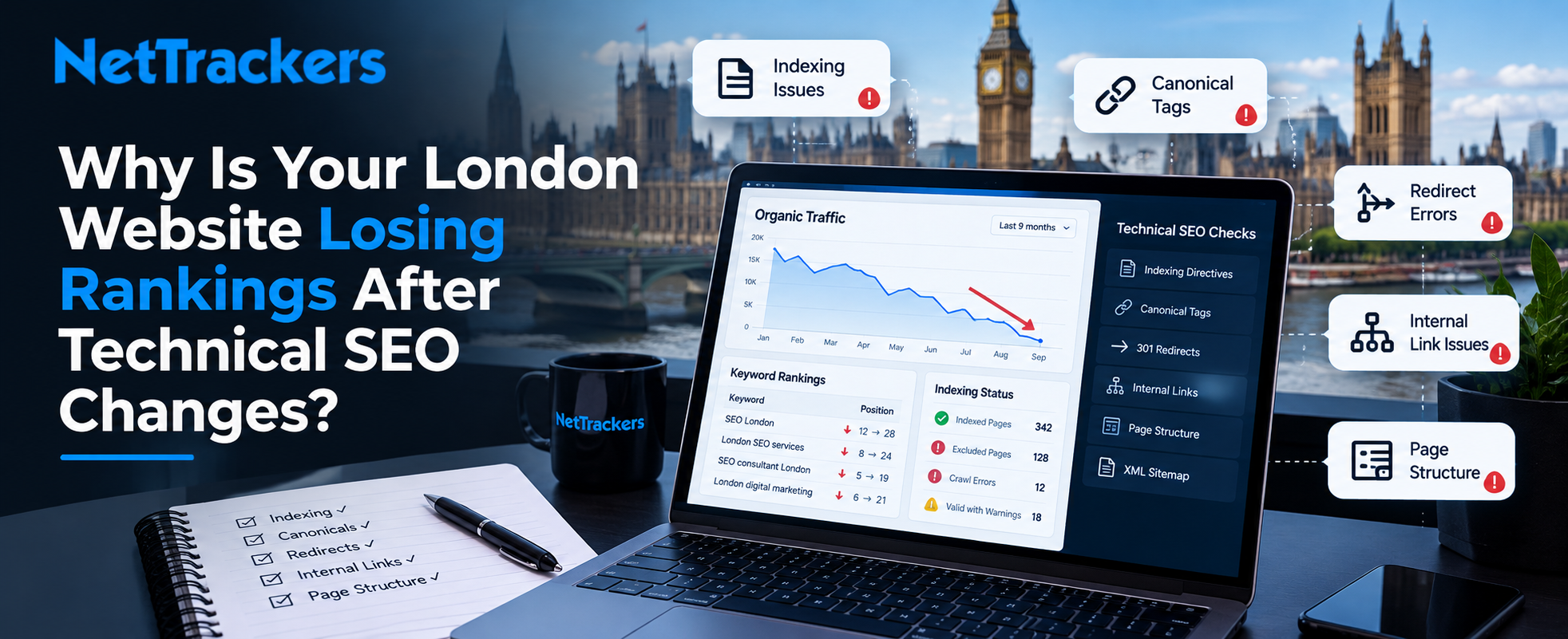

Your website was ranking well for important London searches, but something changed after a recent update. Perhaps your developers redesigned a service page, adjusted redirects, changed URL structures or installed a new SEO plugin. Traffic has started declining, important pages are disappearing from search results, and enquiries are becoming less consistent. A structured SEO London investigation can help identify whether technical changes have affected Google’s ability to discover, index or understand your pages. Before rewriting content or investing in additional backlinks, businesses should establish what actually changed and which pages were affected.
Why Can Technical Website Changes Cause Ranking Losses?
Search engines rely on technical signals to discover pages, interpret their relationships and determine which URLs should appear in search results. When these signals change, search engines may need to recrawl and reassess affected content. Some changes are harmless, while others can prevent important pages from being indexed or weaken their internal connections. Ranking declines may also coincide with algorithm updates, competitor improvements or changes in search demand. The first task is to distinguish a genuine technical problem from other possible causes.
Why Do Rankings Sometimes Drop After a Website Redesign?
A redesign often changes more than a website’s visual appearance. Developers may modify navigation, page templates, headings, URLs, internal links and structured data during implementation. Even when the new design looks better, these changes can alter how search engines interpret the site’s content and architecture. Important service pages may become harder to reach, or their previous URLs may no longer resolve correctly. A post-launch comparison helps determine whether the redesign introduced problems that require attention.
Can Small Technical Changes Affect Multiple Pages?
A single template or configuration change can affect hundreds of URLs simultaneously. For example, an incorrect canonical setting applied through a shared template may send misleading signals across an entire section. A navigation update can remove internal links from multiple service and location pages at once. Changes to robots directives may also affect groups of pages that previously remained indexable. This is why technical investigations should examine site-wide patterns rather than only the homepage.
Why Should You Avoid Making Immediate SEO Changes?
A ranking decline can create pressure to rewrite content, change keywords or rebuild landing pages immediately. However, making multiple changes before identifying the cause can complicate the investigation. If a page has accidentally been marked as non-indexable, rewriting its content will not resolve the underlying problem. Similarly, adding backlinks will not repair a broken redirect or restore a missing canonical relationship. Preserving evidence and investigating systematically provides a more reliable starting point.
Which Technical Changes Can Affect London SEO Rankings?
Several technical changes can influence how Google accesses and evaluates your website. Common areas include indexing directives, canonical tags, redirects, internal links and page structure. These elements work together, so a problem in one area may affect another. An effective SEO London recovery review should examine the affected URLs and the technical changes introduced before the decline. The objective is to identify evidence of a specific problem rather than assume that every technical modification causes ranking losses.
Can Robots.txt Changes Prevent Important Pages From Being Crawled?
The robots.txt file provides instructions about which areas of a website automated crawlers may access. An incorrect disallow rule can prevent Googlebot from crawling important pages or resources. This may limit Google’s ability to discover updated content or evaluate relevant page information. However, blocking crawling does not necessarily remove an already known URL from Google’s index. Site owners should verify the actual rule, affected paths and crawl behaviour before deciding on corrective action.
How Can Noindex Directives Affect Search Visibility?
A noindex directive tells supporting search engines not to include a page in their search index once the directive is discovered and processed. These directives may appear in HTML meta tags or HTTP response headers. During staging or development, teams sometimes use noindex settings to prevent unfinished pages from appearing in search results. Problems arise when these settings remain active on production pages after launch. Checking the rendered page and HTTP headers can reveal whether important URLs are unintentionally excluded.
What Happens When URL Structures Change?
Changing URLs can affect how search engines and visitors reach existing content. A properly planned migration usually includes relevant permanent redirects from old URLs to their appropriate replacements. Missing redirects may result in broken pages, while redirect chains can introduce unnecessary complexity. Redirecting unrelated pages to a generic destination can also create a poor user experience and confusing relevance signals. Every important URL change should be reviewed against the previous site structure.
Can Changes to Headings and Page Content Affect Rankings?
Page headings and content help search engines understand the subject and purpose of a page. Removing useful location-specific information during a redesign may weaken the page’s relevance to particular searches. Changes to titles, headings and body content can also alter the queries for which a page is considered relevant. These changes should be assessed alongside technical signals rather than treated as a separate issue. Comparing historical and current versions can reveal whether valuable information was unintentionally removed.
How Can Indexing and Canonical Issues Reduce Visibility?
Indexing and canonicalisation are related but different aspects of technical SEO. Indexing determines whether a URL is eligible to appear in search results, while canonicalisation helps search engines select a preferred version among similar or duplicate pages. Problems can arise when the signals provided by a website contradict its intended structure. Important London landing pages may be accessible to users but still fail to appear as expected in Google. Investigating these signals can clarify whether the problem concerns discovery, indexing or URL selection.
What Is a Canonical Tag?
A canonical tag identifies the URL that a website owner prefers search engines to treat as the representative version of a page. It is particularly useful when similar content can be accessed through multiple URLs. However, canonical tags are signals rather than absolute instructions, and Google may select a different canonical. Incorrect implementation can cause search engines to favour a page that does not match the site’s intended targeting. Canonical relationships should therefore be checked carefully after migrations and template changes.
Why Might Google Choose a Different Canonical URL?
Google evaluates multiple signals when deciding which version of a page to index. These may include redirects, canonical annotations, internal links and the similarity of available content. If a London location page closely duplicates a general service page, Google may interpret their relationship differently from the site owner’s intention. Conflicting signals can make this decision less predictable. The appropriate response is to investigate the underlying signals and improve page differentiation where necessary.
How Can You Check Whether Important Pages Are Indexed?
Google Search Console provides tools for examining the indexing status of specific URLs. The URL Inspection tool can show information about Google’s selected canonical and the page’s indexing status. The Page Indexing report can also reveal patterns affecting groups of URLs. These reports should be interpreted alongside actual page responses and crawling results. A page’s presence in a sitemap does not guarantee that Google will index it.
Should Every London Service Page Be Indexed?
Not every URL needs to appear independently in search results. Duplicate, low-value or utility pages may have legitimate reasons to remain excluded. However, important service and location pages intended to attract relevant organic traffic should be technically eligible for indexing. Their content should also provide a distinct reason for users to visit them. The goal is not to maximise the number of indexed URLs but to ensure that useful pages are discoverable and appropriately represented.
Why Does Your London Location Page Need Strong Internal Links?
Internal links help visitors and search engines navigate between related pages on your website. They can also communicate how services, locations and supporting content fit into the broader site structure. A London location page that receives few relevant internal links may be harder to discover and understand in context. Strong internal linking does not guarantee higher rankings, but it supports a clearer information architecture. This becomes particularly important after redesigns that change navigation or remove links from existing content.
How Can Navigation Changes Affect Location Pages?
Navigation menus often provide consistent internal links to important pages. When a menu is simplified, some service or location links may be removed. Those pages can become more deeply buried within the website, even if their URLs remain unchanged. A crawl comparison can identify changes in internal link counts and click depth. Restoring useful navigation connections may help visitors and search engines reach important content more easily.
Should Service Pages Link to Relevant Location Pages?
Service and location pages often address complementary user needs. A general service page explains what a business offers, while a location page can explain how that service relates to a particular market. Contextual links between these pages help users move towards information relevant to their requirements. For example, businesses reviewing organic SEO services may also benefit from understanding the agency’s London-focused approach. These links should be included where they genuinely help users rather than added solely to repeat keywords.
What Makes Internal Anchor Text Useful?
Anchor text is the clickable wording used within a hyperlink. Descriptive anchor text helps users understand what they can expect from the destination page. It can also provide search engines with contextual information about the linked content. However, repeating identical keyword-rich anchors across every page is unnecessary and can make writing feel unnatural. A sensible internal linking strategy uses relevant, varied wording that fits the surrounding content.
How Can You Identify Orphan Pages?
An orphan page has no discoverable internal links pointing to it within the site’s crawlable structure. It may still appear in a sitemap or be accessible through an external link. However, relying on these routes alone can make the website harder to navigate and maintain. Crawling software and URL inventory comparisons can help identify pages missing from the internal link structure. Important orphaned pages should be reviewed and connected appropriately where they provide value.
How Can You Identify a Ranking Drop Without Guessing?
Technical SEO recovery begins with evidence, not assumptions. You need to establish when visibility changed, which pages were affected and whether the decline coincided with a specific website update. Google Search Console, analytics data, crawl reports and deployment records can each contribute different information. No single report provides a complete explanation for every ranking decline. Combining these sources helps narrow the investigation to the most plausible causes.
Start With Google Search Console Performance Data
Google Search Console can show changes in organic clicks, impressions, click-through rate and average position. Reviewing these metrics at page and query level can reveal whether the decline affects a specific service, location or wider section. Compare suitable date ranges while considering seasonality and changes in search demand. A drop in clicks does not always indicate a technical ranking problem if impressions or user behaviour have changed. The objective is to identify the pattern before deciding what to investigate next.
Compare Performance Before and After the Website Change
Establish the date when the technical update was deployed. Then compare relevant performance and indexing information from before and after that date. Look for sudden changes in the affected URLs, not simply fluctuations in site-wide traffic. If the decline began well before the deployment, the update may not be the primary cause. A clear timeline helps prevent incorrect conclusions.
Review Crawling and Indexing Reports
A technical crawl can identify status codes, redirects, canonical tags, indexability directives and internal link relationships. Comparing current crawl data with an earlier version can highlight meaningful differences. Search Console can provide additional evidence about how Google has processed affected URLs. Server logs may also help larger websites investigate crawler access where those records are available. Findings should be prioritised according to their likely impact and the importance of the affected pages.
Check Whether the Problem Is Limited to London
A London-specific decline may require a different investigation from a site-wide visibility loss. Review whether London landing pages have lost impressions while other location pages remain stable. Examine whether location-specific content, internal links or canonical settings changed during the update. Also consider whether competitors or search results have changed for the affected queries. This comparison can help determine whether the issue is technical, content-related or market-specific.
What Should a Technical SEO Recovery Audit Include?
A technical audit should identify the issues most likely to affect important pages and explain how those findings were verified. It should not simply produce a long list of automated warnings without context. A useful audit connects technical evidence with the site’s search visibility and commercial priorities. For businesses evaluating an SEO consultant London, the ability to explain findings and recommend practical fixes is particularly important. The output should provide a prioritised plan that developers and marketing teams can implement and verify.
Review Indexability and Crawl Access
Start by confirming that important pages return appropriate HTTP status codes and are accessible to search engine crawlers. Check robots.txt rules, noindex directives and other relevant indexing signals. Identify pages that have become excluded following recent changes. Compare findings with Google Search Console where possible. Document which issues are confirmed and which require further investigation.
Audit Canonical Tags and Redirects
Review canonical tags across service pages, location pages and other commercially important URLs. Identify cases where the preferred canonical points to an unexpected or unrelated destination. Check redirects introduced during migrations or URL restructuring. Look for broken destinations, unnecessary chains and inconsistent internal references. Prioritise issues affecting pages that previously attracted relevant organic traffic.
Evaluate Internal Links and Website Architecture
Examine whether important London pages remain accessible through logical navigation and contextual links. Compare their internal link relationships with earlier site versions when available. Identify orphan pages, broken links and unnecessary depth within the site structure. Review whether supporting content helps users discover related services and locations. Recommendations should improve navigation as well as search engine discoverability.
Check Page Content and Search Intent
Technical problems are not the only reason rankings change after a redesign. Important headings, service descriptions and location-specific details may have been shortened or removed. Review whether each landing page still addresses the needs of its intended audience. Compare the current page with previous versions and relevant search results. Avoid adding generic location references merely to increase keyword frequency.
Can AI Search Changes Affect Your London Website Visibility?
Traditional organic search and AI-generated search experiences may present information differently. However, a decline in conventional rankings should not automatically be attributed to AI search features. Businesses should first investigate the affected search results, pages and measurable performance changes. An AI SEO agency may help evaluate content structure and discoverability across evolving search experiences. Technical accessibility, useful content and clear website organisation remain important foundations regardless of how search interfaces develop.
Why Is Clear Content Structure Still Important?
Well-organised content helps visitors understand what a business offers and how its services address their needs. Descriptive headings, relevant supporting information and logical internal links make pages easier to navigate. These features also provide context for systems that retrieve and interpret website content. However, no particular heading structure guarantees inclusion in AI-generated answers. Content should be organised primarily to communicate useful information accurately.
Should You Rewrite Every Page for AI Search?
Rewriting an entire website without evidence of a problem can create unnecessary work and introduce new risks. Some pages may already answer relevant questions clearly and provide useful service information. Others may benefit from improved explanations, stronger supporting details or clearer navigation. The appropriate changes depend on actual content gaps and business priorities. Technical recovery should remain focused on confirmed issues before broader optimisation begins.
How Can Content Support Technical SEO Recovery?
Technical corrections help search engines access and interpret pages, but content still needs to satisfy relevant search intent. A technically healthy page may struggle if it provides little useful information or fails to address what users are searching for. London businesses should review whether important landing pages explain their services clearly and provide meaningful local context. A content marketing agency London can help develop supporting content that answers relevant customer questions and connects logically with service pages. This work should complement technical fixes rather than distract from unresolved indexing or redirect problems.
Should You Update Existing Content or Publish New Pages?
Updating existing pages may be appropriate when they already address the correct search intent but contain outdated or incomplete information. New content may be useful when a distinct customer question is not adequately covered elsewhere. Publishing several overlapping pages can create unnecessary competition within the same website. A content review should identify which topics deserve their own pages and which belong within existing resources. The decision should reflect user needs and the site’s information architecture.
How Can Supporting Articles Help London Landing Pages?
Supporting articles can explain specific problems that potential customers encounter before choosing a service provider. For example, articles about website migrations, indexing issues and technical audits can help readers understand common SEO challenges. Relevant internal links can then guide interested visitors towards appropriate service or location pages. This creates a more coherent journey from educational content to commercial information. The links should be helpful and contextually relevant rather than inserted mechanically.
How Long Does It Take to Recover Lost SEO Rankings?
There is no universal recovery timeline for technical ranking losses. Some corrections may be discovered and processed relatively quickly, while others require further crawling, indexing and reassessment. The timeline also depends on the severity of the problem, the affected pages and whether other ranking factors have changed. Restoring a previous technical configuration does not guarantee that earlier positions will return. Businesses should monitor relevant signals and evaluate progress against the actual cause identified.
What Should You Monitor After Implementing Fixes?
Monitor the status of affected URLs and confirm that technical corrections remain in place. Review indexing information, organic impressions, clicks and relevant query performance. Check whether internal links and redirects continue to work as intended. Allow for normal variation rather than drawing conclusions from a single day’s data. Recovery reporting should explain what has changed and what remains uncertain.
Why Might Rankings Remain Lower After a Fix?
A technical correction may resolve one problem without addressing every factor influencing search performance. Competitors may have improved their content or gained visibility during the same period. The search engine may also interpret the page differently after recrawling it. In some cases, additional content or structural improvements may be justified. Further changes should be guided by evidence rather than an assumption that the original fix failed.
When Should You Request a Technical SEO Audit?
A technical audit is worth considering when ranking declines follow a redesign, migration, plugin update or other significant website change. It is also useful when important pages disappear from search results or indexing reports show unexpected exclusions. Businesses should seek an investigation that identifies affected URLs, explains the likely causes and prioritises corrective action. A professional SEO London review can connect technical findings with the pages that matter most for enquiries and revenue. The aim is to restore a reliable technical foundation before investing in additional optimisation.
What Information Should You Prepare?
Gather the dates of recent website changes and any available deployment records. Identify the pages and search queries that previously performed well. Export relevant Search Console information if you have access to it. Note any known changes to URLs, navigation, plugins or page templates. This background can make the investigation more efficient and help establish a useful timeline.
What Should You Expect From the Audit?
A useful audit should distinguish confirmed technical problems from potential improvement opportunities. It should explain which pages are affected and why the findings matter. Recommendations should be prioritised according to impact, implementation effort and commercial relevance. The audit should also identify how corrections will be verified after deployment. Clear documentation helps developers and marketing teams coordinate the recovery process.
How Can NetTrackers Help London Businesses Investigate Ranking Losses?
NetTrackers provides SEO and digital marketing services for businesses seeking to improve their online visibility. Technical ranking investigations require a structured review of indexing, canonicalisation, redirects, internal links and relevant page content. The appropriate scope depends on the website’s size, recent changes and available performance data. NetTrackers can be contacted to discuss an SEO audit and the technical issues affecting your website. Businesses should use the findings to prioritise verified problems rather than rely on generic ranking promises.
Why Start With an Audit Instead of More Content?
Publishing new content may be useful for a healthy website, but it cannot directly repair every technical issue. If important pages are blocked from indexing, the first priority is to identify and correct that configuration. If redirects are broken, the affected URLs and destinations need to be reviewed. Once technical access and page relationships are understood, content improvements can be planned more effectively. This sequence helps avoid spending resources on work that does not address the underlying problem.
What Makes a Recovery Plan Practical?
A practical recovery plan identifies the issue, affected pages, recommended correction and method of verification. It should also clarify whether the work requires developer access, content changes or further investigation. High-impact problems should generally receive attention before minor technical refinements. Progress should be documented so that teams can assess whether the changes have been implemented correctly. The plan should remain adaptable as new evidence becomes available.
Conclusion: How Can You Restore London Search Visibility After Technical Changes?
A decline in search rankings after a technical update deserves investigation rather than immediate guesswork. Indexing directives, canonical tags, redirects, internal links and page structure can all influence how search engines process important pages. The most useful starting point is to compare performance and technical conditions before and after the change. A focused audit can identify confirmed problems, clarify priorities and guide appropriate corrections. Sustainable recovery depends on accurate diagnosis, careful implementation and ongoing monitoring.
Request a Free SEO Audit From NetTrackers
If your London website has lost rankings following a redesign, migration or technical update, start by identifying what changed. Review affected pages, indexing signals and internal links before making further optimisation decisions. Request a free SEO audit UK to discuss potential technical issues and the next steps for your website. NetTrackers can help you explore SEO services relevant to your business and its search visibility goals. Contact the team on +44 20 4572 4940 or visit https://nettrackers.co.uk/ to get started.


Join the conversation