


Choosing an accounting system is an important decision for real estate businesses that want to maintain accurate financial records and efficient property operations. Microsoft Excel remains a widely used tool for organizing financial information, preparing calculations, and maintaining customized accounting worksheets. However, property management introduces complexities that extend beyond ordinary bookkeeping, especially when multiple properties, ownership structures, and financial responsibilities are involved.
Comparing Property Management Accounting Software vs. Excel helps businesses understand how each solution handles financial data, supports accounting controls, and adapts to changing operational requirements. Both approaches have advantages, but their effectiveness depends on how a company manages information and coordinates accounting activities. Understanding these differences allows real estate professionals to select a financial management approach that supports accuracy, accountability, and long-term efficiency.
Understanding the Fundamental Difference
Excel is a general-purpose spreadsheet application that allows businesses to create custom financial models, organize transactions, and perform calculations using formulas. Its flexibility makes it useful for accountants who need to analyze information, prepare working papers, or create reports tailored to specific requirements.
Property management accounting software Dubai is designed around the financial relationships involved in real estate operations. Rather than storing information primarily in cells and worksheets, dedicated systems maintain structured records for buildings, tenants, owners, suppliers, and accounting transactions.
The difference is therefore not simply between manual and automated accounting. It is between a flexible spreadsheet environment and a specialized system built to maintain interconnected financial information.
How Data Structure Influences Accounting Reliability
An often-overlooked factor in selecting accounting technology is how financial data is organized.
In Excel, businesses determine their own worksheet structures, naming conventions, and formulas. This allows considerable customization, but different employees may organize similar information inconsistently.
Dedicated real estate accounting software typically establishes defined relationships between accounting records. Individual transactions can be associated with the relevant property, ownership account, or financial category.
This consistency becomes valuable when an organization needs to compare information across departments or retrieve historical accounting details.
A well-designed Excel workbook can also provide reliable information, but maintaining standardized data structures requires ongoing supervision.
Property Management Accounting Software vs. Excel: Feature Comparison
| Evaluation Criteria | Excel | Property Accounting Software |
| Financial data structure | Custom worksheets and tables | Structured accounting records |
| Customization | Highly flexible formulas and models | Configuration within system capabilities |
| Multi-user accounting | Shared workbooks and collaboration | Dedicated user roles and workflows |
| Transaction relationships | Formulas, references, and lookups | Connected property and accounting records |
| Financial controls | Manual procedures and file permissions | Accounting controls where supported |
| Historical transaction review | Workbook versions and maintained logs | Transaction histories and audit features |
| Financial analysis | Advanced calculations and pivot tables | Standard accounting and property reports |
| Implementation | Relatively simple for basic needs | Requires setup, migration, and training |
Neither option guarantees accurate accounting. Results depend on system design, data quality, and the controls established by the business.
1. Data Integrity: Which System Better Protects Accounting Records?
Data integrity refers to the accuracy, completeness, and consistency of information throughout its lifecycle.
Excel offers data validation, protected worksheets, version history, and other features that can help users manage information responsibly. However, errors may still occur when formulas are overwritten, rows are deleted, or linked workbooks are modified incorrectly.
Property accounting platforms can provide more controlled transaction-entry processes through defined fields, accounting periods, permissions, and record relationships.
For real estate businesses, this distinction matters when several employees handle information associated with the same properties.
A structured system may make it easier to establish consistent accounting practices, although its controls must be configured and used correctly.
2. Auditability: Can You Explain How a Financial Balance Changed?
Financial accountability involves more than producing the correct closing balance. Accountants may need to explain when an adjustment occurred, why it was necessary, and who authorized it.
Excel provides version history and change-tracking capabilities in supported environments. Nevertheless, reconstructing a detailed accounting history can be difficult when businesses frequently copy files, replace formulas, or maintain separate workbook versions.
A specialized property accounting system may provide transaction histories, journal references, and audit-related controls that help finance teams investigate changes.
This can be particularly useful during financial reviews, internal audits, and accounting handovers.
Businesses should verify whether a prospective system retains sufficient transaction information and supports appropriate adjustment procedures.
3. Collaboration: How Do Accounting Teams Work Together?
Real estate accounting often involves employees performing different responsibilities. Leasing staff maintain contractual information, finance teams handle accounting entries, and managers review financial results.
Excel supports real-time collaboration through Microsoft 365, making it possible for multiple users to work on shared information. However, coordinating detailed accounting responsibilities within shared workbooks may require additional rules and careful access management.
A dedicated platform can provide separate user roles and workflows suited to different financial responsibilities.
For example, an employee responsible for reviewing property expenses may not require permission to modify general ledger balances.
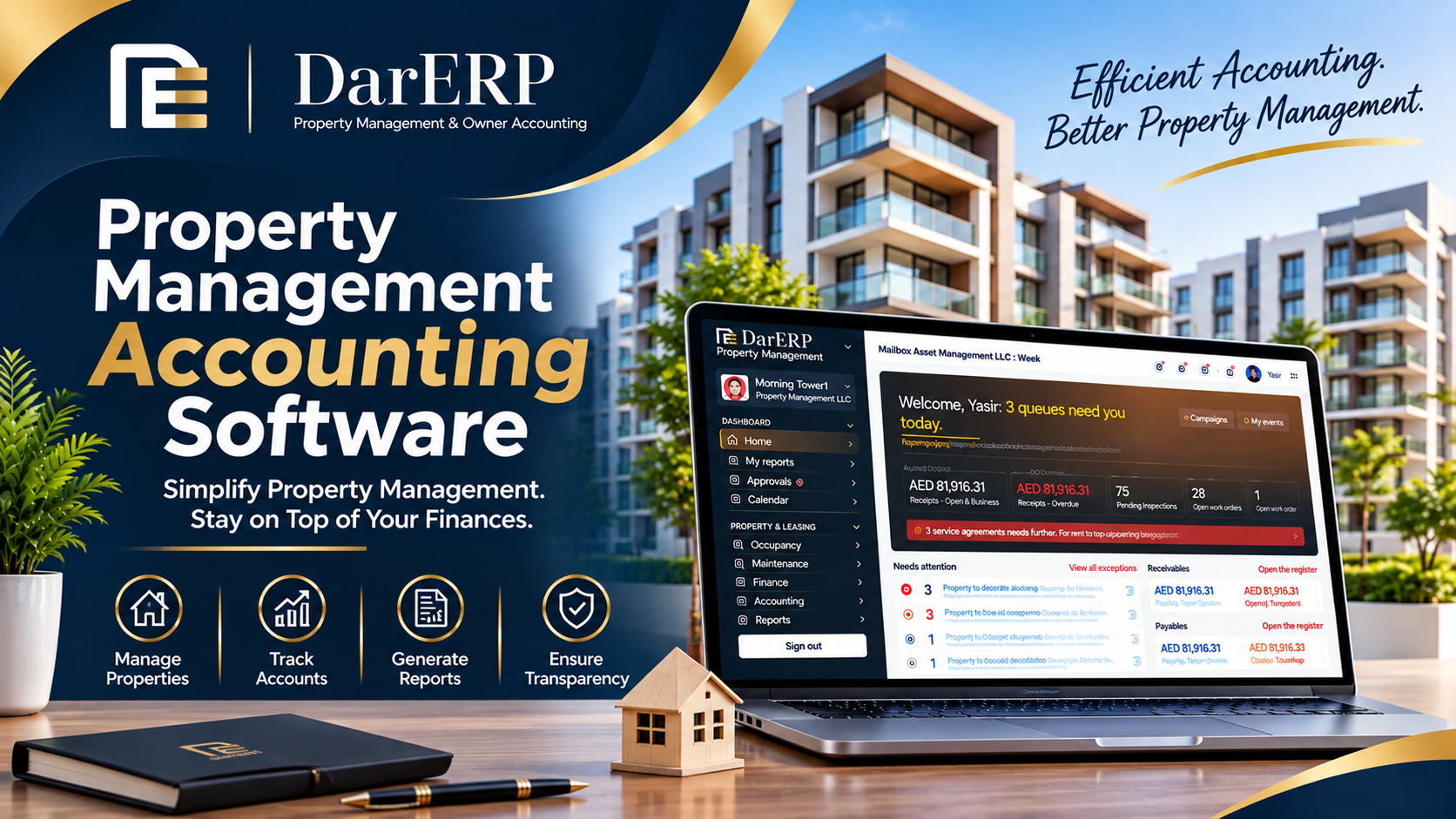
DarERP combines property administration with core accounting functions, making it relevant to organizations seeking a shared system for real estate operations and financial record management.
The key consideration is whether employees can complete their responsibilities without compromising accounting controls or creating conflicting records.
4. Financial Analysis: Where Excel Still Has an Advantage
Excel remains particularly valuable for financial analysis and customized modeling.
Accountants can create specialized calculations, build forecasting models, analyze large datasets, and prepare different financial scenarios using formulas, pivot tables, and Power Query.
These capabilities are useful when management needs an analysis that falls outside standard accounting reports.
Dedicated property accounting software typically provides structured financial reports and transaction information, but customization depends on the platform.
For this reason, many real estate businesses do not need to treat the two tools as complete alternatives.
Property accounting software can maintain the official financial records, while Excel can support supplementary analysis and management planning.
This combination often provides more flexibility than relying exclusively on either application.
5. Accounting Controls: Which Approach Supports Better Governance?
Financial governance becomes increasingly important as a real estate company expands its operations.
Businesses need procedures for authorizing transactions, controlling access, reviewing adjustments, and ensuring that accounting activities follow established policies.
Excel can support controlled financial workflows when businesses establish file permissions, protected templates, review procedures, and documented approvals.
However, maintaining these controls across numerous independent workbooks may require considerable administrative discipline.
Dedicated accounting systems can provide more consistent application-level controls, such as accounting permissions, transaction approval responsibilities, and period restrictions where supported.
The most suitable approach depends on the organization’s internal control requirements rather than software complexity alone.
6. Scalability: What Happens as the Business Grows?
Scalability concerns how effectively a system handles increasing information, users, transactions, and reporting responsibilities.
Excel can manage substantial datasets and is powerful when designed appropriately. However, a collection of highly interdependent workbooks may become difficult to maintain as more employees and departments rely on them.
A multi-property accounting platform is typically designed to maintain consistent relationships between financial records even as additional properties and users are introduced.
This is particularly relevant for organizations managing different ownership structures or operating through multiple business entities.
DarERP Property Management Software includes general ledger, accounts receivable, accounts payable, and other property-related financial functions that businesses can evaluate against their accounting requirements.
Before implementation, companies should examine whether the system supports their actual transaction volumes, reporting needs, and organizational structure.
The Hidden Importance of Data Ownership and Portability
An important software-selection question is how easily a business can retrieve and transfer its financial information.
Excel files are widely supported and can usually be opened, exported, or analyzed using different applications. This makes spreadsheets convenient for sharing information and maintaining independent records.
Dedicated accounting platforms may provide stronger structured data relationships, but the ability to export records varies between providers.
Businesses should evaluate whether they can retrieve general ledger entries, account balances, property information, and historical transactions in usable formats.
Reliable backups and access to business data are important regardless of the accounting technology selected.
Can Property Accounting Software and Excel Work Together?
Yes. For many real estate organizations, using both tools provides a practical accounting arrangement.
A dedicated accounting system can maintain official transaction records and support routine financial procedures. Excel can then be used for specialized financial analysis, scenario planning, and presentations.
For example, an accountant may export approved financial information to Excel to create a customized operating-cost comparison.
The distinction is important: exported worksheets should not become competing versions of the organization’s official accounting records.
Establishing a clear source of truth helps maintain consistency while allowing employees to benefit from Excel’s analytical flexibility.
Which Option Is Better for Different Real Estate Businesses?
The ideal approach depends on operational complexity and financial responsibilities.
Independent landlords may find Excel sufficient when they manage limited rental activities and have straightforward record-keeping requirements.
Property management companies often benefit from specialized accounting systems because they administer information involving several properties, tenants, and ownership accounts.
Real estate investment groups may require structured accounting records alongside flexible financial modeling. In such cases, combining a dedicated platform with spreadsheet analysis can be particularly useful.
Developers with multiple business entities may need accounting software capable of supporting company-level separation, general ledger structures, and consolidated financial reviews.
No single approach is universally suitable for every organization.
How to Evaluate the Right Accounting Approach
Before choosing a system, review how financial information currently moves through the business.
Identify who creates accounting entries, who verifies transactions, how adjustments are recorded, and which reports management depends on. Examine whether existing spreadsheets provide sufficient consistency and whether employees can reliably investigate historical information.
When considering a dedicated platform, test real accounting scenarios involving journal adjustments, user permissions, reconciliation, reporting, and data exports.
Businesses should also examine implementation requirements, employee training, integration needs, security, and ongoing maintenance responsibilities.
For UAE real estate companies, the chosen system should support applicable financial record-keeping and accounting requirements.
Final Thoughts
The decision between Excel and dedicated property accounting software is not simply about choosing the most advanced technology.
Excel offers exceptional flexibility for financial calculations, analysis, and customized reporting. It remains a useful tool for businesses with straightforward requirements and for accountants who need to perform specialized analysis.
Property Management Accounting Software provides a more structured approach to maintaining financial relationships, controlling transactions, supporting collaboration, and organizing accounting information across real estate operations.
For businesses managing complex portfolios, dedicated software may serve as the primary accounting environment while Excel continues to support detailed financial analysis.
The best solution is the one that maintains reliable records, supports appropriate financial controls, and allows accounting teams to work efficiently as business requirements develop.
Frequently Asked Questions
1. Is property management accounting software more accurate than Excel?
Property management accounting software can support more consistent transaction records and accounting controls, particularly in complex environments. However, accuracy depends on correct configuration, reliable data entry, and regular verification. Excel can also produce accurate results when properly maintained.
2. Can real estate companies continue using Excel after implementing accounting software?
Yes. Many businesses use dedicated accounting software for official financial records and Excel for additional analysis, budgeting, forecasting, and customized reports. Maintaining a clear distinction between these purposes helps avoid inconsistent records.
3. What should a real estate business consider when choosing between Excel and accounting software?
Important considerations include transaction complexity, data integrity, audit requirements, collaboration, accounting controls, reporting flexibility, scalability, security, and implementation resources. The choice should reflect the company’s financial responsibilities and long-term operational requirements.



Join the conversation