WRITER OF THE WEEKWax Papers27 new stories in two weeks
Why Disruption Management Is Becoming an Essential Skill for Aviation Hospitality Management Professionals
Aviation management teams face delays, cancellations, and lost bags daily. Learn how disruption management protects passengers and builds essential hospitality skills.
A departure board turns red and a terminal changes character. Phones come out. Queues form. Someone sits on a suitcase and starts calculating how late they will reach a wedding. Airlines run thousands of flights smoothly each day, yet the passengers who remember your service are the ones who met the bad day.
Many aviation graduates train for check-in, lounges and cabin service. Fewer practice what to do when a storm closes an airport at 9 p.m. with three hundred people waiting. Ignore that gap and the cost lands everywhere. Passengers lose trust. Staff burn out. Social media does the rest.
This guide explains how aviation hospitality teams handle delays, cancellations, missed connections, and baggage problems. You will see how communication, rebooking, accommodation and coordination work in practice, why routine customer service falls short, and why aviation management education should treat disruption as a core skill.
The Day the Departure Board Turns Red
Every airport meets this day sooner or later. Before you can manage it, you need to name it and size it. The two parts below do both.
What Counts as a Disruption?
Students and new recruits often search for “what is irregular operations management in aviation?” The industry calls a day when the plan breaks into irregular operations, or IROPS. That label covers flight delays, flight cancellations, diversions, missed connections, and baggage disruptions. Irregular operations management means coordinating airline, airport and service teams, so passengers stay safe, informed and moving while the schedule gets rebuilt. Operations staff fix aircraft and crew. Aviation hospitality teams fix the human side, which is where most complaints begin.
How Common the Problem Really Is?
Disruption is no rare event. A September 2025 survey of 1,100 UK travellers by CMAC Group found that 75% had faced delays or cancellations during 2025. SITA’s 2026 Baggage IT Insights Report adds that airlines carried 5 billion passengers in 2025 and mishandled 24 million bags. Even a rate that improved by 23% leaves millions of people standing at a carousel with nothing to collect. Anyone planning an aviation management career will meet these moments often.
Talking to Passengers Before They Ask
Silence makes every delay feel longer. Clear, early communication costs little and earns a surprising amount of patience. Two parts follow, one on structure and one on tone.
Setting a Rhythm for Updates
Passenger communication protocols decide who speaks, through which channel and how often. The CMAC survey found that 21% of passengers received no communication at all during disruption. That gap is fixable. Strong teams share the facts they know, say what they do not know yet, and promise the time of the next update. They repeat the same message on boards, apps, SMS and public address, so nobody hears conflicting versions. IATA’s 2018 Global Passenger Survey found that 54% of travellers wanted real time, accurate notifications when a flight was disrupted. An honest update every thirty minutes beats a perfect one that never arrives.
Choosing Words That Calm
Empathy sounds simple and fails often. Compare two lines. “Your flight will leave about two hours late, and the next update comes at 4.30 p.m.” gives facts and a time. “We apologize for any inconvenience” gives nothing. Proactive communication works best when staff acknowledge the frustration, state the facts, offer the next step, and avoid blaming other teams. IATA has also reported that passengers prefer personal assistance over self-service when things go wrong, so a calm human voice still matters.
Racing the Clock to Get People Moving Again
Once passengers know what happened, they want to know how soon they can leave. Rebooking decides how the rest of the story reads.
Triage Before Tickets
Rebooking assistance works best when teams triage first. A traveller about to miss an onward international flight, a family with infants, a passenger who needs wheelchair support and a business traveller with a meeting all need different handling. Teams sort by connection risk, special needs and the last available seats. They then reissue boarding passes, update baggage routing, and confirm the new itinerary in writing. Skipping the baggage step explains many lost suitcases.
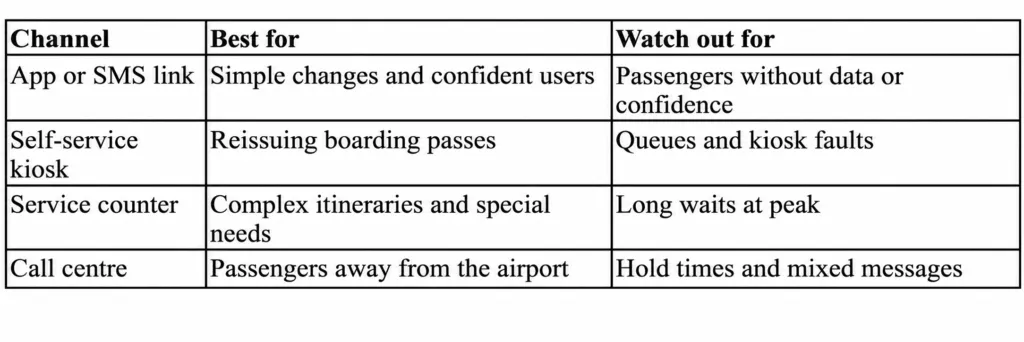
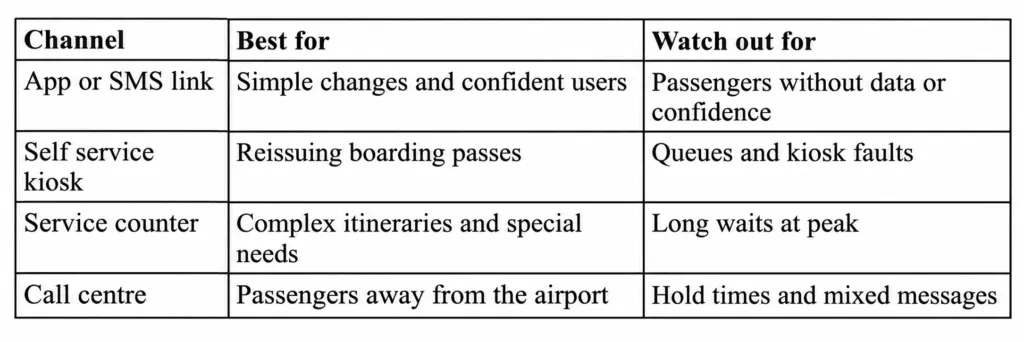
Matching the Channel to the Passenger
Digital tools help, but they do not fit everyone. The CMAC survey found that one in three passengers used a digital self-service link during disruption, and 87% reported satisfaction with flight rebooking. Teams still keep counters open for people who need a person.
The Suitcase Problem Needs Its Own Playbook
A late flight annoys people. A missing bag can ruin a holiday or a business trip. The numbers explain why teams plan for it separately.
What the Data Says About Mishandled Bags?
Société Internationale de Télécommunications Aéronautiques (SITA) reports that the global mishandled baggage rate fell 23% in 2025 to 4.9 bags per 1,000 passengers, which still means 24 million bags. Each one costs an airline about $260 on average, and the industry bill reached $6.3 billion. Transfers cause the largest share, at 39% of cases, so missed connections and bag problems often arrive together. That overlap explains why transfer baggage deserves a dedicated check during every rebooking.
Handling the Conversation at the Desk
A passenger without a bag feels exposed. Staff should file the property irregularity report quickly, give a tracking reference, and explain how the bag will be traced. SITA’s WorldTracer system supports bag tracing for many airlines. Offer essentials such as toiletries where policy allows, state a realistic delivery window, and call back when the status changes. Never promise a time you cannot meet. A dull, accurate update beats an optimistic guess.
Keeping Stranded Travellers Fed, Rested and Informed
Long delays turn an airport into a temporary village. People need food, a place to sleep, and a clear plan. This section covers the logistics and the rules behind them.
Coordinating Hotels and Transport at Short Notice
Disruption related accommodation needs speed and accuracy. Teams hold standing allotments with nearby hotels, agree room rates in advance and keep a list of transport partners. On the night, they count affected passengers, match rooms to needs such as accessibility or dietary rules, confirm meals and dispatch buses in waves. Hospitality providers sit at the heart of this work. A hotel that receives a clear passenger list, an arrival window and a named airline contact serves guests faster and complains less.
What Passengers Are Entitled to in India?
Many travellers search What must airlines provide during a flight delay in India? According to the government’s reply in the Rajya Sabha, citing the DGCA Civil Aviation Requirement, airlines offer meals and refreshments when they expect a delay of two hours or more for passengers who checked in on time. They provide hotel accommodation with transfers for overnight delays. If the expected delay exceeds six hours, they offer an alternate flight or a full refund. Thresholds can vary by flight type and circumstance, so teams should read the current rule. This duty of care guides every service decision.
Who Does What Behind the Counter?
No single team owns a disruption. Airline staff, airport operators, call centres and hotels each hold a piece, and gaps appear between them.
Mapping Roles Across Teams
Clear roles prevent duplicate work and dropped tasks. The table shows who carries which job and what each team must hand over.
The table shows why one shared information feed matters. If ground staff change the departure time and the hotel never hears, guests wait on a cold pavement.
A Simple Service Recovery Frame
Service recovery frameworks give staff a script under pressure. One practical version has four steps.
· Acknowledge the problem plainly
· Apologize once and mean it
· Act with a concrete fix and a time
· Follow up after the journey
Teams that practice these steps respond faster than teams that improvise. Practice turns panic into routine and protects the passenger experience even on a terrible day.
Why These Skills Deserve a Place in the Classroom?
Routine service teaches politeness. Disruption tests judgement. Education should reflect that difference.
Why Routine Customer Service Falls Short?
Routine service follows scripts for predictable requests. A disruption throws incomplete information, angry crowds, tight rules and competing priorities at one person. Disruption management therefore demands decision making under uncertainty, regulatory knowledge, teamwork across organizations and emotional control. A student who only practiced smiling at a check-in desk will struggle at midnight with 200 stranded travellers and reduce passenger frustration only by luck.
What Aviation Students Should Practice?
A strong aviation management programme builds skills through scenarios, not slides. Students should rehearse delay announcements, run mock rebooking queues, plan hotel allotments, read passenger requirements such as the DGCA rules, and review baggage cases. They should work in mixed teams that play airline, airport, and hotel roles. Feedback matters most, so every exercise ends with a debrief on tone, speed and accuracy. Employers notice graduates who have already survived a pretending bad day.
In a Nutshell
Disruption does not interrupt aviation. It belongs to it. Flight delays, cancellations, missed connections, and baggage disruptions will reach your team, and passengers will judge your whole organization by how you respond in those hours.
Here is what effective disruption management asks of you. Share early, honest updates. Triage before you rebook, so families, passengers needing assistance and tight connections get help first. Check transfer baggage with every rebooking. Coordinate hotels, meals and transport through one shared information feed, and honour the duty of care that Indian rules describe. Let empathy guide every conversation.
Start practising now. Rehearse scenarios, learn the rules and study how airlines, airports and hospitality providers handover work to each other. Routine service starts your career. Disruption skills build you into a leader, and strong aviation management needs people who deliver both when the departure board turns red.
Prepare for a Service Career with IndianIHM
At IndianIHM, we prepare you for hospitality careers with service skills, grooming and real industry exposure. Choose our Diploma, Bachelor or Masters and MBA in Hospitality Management, and build your confidence through industrial training and national and international internships.
At our two campuses in Salt Lake, Kolkata, we offer exception theoretical and practical training along with amazing scholarships of up to 50% along with education loan support. Admissions for 2026 are open. Visit indianihm.com, call +91 90514 75838 or email admission@indianihm.com, and start building a career where calm service makes the difference.
Frequently Asked Questions
1. What is disruption management in aviation?
It is the coordinated effort to protect passengers and schedules during delays, cancellations, diversions, and baggage problems. Teams communicate, rebook, arrange accommodation and recover service quality under time pressure.
2. Why does passenger communication matter during flight delays?
Silence increases frustration. A UK survey found 21% of disrupted passengers received no communication. Early, honest updates with a stated next update time keep travellers calmer and reduce crowding at counters.
3. Who coordinates during airline disruptions?
Airline ground staff, airport authorities, customer service teams, and hospitality providers share the work. Clear information flow between them prevents contradictory messages and delays in rebooking, meals and hotel transfers.
4. How much does mishandled baggage cost airlines?
Société Internationale de Télécommunications Aéronautiques (SITA) estimates each mishandled bag costs about $260 on average, and mishandling cost the industry around $6.3 billion in 2025, even after the global rate fell by 23 percent.
5. Can aviation management students learn disruption handling?
Yes. Good programmes teach it through scenarios, role play and mock rebooking exercises, supported by regulation reading and team debriefs, so graduates handle real disruption with confidence.
Join IndianIHM, one of the best hotel management institutes in Kolkata. Explore hotel management courses, develop essential hospitality skills, and take the first step toward a bright future in the hotel industry. Contact IndianIHM to learn more about courses and admissions.







Join the conversation