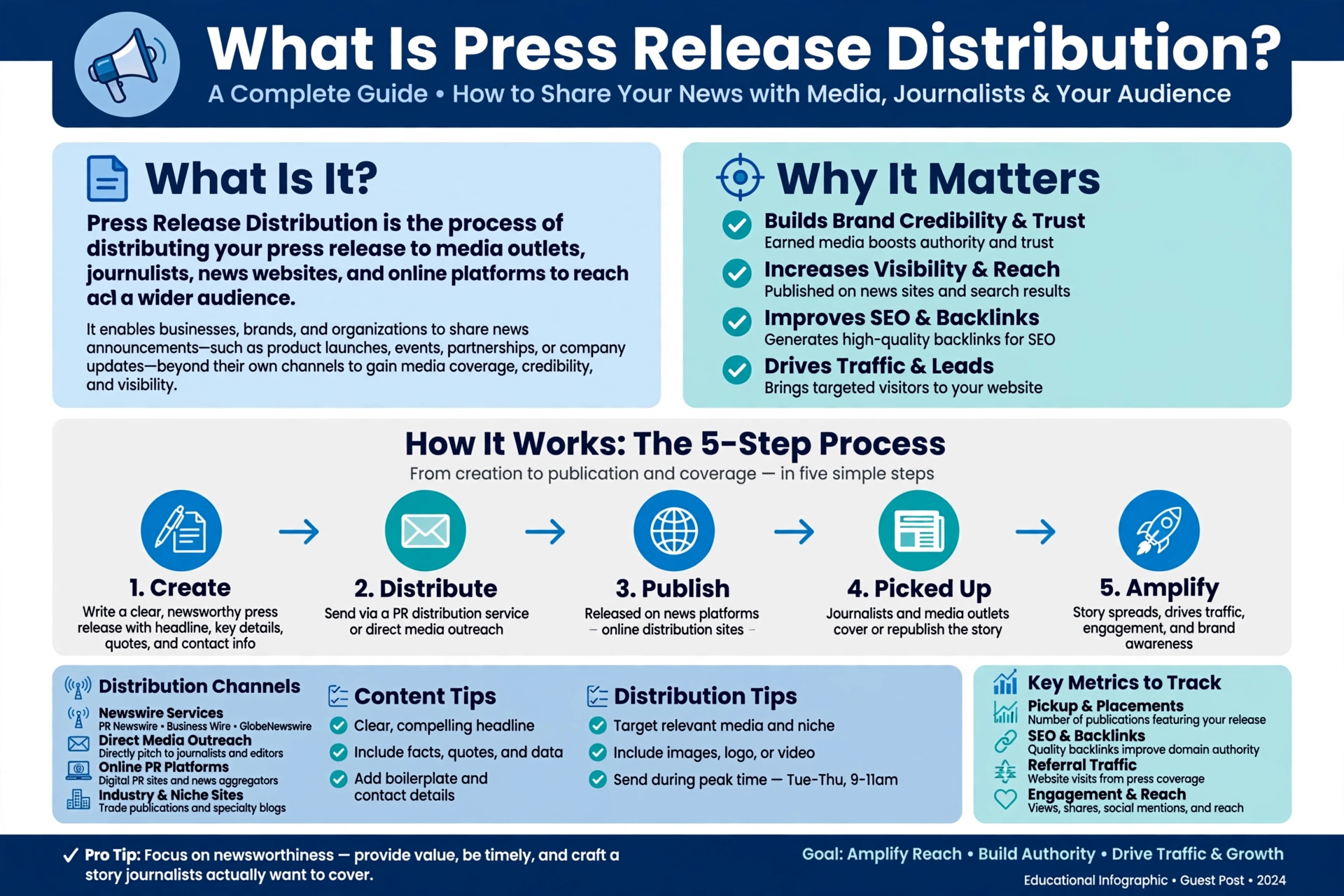
Press release distribution is the process of sharing a professionally written press release with journalists, news organizations, online publications, industry websites, and other relevant media contacts. It is commonly used by businesses, nonprofits, startups, public organizations, and professionals to communicate newsworthy developments to a broader audience.
A press release may announce a new product, business expansion, executive appointment, partnership, research finding, event, award, acquisition, or another development that has legitimate news value. However, writing the announcement is only one part of the process. Distribution determines how the information is delivered beyond the organization’s own website or communication channels.
For organizations in the United States, understanding how press release distribution works can make it easier to plan announcements, evaluate distribution options, and understand the factors that influence press release pricing.
What Is a Press Release?
A press release is a structured news announcement prepared for journalists, editors, publications, and other audiences interested in an organization’s activities.
Unlike a regular promotional advertisement, a traditional press release is generally written in a news-oriented format. It focuses on the facts surrounding an announcement and gives readers enough information to understand what happened, why it matters, and where they can find additional information.
A standard press release often includes:
- A clear headline
- A short summary or subheadline
- Dateline and location
- Introduction explaining the announcement
- Supporting details
- Quotes from relevant representatives
- Background information
- Company or organization description
- Media contact information
- Links to relevant resources when appropriate
The purpose is to make important information easy for media professionals and other readers to understand.
What Does Press Release Distribution Mean?
Press release distribution refers to delivering a completed press release to selected media channels or distribution networks.
Traditionally, organizations relied heavily on direct relationships with newspapers, magazines, television stations, radio stations, and individual journalists. Digital distribution has expanded the process. Today, press releases may be distributed through online news networks, media databases, industry publications, regional outlets, and other digital channels.
The distribution process typically involves several stages.
First, the organization prepares a newsworthy announcement. The release is then reviewed and formatted according to the requirements of the selected distribution channel. After submission, the distribution service delivers the release to its available media network or publishes it through designated channels.
Depending on the service, the organization may receive a report showing where the release was distributed, published, or potentially viewed.
Why Do Organizations Distribute Press Releases?
Organizations distribute press releases for several communication purposes.
Sharing Important Company News
A press release provides a structured way to communicate significant developments. For example, a company might announce a new location, leadership change, strategic partnership, investment, or expansion into a new market.
Supporting Media Outreach
A distributed release can help provide journalists with information about an announcement. However, distribution does not guarantee that a journalist will write a separate article about the organization.
Journalists make their own editorial decisions based on factors such as newsworthiness, relevance, timing, available information, and audience interest.
Creating a Public Record of an Announcement
Publishing a press release online can create a publicly accessible record of an organization’s announcement. This can be useful when customers, partners, investors, employees, or members of the public need to find information about a particular development.
Reaching Different Geographic Markets
Businesses operating across the United States may have announcements relevant to national, regional, or local audiences. Distribution strategies can therefore be organized around the geographic area most closely connected to the news.
For example, a local business opening a new facility may have stronger regional relevance, while a major corporate announcement may have broader national interest.
How Does Press Release Distribution Work?
The process can vary between providers, but the general workflow is relatively straightforward.
1. Identify the News
The first step is determining what the organization actually has to announce. A press release should focus on something reasonably newsworthy rather than simply promoting a routine product or service.
Questions that can help include:
- What has changed?
- Why is the development important?
- Who is affected?
- What evidence supports the announcement?
- Why would a reader or journalist care about this information?
2. Write the Press Release
The announcement should be written clearly and objectively. The most important information normally appears near the beginning so readers can quickly understand the story.
Supporting details, statistics, quotes, and background information can then provide additional context.
3. Select a Distribution Approach
Organizations can distribute releases through several methods. These may include direct outreach to journalists, online distribution services, industry publications, local media, or combinations of these approaches.
The appropriate option depends on the nature of the announcement, target audience, geography, and communication objectives.
4. Submit the Release
Once the distribution method has been selected, the release is submitted for review and formatting. Some distribution systems have specific requirements relating to word count, links, images, contact information, or prohibited content.
5. Distribution and Publication
After approval, the release may be distributed through the selected network. Depending on the service, it may appear on participating news websites, databases, or other media channels.
Distribution should not be confused with guaranteed editorial coverage. A release being delivered to media contacts does not mean every recipient will publish or report on it.
6. Review Results
After distribution, organizations can review available reporting. Depending on the provider, reports may include publication locations, links, estimated audience information, or other distribution metrics.
These reports can help organizations understand where their announcement appeared and evaluate future communication efforts.
What Factors Affect Press Release Pricing?
One of the most common questions businesses ask is how much press release distribution costs. Press release pricing can vary significantly because different services provide different levels of distribution, targeting, editorial support, reporting, and media access.
Several factors can influence the cost.
Distribution Scope
A local distribution package may cost less than a broader national or international distribution option because the size and scope of the network can differ.
Geographic Targeting
Some services allow organizations to select particular states, cities, or regions. More specialized geographic targeting may affect the overall cost.
Media Categories
Distribution can sometimes be organized around industries or subject areas. For example, a technology announcement may be targeted toward technology-related media, while a healthcare announcement may be more relevant to healthcare publications.
Editorial Services
Some providers offer additional editing, formatting, proofreading, or consultation. These services may be priced separately from basic distribution.
Multimedia Options
Images, videos, logos, documents, and other multimedia elements can require additional processing or distribution capabilities. Whether these features affect the price depends on the provider.
Reporting and Analytics
Distribution reports can vary in detail. Some services provide basic publication information, while others offer more comprehensive reporting and monitoring features.
Because services differ considerably, comparing the individual features included in a package is generally more useful than looking at the headline price alone.
Press Release Distribution vs. Direct Media Outreach
Press release distribution and direct journalist outreach are related but different activities.
A distribution service generally provides access to an established network or publishing infrastructure. Direct outreach involves identifying individual journalists or editors who cover a specific subject and contacting them personally.
For example, a technology company announcing a new research project might distribute its release through a newswire while also contacting journalists who regularly cover that particular technology field.
Neither method automatically guarantees coverage. Editorial decisions remain with individual journalists and publications.
What Makes a Press Release Newsworthy?
Distribution cannot compensate for an announcement that lacks meaningful news value.
A strong release usually communicates a specific development rather than making broad promotional statements. Examples of potentially newsworthy announcements include:
- New business launches
- Significant partnerships
- Major organizational changes
- Research findings
- Awards or recognized achievements
- Community initiatives
- Expansion into new markets
- Important events
- Product or technology developments
- Funding or investment announcements
The announcement should be supported by accurate information and presented in a way that makes its significance understandable.
Common Mistakes in Press Release Distribution
Several mistakes can reduce the usefulness of a distribution campaign.
Making the Release Too Promotional
A press release should communicate news rather than read like an advertisement. Excessive marketing language can make an announcement less useful to journalists.
Using an Unclear Headline
The headline should quickly communicate the main news. Vague or overly creative headlines can make it difficult for readers to understand the announcement.
Including Unsupported Claims
Facts, statistics, awards, performance figures, and other claims should be accurate and verifiable. Organizations should avoid exaggerating results or presenting opinions as established facts.
Targeting the Wrong Audience
A release about a highly specialized subject may have limited relevance to a general audience. Distribution works more effectively when the intended audience matches the subject of the announcement.
Ignoring Timing
The timing of an announcement can affect its relevance. Organizations should consider important industry events, holidays, business milestones, and other circumstances that could influence media attention.
Expecting Guaranteed Coverage
Distribution provides a pathway for delivering information. It does not guarantee that journalists will write stories about the announcement. Editorial coverage depends on independent decisions by media organizations and journalists.
How to Evaluate a Press Release Distribution Service
Organizations comparing distribution services should examine more than price.
Important questions include:
- What geographic areas are covered?
- Which industries or media categories are available?
- How is the release distributed?
- Are editorial review services included?
- What multimedia options are available?
- What reporting is provided?
- Are additional fees charged for specific features?
- What are the submission requirements?
- Does the service clearly explain what distribution actually includes?
For businesses researching providers, Vertex Newswire can also be considered as one example of a press release distribution platform when comparing available approaches and service features.
When evaluating any provider, businesses should review the current service information and terms rather than relying solely on third-party descriptions.
The Role of SEO in Press Release Distribution
Press releases can also have a digital search component. When a release is published online, it may create additional publicly accessible content related to an organization, event, product, or announcement.
However, businesses should not treat press releases simply as a way to generate backlinks or manipulate search rankings. Search engines evaluate content according to their own systems, and publication of a release does not automatically result in improved organic rankings.
The primary purpose of a press release remains communication: providing accurate information about a legitimate announcement.
Organizations interested in digital visibility can combine press releases with broader content marketing, media relations, social media, and their own website content.
Final Thoughts
Press release distribution is a communication process that connects an organization’s news announcement with relevant media and online channels. It involves more than simply submitting a document. Effective distribution starts with genuine news value, clear writing, accurate information, appropriate audience targeting, and realistic expectations.
For U.S. businesses, understanding the differences between local, regional, national, and specialized distribution can help make the process more organized. It is also important to understand that press release pricing depends on factors such as distribution scope, geographic targeting, editorial services, multimedia options, and reporting.
Ultimately, a press release is most useful when it provides meaningful information that readers and journalists can understand and evaluate. Distribution can help deliver that information, but editorial interest and media coverage remain independent decisions.