

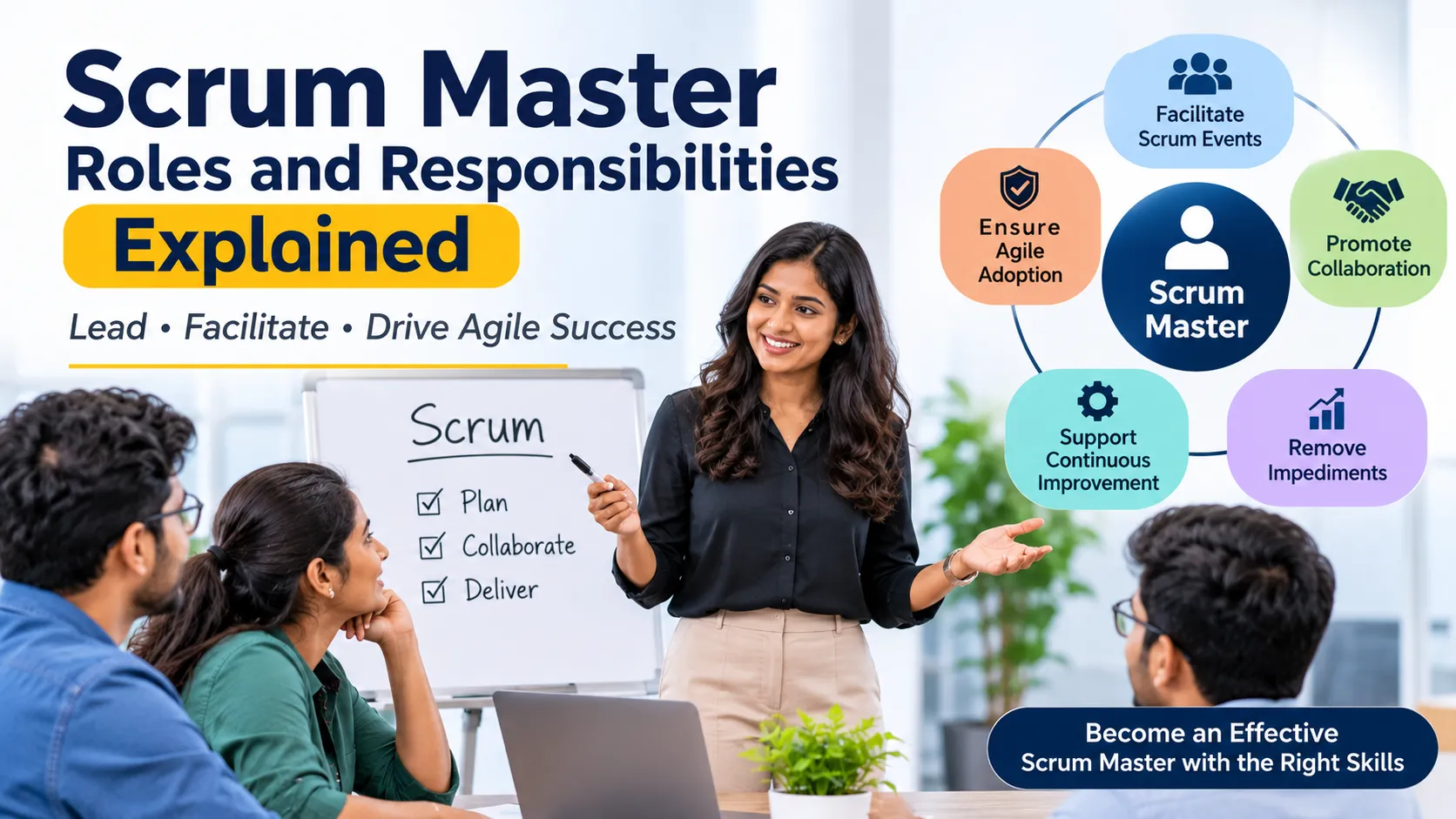

Agile project management has become an important part of modern software development and business operations. Organizations are increasingly adopting the Scrum framework to improve collaboration, deliver value faster, and manage projects more effectively. At the center of this framework is the Scrum Master, who helps teams understand and implement Scrum practices successfully.
But what does a Scrum Master actually do? What are the key Scrum Master roles and responsibilities, and why is this position important for Agile teams? In this guide, we will explore the responsibilities of a Scrum Master, the skills required, and how professionals can build a career in this growing field.
Who Is a Scrum Master?
A Scrum Master is a professional who helps establish Scrum as defined in the Scrum Guide and supports the Scrum Team in becoming more effective. The Scrum Master is accountable for the Scrum Team’s effectiveness. They achieve this by coaching team members, facilitating Scrum events, removing impediments, and promoting continuous improvement.
Unlike a traditional project manager, a Scrum Master does not simply assign tasks or control team members. Instead, they encourage collaboration, self-management, and shared accountability.
7 Key Scrum Master Roles and Responsibilities
1. Facilitate Scrum Events
One of the primary Scrum Master responsibilities is ensuring that Scrum events are productive and effective.
These events include:
Sprint Planning: Helps the Scrum Team establish a Sprint Goal and plan the work.
Daily Scrum: Supports the Developers in inspecting progress toward the Sprint Goal.
Sprint Review: Helps the Scrum Team and stakeholders inspect the Sprint outcome.
Sprint Retrospective: Encourages the team to identify improvements for the next Sprint.
The Scrum Master ensures these events take place and are understood by the Scrum Team.
2. Remove Team Impediments
Teams sometimes face challenges that affect their productivity, such as communication gaps, technical issues, unclear requirements, or dependency delays.
A Scrum Master helps identify these impediments and works with the team and organization to address them.
Removing obstacles allows Developers to focus on delivering valuable product increments.
3. Coach the Team on Agile and Scrum Practices
A Scrum Master helps team members understand Agile principles and the Scrum framework.
They encourage self-management, cross-functionality, collaboration, and continuous learning.
For professionals pursuing Scrum Master Training in India, understanding these coaching responsibilities is an important part of developing practical Scrum knowledge.
4. Support the Product Owner
The Product Owner is responsible for maximizing product value and effective Product Backlog management.
The Scrum Master supports the Product Owner by helping with:
Effective Product Goal communication.
Clear Product Backlog management practices.
Stakeholder collaboration.
Understanding and applying empirical product planning.
This partnership helps the Scrum Team maintain clarity and focus.
5. Promote Collaboration and Communication
Successful Agile teams depend on transparent communication and strong collaboration.
A Scrum Master encourages open discussions between Developers, Product Owners, and stakeholders.
They help create an environment where team members can share ideas, raise concerns, resolve conflicts, and work toward common goals.
6. Encourage Continuous Improvement
Continuous improvement is an important part of the Scrum framework.
During Sprint Retrospectives, the Scrum Master helps the team inspect its working practices and identify opportunities for improvement.
They encourage practical changes that improve quality, teamwork, and overall effectiveness.
7. Promote Scrum Adoption Across the Organization
A Scrum Master also supports the organization in understanding and adopting Scrum.
They coach employees, managers, and stakeholders on Agile practices and help identify organizational barriers that affect Scrum Team effectiveness.
This responsibility helps create an environment where Agile teams can work more efficiently.
Essential Skills Required to Become a Scrum Master
To perform these responsibilities effectively, a Scrum Master needs a combination of technical understanding and interpersonal skills.
Important skills include:
Communication: Clearly sharing information and encouraging discussions.
Leadership: Supporting teams without relying on traditional authority.
Problem-solving: Identifying and addressing impediments.
Conflict resolution: Helping team members resolve disagreements.
Coaching: Guiding teams toward self-management.
Agile knowledge: Understanding Scrum principles, events, artifacts, and commitments.
Facilitation: Conducting productive Scrum events and workshops.
Developing these skills can help professionals build a strong foundation for an Agile career.
How to Become a Scrum Master in India?
If you want to become a Scrum Master, start by understanding Agile principles and the Scrum framework.
Follow these steps:
Learn the fundamentals of Agile and Scrum.
Understand Scrum roles, events, artifacts, and commitments.
Practice facilitating Scrum events and team discussions.
Develop communication, coaching, and leadership skills.
Explore recognized Scrum certification options.
Gain practical experience by working with Agile teams.
Professionals looking for Scrum Master Training in India or Scrum Training in Hyderabad can explore structured learning programs to develop their knowledge and practical skills.
A Scrum Master plays an important role in building effective Agile teams. From facilitating Scrum events and removing impediments to coaching team members and promoting continuous improvement, their responsibilities help teams deliver value while following Scrum principles.
Understanding these responsibilities is a valuable first step for anyone planning to enter the Agile project management field.
Ready to start your Scrum journey?
Explore HelloSM for Scrum and Agile learning opportunities and develop the skills needed to grow as a confident Scrum professional.
Visit HelloSM today and take your first step toward becoming an effective Scrum Master!



Join the conversation