

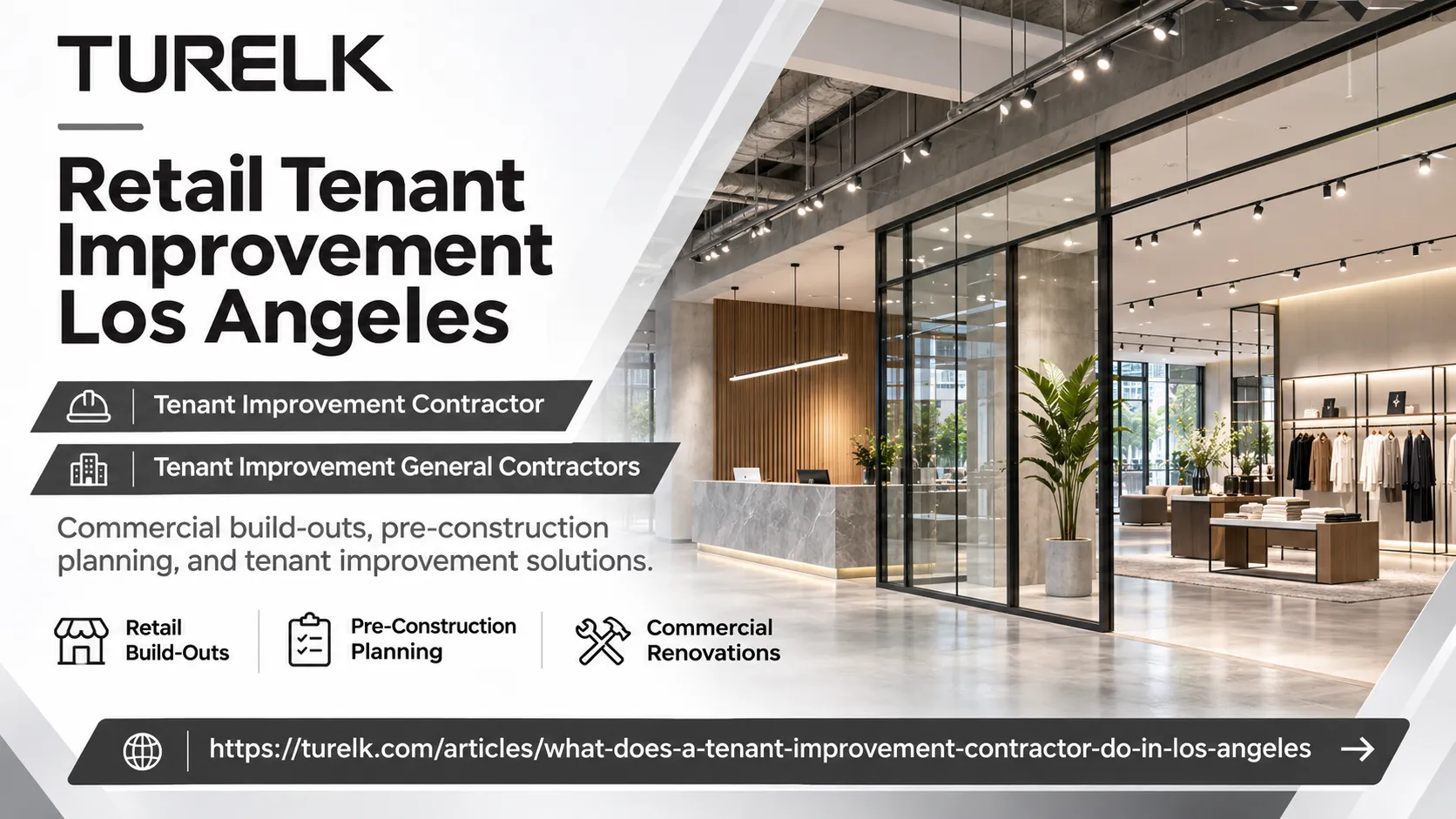

Opening a retail business in Los Angeles requires more than finding a suitable commercial property. Business owners must transform their leased spaces into environments that attract customers, communicate brand identity, and support daily operations.
Many commercial properties require significant modifications before they can accommodate a new tenant. These improvements may involve lighting, flooring, electrical infrastructure, storage facilities, and customer-facing interiors.
Professional retail tenant improvement in Los Angeles helps businesses develop commercial environments that support their operational requirements and long-term growth objectives.
What Is Retail Tenant Improvement?
Retail tenant improvement involves modifying a leased commercial property to accommodate the requirements of a retail business.
The scope can range from updating existing finishes to completing a comprehensive interior build-out.
For example, a clothing retailer may require fitting rooms, display fixtures, lighting, and checkout counters. Meanwhile, an electronics retailer might need specialized electrical infrastructure and secure product storage.
A professional tenant improvement contractor coordinates the construction activities necessary to transform the property into an operational retail environment.
Seven Business Benefits of Retail Tenant Improvement
1. Creates a Strong First Impression
Customers often form opinions about a retail business based on its physical environment.
An attractive storefront, organized merchandise displays, suitable lighting, and welcoming interiors can influence how customers perceive a brand.
Professional tenant improvements allow businesses to create environments that communicate their identity.
Retailers can incorporate distinctive materials, colors, signage, and architectural features into their commercial interiors.
These elements help establish a recognizable customer experience.
2. Improves Customer Circulation
Retail layouts influence how customers move throughout a store.
Poorly organized spaces may create congestion, obstruct merchandise visibility, or make products difficult to locate.
Thoughtful space planning allows businesses to establish clear pathways between entrances, displays, checkout counters, and service areas.
Construction professionals can coordinate partitions, fixtures, and infrastructure with these requirements.
A functional layout can support a more convenient shopping experience.
3. Supports Efficient Business Operations
Retail employees require suitable environments for inventory management, customer service, and administrative activities.
Tenant improvement projects can incorporate storage facilities, employee areas, checkout stations, and merchandise preparation spaces.
For example, a retailer with frequent inventory deliveries may require accessible storage near its receiving area.
Planning these operational requirements before construction helps businesses create spaces that support everyday responsibilities.
4. Helps Manage Construction Expenses
Retail construction involves several interconnected costs.
Materials, labor, permits, technical infrastructure, and interior finishes contribute to the overall project budget.
Engaging a tenant improvement contractor during early planning allows businesses to evaluate construction requirements before finalizing their investment.
Detailed estimates and constructability reviews can help identify potential expenses and alternative solutions.
This approach supports more informed budgeting decisions.
5. Coordinates Technical Infrastructure
Modern retail businesses depend on reliable electrical systems, lighting, internet connectivity, security equipment, and climate control.
These systems must align with the store’s layout and operational requirements.
For example, checkout counters need suitable electrical and data connections, while display areas may require specialized lighting.
Early construction coordination can help reduce conflicts between architectural designs and technical installations.
6. Supports Regulatory Compliance
Commercial retail renovations may require permits, inspections, and accessibility improvements.
In the City of Los Angeles, commercial tenant improvement projects can involve plan review addressing accessibility, fire protection, and life-safety requirements.
LADBS
Business owners should work with qualified project professionals to determine which requirements apply to their specific property.
Addressing these obligations during planning can help reduce avoidable construction complications.
7. Accommodates Future Business Growth
Retail requirements can change as businesses expand their product ranges or introduce new services.
Flexible store layouts and adaptable infrastructure may help businesses respond to these developments.
For example, strategically positioned power connections and flexible display arrangements can accommodate future merchandising changes.
Considering long-term operational needs helps organizations make more informed construction decisions.
Why Choose a Design-Build Contractor in Los Angeles?
Business owners searching for a Design Build Contractor Los Angeles service provider often want greater coordination between project design and construction.
A design-build approach connects these activities within an integrated delivery arrangement.
Early contractor participation allows construction teams to evaluate design feasibility, material availability, budget requirements, and scheduling considerations.
This collaboration may help reduce misunderstandings that arise when design and construction teams work independently.
However, businesses should confirm which architectural, engineering, and construction responsibilities are included in their agreement.
Understanding Tenant Improvement Allowances
Commercial landlords sometimes provide financial contributions toward improvements within leased premises.
These contributions are commonly known as tenant improvement allowances.
The amount, eligible expenses, payment conditions, and documentation requirements depend on the lease agreement.
Business owners should review these conditions before approving construction activities.
Obtaining preliminary construction estimates during lease negotiations can help tenants understand whether the available allowance adequately supports their planned improvements.
Choosing the Right Retail Construction Partner
Not every commercial contractor has extensive experience managing leased retail properties.
Businesses should evaluate a contractor’s relevant project experience, communication practices, estimating procedures, and ability to coordinate with landlords.
Consider asking how the contractor manages construction schedules, supplier lead times, subcontractor responsibilities, and unexpected site conditions.
A suitable construction partner should explain project risks and responsibilities clearly rather than relying on unrealistic promises.
Working With Turelk in Los Angeles
Established in 1978, Turelk specializes in commercial interior construction and tenant improvements throughout Southern California.
Its pre-construction approach includes detailed estimating, subcontractor procurement, construction feasibility reviews, and schedule development.
Turelk, Inc+1
Retail businesses can explore Turelk’s guide to retail tenant improvement and contractor responsibilities in Los Angeles to understand how professional construction management supports commercial build-outs.
Frequently Asked Questions
What does retail tenant improvement in Los Angeles include?
It may include interior partitions, flooring, lighting, electrical infrastructure, plumbing, display areas, storage facilities, and commercial finishes.
When should businesses hire a tenant improvement contractor?
Ideally, businesses should involve a contractor before finalizing their lease or committing to detailed construction plans.
What does a design-build contractor do?
A design-build contractor coordinates construction and design responsibilities within an integrated project delivery arrangement, as defined by the contract.
How long does a retail tenant improvement project take?
Project duration depends on the property condition, construction scope, permitting requirements, material availability, and installation schedules.
Can retail tenant improvements increase business revenue?
Thoughtful improvements can support customer experiences and operational efficiency. Revenue also depends on factors such as location, pricing, product demand, and business management.
Conclusion
Retail tenant improvement in Los Angeles allows businesses to transform leased commercial properties into functional environments that reflect their brands and operational requirements.
By working with an experienced tenant improvement contractor and considering coordinated design-build services, retailers can develop more informed construction strategies.



Join the conversation