


Establishing an offshore company in the UAE can offer international investors a suitable structure for holding assets, managing investments and organising business interests. However, company registration is only one part of the process. Investors must also understand the tax and compliance responsibilities that come with owning a UAE-registered entity.
One common misunderstanding is that offshore companies are automatically exempt from UAE Corporate Tax. This is not correct. The tax treatment of a company depends on its legal status, activities, income and applicable tax rules.
Understanding RAK ICC company tax UAE requirements is important for foreign investors who want to maintain their companies properly and avoid unexpected tax liabilities. RAK International Corporate Centre (RAK ICC) companies may have registration, reporting and record-keeping obligations under UAE law.
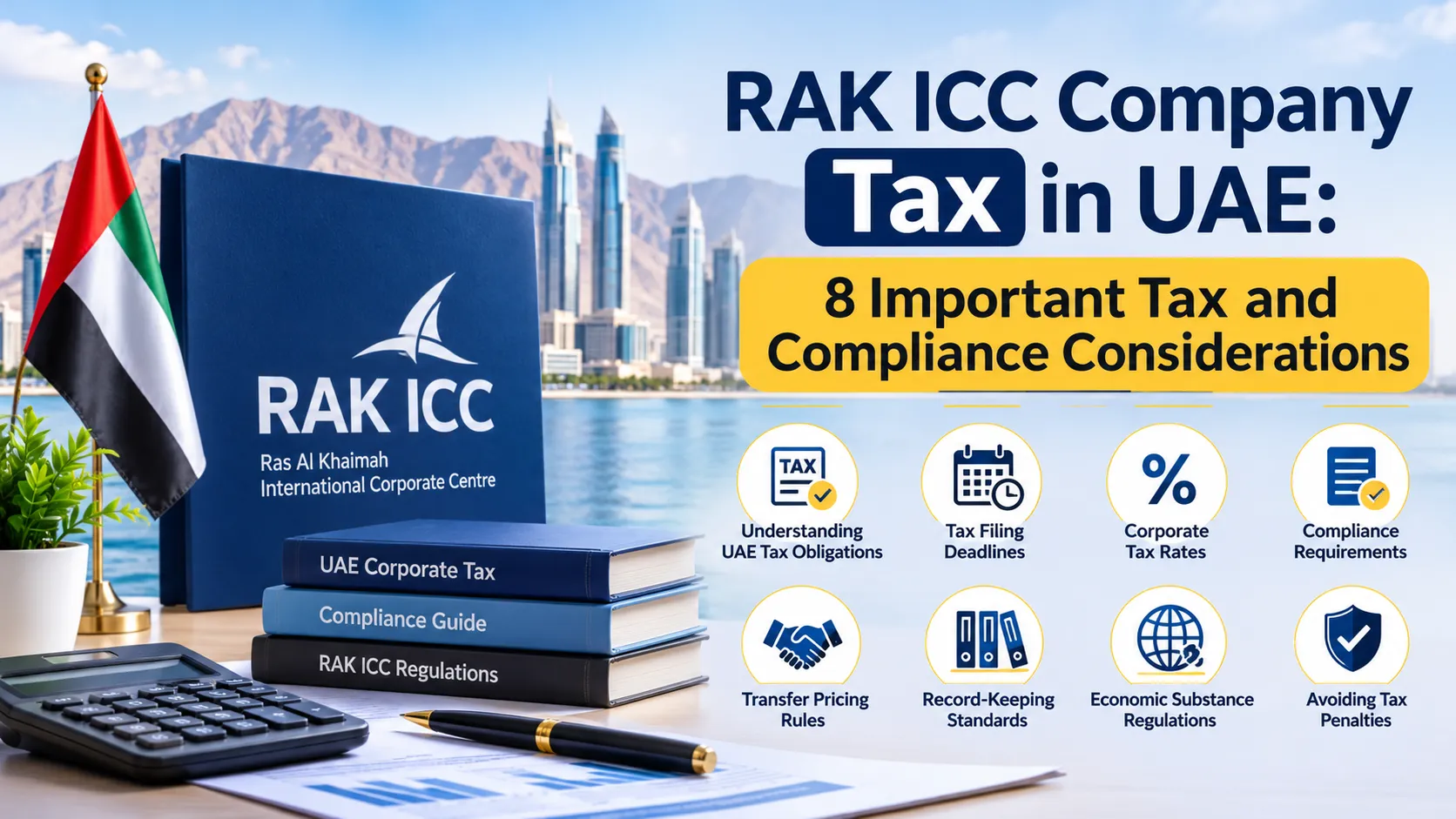
Here are eight important tax and compliance considerations every RAK ICC company owner should understand.
1. Understand Whether Your RAK ICC Company Is Subject to UAE Corporate Tax
The first step is to understand how UAE Corporate Tax applies to offshore companies.
The UAE introduced Corporate Tax for financial years starting on or after 1 June 2023. The rules apply to businesses and legal entities that meet the definition of a taxable person under the Corporate Tax Law.
An important point for RAK ICC investors is that an offshore company incorporated under UAE legislation can fall within the category of a UAE resident juridical person.
This means that offshore status alone does not remove a company from the Corporate Tax system.
RAK ICC companies may therefore need to consider:
Whether the company is a UAE resident taxable person.
Whether it must register with the Federal Tax Authority (FTA).
Whether its income is subject to Corporate Tax.
Whether it needs to submit annual tax returns.
Which records it must maintain.
For example, an investor who establishes a RAK ICC company to hold shares in overseas businesses should not assume that the company has no UAE tax responsibilities simply because its investments are outside the country.
The company’s legal status and applicable tax provisions must be reviewed before reaching a conclusion.
Understanding this position early can help investors plan their finances and avoid missing important compliance requirements.
2. Understand the UAE Corporate Tax Rates
Another important consideration is the Corporate Tax rate that may apply to the company.
Under the UAE Corporate Tax system, the standard rates for taxable persons are:
Taxable incomeCorporate Tax rateUp to AED 375,0000%Above AED 375,0009%
The 0% rate on the first AED 375,000 applies to taxable income, not total company revenue.
For example, if a RAK ICC company has taxable income of AED 500,000 for a tax period, the calculation under the standard Corporate Tax rates would be:
CalculationAmountTotal taxable incomeAED 500,000First AED 375,000 taxed at 0%AED 0Remaining AED 125,000 taxed at 9%AED 11,250Total Corporate TaxAED 11,250
This example assumes the company is subject to the standard Corporate Tax regime and no special relief or exemption applies.
Investors should also understand that accounting profit and taxable income may not always be the same. Certain income and expenses may require adjustments when calculating the final taxable amount.
Therefore, maintaining accurate financial statements is important for determining the correct tax liability.
3. Do Not Assume That RAK ICC Offshore Companies Automatically Qualify for 0% Free Zone Tax
The UAE offers a special Corporate Tax regime for qualifying Free Zone companies. Under this regime, a Qualifying Free Zone Person (QFZP) may benefit from a 0% Corporate Tax rate on qualifying income, while non-qualifying taxable income may be subject to the 9% rate.
However, this benefit is not automatically available to every company registered in the UAE.
To qualify, an entity must meet specific conditions, including:
Maintaining adequate substance in the UAE.
Earning qualifying income.
Complying with applicable transfer pricing requirements.
Maintaining the required financial records.
Meeting other conditions under the Corporate Tax legislation.
An important distinction is that an RAK ICC offshore company should not automatically be treated as a qualifying Free Zone Person simply because it is registered in Ras Al Khaimah.
RAK ICC offshore registration and registration as an operating Free Zone company are not the same thing.
Investors should review the company’s legal classification and activities before relying on any Free Zone tax benefit.
For example, an investor who establishes a RAK ICC company to hold international investments should obtain advice on the relevant Corporate Tax rules rather than assuming that the company qualifies for a 0% rate on all its income.
Making this distinction can prevent incorrect tax planning and unexpected liabilities.
4. Complete Corporate Tax Registration With the Federal Tax Authority
Corporate Tax registration is another important responsibility for companies that fall within the scope of the UAE tax system.
A UAE-incorporated juridical person that qualifies as a resident taxable person is generally required to register with the FTA and obtain a Corporate Tax Registration Number.
This requirement also covers relevant offshore companies incorporated under UAE legislation.
For RAK ICC company owners, it is important to check the applicable registration deadline rather than assuming that an offshore entity does not need to register.
The registration process generally involves:
Creating or accessing an EmaraTax account.
Setting up the taxable person’s profile.
Providing the company’s incorporation information.
Submitting the required identification and ownership details.
Providing supporting corporate documents.
Completing the application and obtaining the registration number.
The FTA may request documents such as the Certificate of Incorporation, Memorandum of Association and information about the company’s owners and authorised signatories.
Late Corporate Tax registration can result in an administrative penalty of AED 10,000, subject to the applicable rules and relief provisions.
Investors should therefore confirm their company’s registration status and ensure that the application is submitted within the required timeframe.
5. Meet Corporate Tax Return Filing and Payment Deadlines
Registering for Corporate Tax is not the final step. Taxable companies must also meet their reporting and payment obligations.
Under the UAE Corporate Tax Law, a taxable person is generally required to submit a Corporate Tax Return within nine months from the end of the relevant tax period.
Any Corporate Tax payable must also be settled within this timeframe.
For example, if a company’s financial year ends on 31 December 2026, its Corporate Tax Return and payment would generally be due by 30 September 2027.
A company may still need to file a return even if its taxable income is below AED 375,000 and its Corporate Tax liability is zero.
This is because the 0% tax rate does not automatically remove the company’s filing responsibilities.
Investors should keep track of:
The company’s financial year-end.
Corporate Tax registration details.
Tax return submission dates.
Taxable income calculations.
Payment deadlines.
Any information requested by the FTA.
Missing deadlines can lead to administrative penalties and additional compliance work.
Maintaining a tax calendar and reviewing financial information before the reporting deadline can help companies meet their obligations on time.
6. Maintain Accurate Financial Records and Accounting Documents
Proper record-keeping is essential for RAK ICC companies that fall within the UAE Corporate Tax framework.
Investors should maintain clear financial information to support their income, expenses, ownership arrangements and tax calculations.
Relevant records may include:
Annual financial statements.
Bank statements.
Sales and purchase invoices.
Investment and dividend records.
Shareholder and director information.
Contracts and agreements.
Records of related-party transactions.
Supporting documents for business expenses.
Under the Corporate Tax Law, taxable persons must generally retain relevant tax records and documents for seven years following the end of the relevant tax period.
These records help demonstrate how the company’s taxable income was calculated and support the information submitted in its Corporate Tax Return.
For example, a RAK ICC company holding shares in overseas businesses should maintain relevant investment records, dividend statements and supporting financial documents.
Without proper records, it may become difficult to explain the company’s financial position or support its tax treatment during an FTA review.
Investors should establish an organised accounting system from the beginning rather than waiting until the first tax return is due.
7. Review Transfer Pricing Rules and Related-Party Transactions
Transfer pricing is another important consideration for companies with international ownership and business arrangements.
It refers to the pricing of transactions between related parties and connected persons.
For example, a RAK ICC company may have transactions with another company owned by the same shareholder. These transactions could involve:
Management fees.
Consultancy services.
Loans and financing arrangements.
Intellectual property payments.
Shared administrative expenses.
Other intercompany transactions.
Under UAE Corporate Tax rules, transactions between related parties and connected persons must follow the arm’s length principle.
This means that the terms and prices should be consistent with those that independent parties would agree under comparable circumstances.
For example, if a RAK ICC company provides management services to another company within the same group, the fee should be supported by the services provided and the relevant commercial arrangements.
Companies should maintain suitable agreements, invoices and supporting records to explain these transactions.
Depending on the company’s circumstances and applicable thresholds, additional transfer pricing documentation may also be required.
Ignoring these rules can create tax risks, particularly for investors who operate several companies under a shared ownership structure.
A proper review of intercompany arrangements can help reduce disputes and support accurate tax reporting.
8. Check VAT and Other Cross-Border Tax Obligations
Corporate Tax is not the only tax consideration for RAK ICC company owners.
Depending on the company’s activities, transactions and tax position, other tax rules may also need to be reviewed.
The UAE VAT system generally applies to taxable supplies of goods and services.
For UAE-resident businesses, mandatory VAT registration is generally required when the value of taxable supplies and imports exceeds AED 375,000 over the previous 12 months or is expected to exceed that amount within the next 30 days.
However, VAT treatment depends on the actual activities and transactions of the company.
An offshore company should not assume that its registration status automatically removes it from VAT considerations.
For example, a company involved in taxable supplies in the UAE may need to review whether VAT registration and reporting requirements apply.
International investors should also consider the tax rules of other countries where the company operates, owns assets or receives income.
A RAK ICC company may have international shareholders, overseas investments or business relationships across several jurisdictions.
These arrangements can create tax considerations involving:
Foreign withholding taxes.
Tax residency.
Double taxation agreements.
Permanent establishment risks.
Foreign reporting requirements.
Tax treatment of overseas dividends and investment income.
For example, income received from an overseas investment may be subject to withholding tax in the country where the income originates.
The UAE tax treatment of that income and the availability of any foreign tax relief should be reviewed separately.
Understanding both UAE and foreign tax obligations is important for investors who want to maintain a compliant international business structure.
Why Professional Tax Advice Matters for RAK ICC Companies
RAK ICC company owners may have different tax responsibilities depending on their ownership arrangements, activities, income sources and international business connections.
A company established only to hold investments may have different reporting considerations from one involved in regular commercial transactions or intercompany financing.
Professional advice can help investors:
Understand their Corporate Tax position.
Review tax registration requirements.
Prepare accurate financial statements.
Calculate taxable income.
Identify applicable VAT obligations.
Review related-party transactions.
Maintain supporting financial records.
Meet tax return and payment deadlines.
It is also important to review the company’s position when its business activities or ownership structure change. A change in circumstances may affect its tax responsibilities and reporting requirements.
Final Thoughts
Understanding RAK ICC company tax UAE requirements is an important part of managing an offshore company in the UAE. Although RAK ICC offers an international corporate structure for investors, offshore registration does not automatically provide exemption from Corporate Tax or other applicable obligations.
From understanding the company’s tax status and completing FTA registration to maintaining financial records and reviewing international transactions, each responsibility plays a role in keeping the company compliant.
Investors should assess their tax position based on their actual business activities, income sources and ownership arrangements rather than relying on assumptions about offshore status.
Dubai Business & Tax Advisors can support investors with RAK ICC company formation, UAE Corporate Tax advisory, accounting and compliance services. Professional guidance can help company owners understand their obligations, maintain accurate records and make informed decisions about their international business structures.


Join the conversation