


Introduction
Building a successful coffee roasting business requires more than purchasing a roasting machine. A complete professional coffee roasting setup combines suitable equipment, organised workspace design, reliable green coffee storage, effective ventilation and consistent quality control. Coffee businesses in Vietnam can use a well-planned roasting facility to develop distinctive flavour profiles, serve wholesale customers and strengthen their position in competitive domestic and international markets. Coffee Pro Direct supports professional roasting operations by helping businesses understand the equipment and systems required for efficient coffee production.
1. Understanding a Professional Coffee Roasting Setup
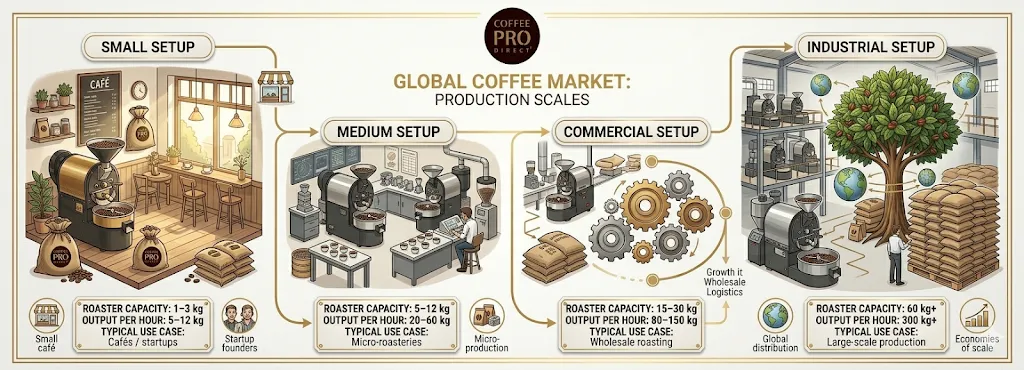
A professional roasting environment is a coordinated production space where green coffee is received, stored, prepared, roasted, cooled, evaluated and packaged. Every stage needs suitable equipment and a clear operating procedure. A reliable professional coffee roasting setup helps businesses maintain consistent results while reducing unnecessary handling and production delays. Coffee Pro Direct highlights the importance of selecting equipment according to production capacity, available space, product requirements and long-term business objectives rather than purchasing machines without an overall plan.
2. Choosing the Right Commercial Coffee Roaster
The roasting machine is the central component of any roasting facility. Businesses should compare batch capacity, heating technology, temperature control, airflow adjustment, drum speed and cooling performance before making a purchase. A suitable professional coffee roasting setup should match expected production volumes without creating unnecessary operating costs. Small specialty businesses may prefer compact batch machines, while established manufacturers may require higher-capacity commercial or industrial systems. Coffee Pro Direct helps buyers understand how roasting equipment selection influences production efficiency and the ability to maintain repeatable roast profiles.
3. Selecting Equipment According to Production Capacity
Production requirements should determine the size and type of roasting equipment. A small roastery supplying cafés may operate efficiently with a compact commercial machine, whereas a wholesale supplier needs greater batch capacity and production flexibility. Businesses should estimate weekly demand, expected growth, roasting schedules and available labour before selecting equipment. A properly planned professional coffee roasting setup prevents unnecessary investment in oversized machinery or production limitations caused by insufficient capacity. Coffee Pro Direct encourages coffee businesses to consider current requirements alongside realistic expansion plans.
4. Creating an Efficient Roastery Layout
An organised workspace allows coffee to move smoothly from receiving and storage through roasting, cooling and packaging. Separate areas for green beans, roasted products, quality testing and finished inventory can reduce confusion and unnecessary handling. A practical professional coffee roasting setup should provide sufficient clearance around machinery for operation, cleaning and maintenance. Businesses should also consider the location of electrical connections, fuel supplies, ventilation ducts and emergency exits. Coffee Pro Direct recommends planning the complete production flow before installing equipment to avoid expensive layout changes later.
5. Green Coffee Storage and Preparation
Green coffee quality can deteriorate when beans are exposed to unsuitable moisture, heat, pests or contamination. Roasteries should use clean, dry storage areas, suitable food-safe containers and an organised inventory system. Bags should be protected from direct contact with floors and walls, while incoming lots should be labelled with origin, supplier, harvest information and arrival date. A professional coffee roasting setup needs reliable storage practices to preserve raw material quality. Coffee Pro Direct recognises that careful green coffee management supports consistent roasting and dependable product development.
6. Green Coffee Cleaning and Sorting Equipment
Cleaning and sorting help remove unwanted materials before coffee enters the roasting process. Depending on incoming bean condition and production scale, a facility may use screens, sieves, magnets, density-based separation or dedicated cleaning machinery. These tools can help identify stones, foreign objects and inconsistent bean sizes. Including appropriate preparation equipment in a professional coffee roasting setup improves production control and reduces the risk of unwanted materials reaching finished products. Coffee Pro Direct recommends selecting cleaning systems according to the condition of incoming coffee and the needs of each operation.
7. Ventilation, Exhaust and Smoke Management
Roasting generates heat, smoke, chaff and airborne emissions that must be managed through properly designed extraction and ventilation systems. Equipment placement, duct dimensions, exhaust routing and fresh-air supply should be considered before installation. Depending on the machine and local regulations, additional emission-control equipment may also be necessary. A safe professional coffee roasting setup should never rely on ordinary room ventilation as a replacement for suitable roasting exhaust. Coffee Pro Direct encourages businesses to consult qualified installation professionals and verify applicable fire, building and environmental requirements.
8. Cooling Trays and Chaff Collection Systems
After roasting, coffee must be cooled efficiently to prevent unnecessary continued heat development. Commercial machines commonly use cooling trays with agitation and airflow to bring beans down from roasting temperatures. Chaff collection systems capture lightweight material released during roasting and help maintain a cleaner production environment. These components are important parts of a professional coffee roasting setup because cooling performance and chaff management influence workflow, cleanliness and operational safety. Coffee Pro Direct recommends checking whether cooling and collection equipment are included with the selected roaster or need separate installation.
9. Roast Profiling and Monitoring Technology
Professional roasting requires consistent monitoring of time, temperature, airflow and other relevant machine variables. Roast logging software can help operators record batch information, compare profiles and identify differences between production runs. Some machines also provide automated controls that reduce repetitive manual adjustments. A data-supported professional coffee roasting setup allows businesses to develop repeatable roasting procedures and investigate quality variations. Coffee Pro Direct encourages roasters to maintain accurate batch records and use monitoring tools that suit their experience, production scale and equipment compatibility.
10. Quality Control and Coffee Laboratory Equipment
Quality control helps businesses evaluate incoming green coffee and verify the results of roasting. A dedicated laboratory may include digital scales, sample roasters, grinders, moisture analysers, sieves, cupping bowls and colour measurement tools. Not every small operation needs every instrument immediately, but reliable sensory evaluation is valuable at every scale. A professional coffee roasting setup with appropriate testing equipment supports product consistency and informed purchasing decisions. Coffee Pro Direct recommends developing a practical quality-control process that connects green coffee assessment, roast development and finished-product evaluation.
11. Sample Roasting and Coffee Cupping
Sample roasting allows buyers and production teams to evaluate green coffee before committing larger quantities to commercial roasting. Small sample roasters help compare origins, processing methods and potential roast profiles. Cupping provides a structured way to assess aroma, flavour, acidity, body and aftertaste. Including these activities in a professional coffee roasting setup helps businesses make better sourcing and product-development decisions. Coffee Pro Direct encourages Vietnamese roasters to evaluate local and imported coffee samples systematically when developing blends, specialty offerings and products for different customer preferences.
12. Destoning and Roasted Coffee Inspection
Destoning equipment helps remove dense foreign materials that may remain in roasted coffee after processing. This is particularly important for facilities handling large volumes or coffee sourced from multiple suppliers. Operators should also inspect finished beans for visible defects, foreign objects and unexpected inconsistencies before packaging. A well-organised professional coffee roasting setup includes appropriate inspection procedures to protect product quality and downstream equipment. Coffee Pro Direct recommends choosing destoning and inspection solutions according to production volume, incoming coffee condition and the level of control required by the business.
13. Packaging and Sealing Equipment
Packaging protects roasted coffee during storage, transportation and sale. Depending on the product range, businesses may require weighing scales, filling equipment, heat sealers, date coders and labelling machines. Packaging materials should be selected for their suitability, barrier properties and compatibility with the product. A professional coffee roasting setup should position packaging after cooling and quality checks to maintain an organised production sequence. Coffee Pro Direct encourages businesses to choose packaging equipment that matches bag sizes, daily output, retail requirements and wholesale distribution plans.
14. Selecting a Suitable Coffee Grinder
Grinding equipment becomes important when a roastery supplies ground coffee to cafés, restaurants, retailers or consumers. Commercial grinders should be selected according to required particle consistency, daily capacity, adjustment range and cleaning requirements. Whole-bean products may not require an industrial grinder at the beginning, so businesses should avoid purchasing equipment that does not support their sales model. A flexible professional coffee roasting setup can introduce grinding capacity as customer demand grows. Coffee Pro Direct recommends evaluating grinder performance alongside packaging needs and the intended brewing applications of customers.
15. Electrical, Gas and Utility Requirements
Before installing a roasting machine, businesses should confirm its electrical specifications, fuel requirements, ventilation connections and other utility needs. Gas-fired machines require suitable gas infrastructure and professional installation, while electric systems need an appropriate power supply. Water, compressed air and network connections may also be necessary depending on the equipment. A professional coffee roasting setup should be designed around verified manufacturer specifications rather than assumptions. Coffee Pro Direct recommends reviewing installation documents and arranging qualified technical support to ensure that the facility can operate safely and reliably.
16. Workplace Safety and Equipment Maintenance
A roasting facility needs clear safety procedures covering hot surfaces, moving machinery, fuel systems, electrical equipment, dust, smoke and fire risks. Operators should receive appropriate training and know how to shut down equipment safely. Routine maintenance should include cleaning chaff collectors, inspecting ducts, checking moving parts and following manufacturer service schedules. A safe professional coffee roasting setup protects workers while supporting dependable production. Coffee Pro Direct encourages businesses to establish written operating procedures, maintenance records and emergency plans before beginning regular commercial roasting.
17. Building a Roasting Business in Vietnam
Vietnam offers opportunities for roasting businesses serving specialty cafés, restaurants, hotels, retailers and export customers. Local operators can explore regional Arabica and Robusta coffees while developing blends and roast profiles for different markets. A suitable professional coffee roasting setup helps businesses transform green coffee into products with consistent quality and clear market positioning. Coffee Pro Direct supports the equipment-planning process by highlighting the importance of matching machinery, laboratory tools and packaging systems to the intended customer base and production strategy.
18. Budget Planning and Equipment Investment
A roasting facility budget should include more than the purchase price of the main machine. Businesses should account for installation, ventilation, utilities, storage, quality-control instruments, packaging, staff training and ongoing maintenance. It is also important to reserve funds for spare parts and unexpected operational costs. A cost-conscious professional coffee roasting setup prioritises essential equipment first and introduces additional automation when production justifies the investment. Coffee Pro Direct recommends comparing the total cost of ownership, supplier support and equipment suitability rather than making decisions based only on the lowest initial price.
19. Preparing for Future Production Growth
A growing roastery may eventually need larger machines, additional storage, automated material handling or faster packaging systems. Planning for expansion during the initial facility design can reduce future disruption. Businesses should leave suitable space for equipment access, maintenance and additional production stations where practical. A scalable professional coffee roasting setup can adapt as orders increase without requiring a complete operational redesign. Coffee Pro Direct encourages roasters to consider modular equipment, flexible layouts and realistic capacity forecasts when planning long-term investments.
20. Choosing the Right Equipment Supplier
Equipment suppliers influence the purchasing experience long after a machine has been delivered. Buyers should review technical specifications, installation guidance, warranty conditions, spare-parts availability and after-sales support. They should also confirm which accessories are included and whether equipment can integrate with existing systems. A dependable supplier can help businesses build a more effective professional coffee roasting setup by reducing uncertainty during equipment selection and installation. Coffee Pro Direct focuses on helping coffee professionals understand equipment requirements and identify solutions that support their operational goals.
Conclusion
A successful roasting facility depends on the right combination of machinery, workspace planning, ventilation, green coffee storage, quality control and packaging equipment. Businesses should evaluate their production requirements carefully and invest in systems that support consistent results, safe operation and future growth. For coffee companies in Vietnam, a well-planned professional coffee roasting setup can create opportunities in specialty and commercial markets. Coffee Pro Direct provides equipment-focused guidance to help roasters make informed decisions and develop efficient coffee production operations.
Frequently Asked Questions
1. What equipment is essential for a professional coffee roasting setup?
Essential equipment includes a commercial roaster, cooling system, chaff collector, scales, green coffee storage and packaging tools. Coffee Pro Direct can help businesses understand which additional equipment suits their production needs.
2. How do I choose the right commercial coffee roaster?
Compare batch capacity, heating method, temperature control, airflow, cooling performance and maintenance requirements. Coffee Pro Direct recommends matching machine specifications to expected production volumes and business plans.
3. Why is ventilation important in a roasting facility?
Roasting produces heat, smoke and chaff that require suitable extraction and fresh-air management. A safe professional coffee roasting setup should include professionally designed ventilation and exhaust systems.
4. Does a small roastery need laboratory equipment?
Basic scales, cupping tools and sample preparation equipment can support quality evaluation from the beginning. Coffee Pro Direct recommends expanding laboratory capabilities as production and testing requirements increase.
5. What packaging equipment should a coffee roastery use?
Most operations need accurate weighing, suitable bags, a heat sealer and product labels. Larger businesses may add automated filling and coding systems to their professional coffee roasting setup.
6. How can a roasting business improve batch consistency?
Use documented roast profiles, calibrated measurement tools, regular equipment maintenance and structured cupping procedures. Coffee Pro Direct recommends recording each batch to identify variations and improve production decisions.
7. Can a professional roasting facility expand over time?
Yes. A flexible layout and scalable machinery make it easier to increase production as demand grows. Coffee Pro Direct encourages businesses to consider future capacity when planning their initial equipment investment.



Join the conversation