
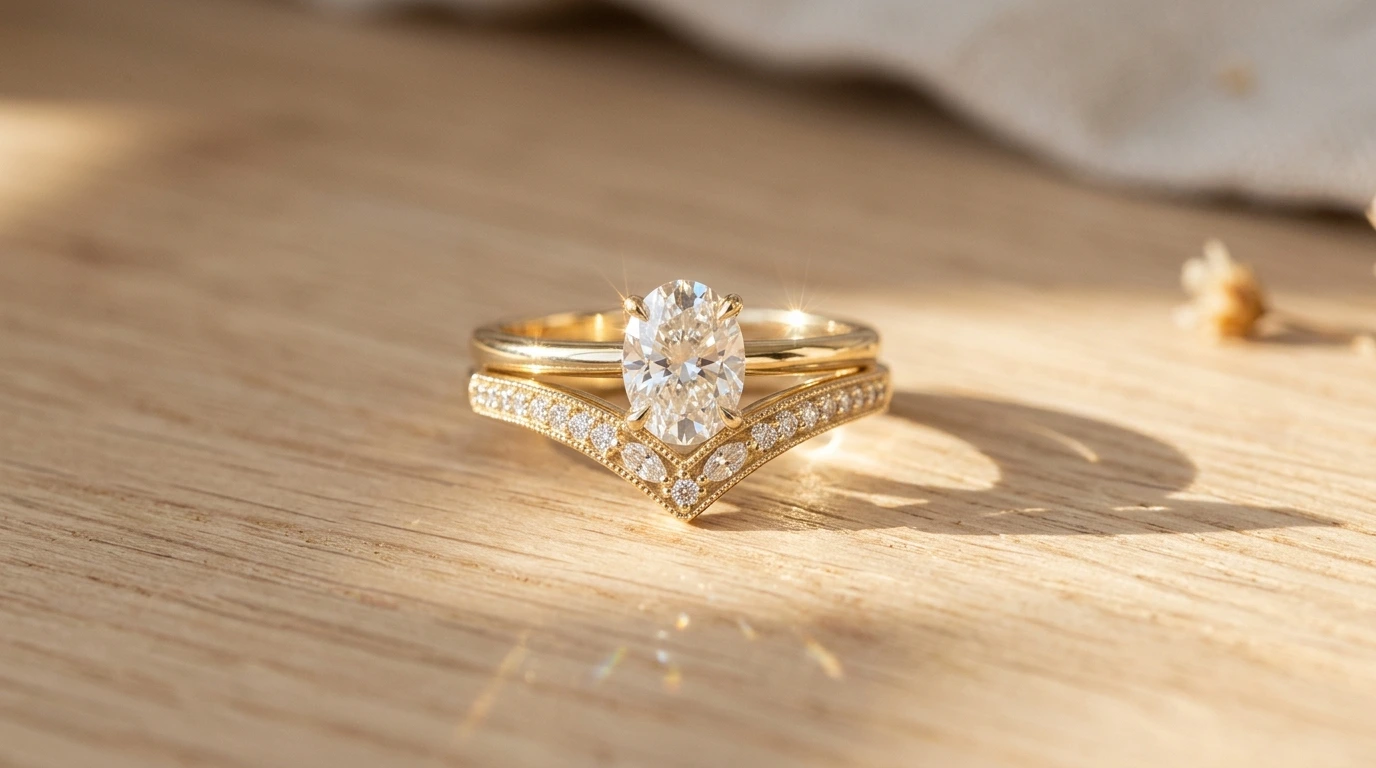

You already picked the solitaire. Now comes the part people don’t think about until they’re standing in a jewelry store holding two rings that don’t quite look right together. Pairing a solitaire with the right diamond band ring is genuinely straightforward once you understand what’s actually driving the decisions—metal, width, setting height, and fit. Get those four things right, and the rest tend to follow.
Why Your Band Choice Can Make or Break the Stack
A solitaire engagement ring is built around one idea: get out of the way and let the diamond do the talking. Everything about the design—the thin shank, the raised setting, the minimal metalwork—exists to serve the center stone. When you add a wedding band to that, you’re introducing a second voice into the conversation. It either complements the solitaire or it argues with it.
A poorly matched band can crowd the setting, visually shrink the center diamond, or just look like it arrived from a different jewelry store entirely. A well-matched one disappears into the stack in the best possible way—present, adding something, but never competing. That’s the goal.
Start with Metal, Not Style
Most people go straight to sparkle. They see a pavé band they love and start imagining it next to their solitaire, only to realize later the metals clash. Metal matching should happen first, before anything else.
If your solitaire sits in a platinum setting, your band should be platinum too, or at minimum white gold in a close tone. Yellow gold solitaires want yellow gold bands. Rose gold, same. Mixing metals can work, but it’s a deliberate style choice that takes some care to pull off—it’s not something you want to stumble into by accident.
There’s also a practical reason beyond looks. Platinum and gold wear at different rates over years of daily use. If your metals don’t match, one ring develops a patina while the other stays bright, and eventually the mismatch becomes more obvious, not less.
How Wide Should the Band Be?
For delicate solitaire rings, a thin band in the 1.5–2mm range creates an elegant, streamlined look. That proportional thinking applies to most solitaires. The solitaire shank is usually slim by design, and a band that’s noticeably wider will throw off the visual balance—the band starts to overpower the very ring it’s supposed to complement.
A wide band can visually overpower a delicate engagement ring. If you have your heart set on a chunkier band, the honest fix is to revisit your solitaire choice, not force the pairing. A solitaire with a wider, more substantial shank can carry a bolder band. One with a fine 1.8mm shank probably cannot.
Which Band Style Actually Works with a Solitaire
The best wedding band styles for solitaire engagement rings highlight the center diamond without overpowering it.
Pavé bands are the most popular pairing for a reason. A single row of small, closely-set diamonds adds sparkle to the stack without trying to upstage the solitaire. A pavé style is a popular choice to pair with a solitaire engagement ring. Thin micro-pavé is especially good alongside a delicate shank.
Plain metal bands—sometimes called comfort-fit or flat bands—are the most timeless option and the least likely to go wrong. If your center diamond is large or has significant character on its own, a clean plain band lets it breathe. There’s nothing competing for attention.
Eternity bands, with diamonds running all the way around, work well because they add overall brilliance rather than a competing focal point. The solitaire still leads; the eternity band just turns up the ambient light.
Curved or contoured bands deserve more attention than they usually get. A curved wedding band fits around the engagement ring, framing it and making both rings look seamless together. If your solitaire has a raised prong basket, a straight band will sit slightly away from it and leave a visible gap. A contoured band solves this without any compromise.
Choosing a Diamond Band Ring That Fits the Setting Height
Setting height is the detail people skip over until the ring is on their finger and something feels off. You can determine a flush set by looking at the side view of the ring style. If the base of the prong or basket protrudes further than the width of the band, it is not a flush set.
High prong settings—the classic cathedral or six-prong styles—often create a raised profile that a straight band simply won’t sit flush against. The gap isn’t huge, but it’s visible and tends to bother people more over time, not less. A shadow band or curved band that’s shaped to nestle under the basket is the cleaner solution and usually more comfortable to wear day-to-day as well.
Always try both rings on together before you commit. Pictures on a website won’t show you how the two rings interact on your actual hand.
Don’t Forget Your Fingers
Take into account the length and width of your fingers when stacking. Slender fingers suit narrow bands. Wider fingers can carry a slightly more substantial stack without looking cluttered. Neither is a hard rule, but they’re worth thinking about—the goal is for the combination to look balanced on your hand, not just balanced in theory.
When the Off-the-Shelf Options Don’t Quite Work
Custom fitting by a jeweler can modify either ring to create a perfect match. If you’ve already fallen for both a solitaire and a specific band that don’t sit quite right together, a jeweler can usually contour the band, adjust the shank width, or build something from scratch around your existing ring’s exact profile. It costs more and takes longer, but it’s often the only way to get a truly seamless result when your solitaire has an unusual setting.
Final Thoughts
Matching your solitaire to the right diamond band ring isn’t complicated, but it does require thinking through the right things in the right order. Metal first, then width, then style, then fit. Understand your solitaire’s setting height before you commit to a band shape. Try them on together. When all of those pieces fall into place, you won’t be overthinking it anymore—the combination will just look right, and you’ll know.



Join the conversation