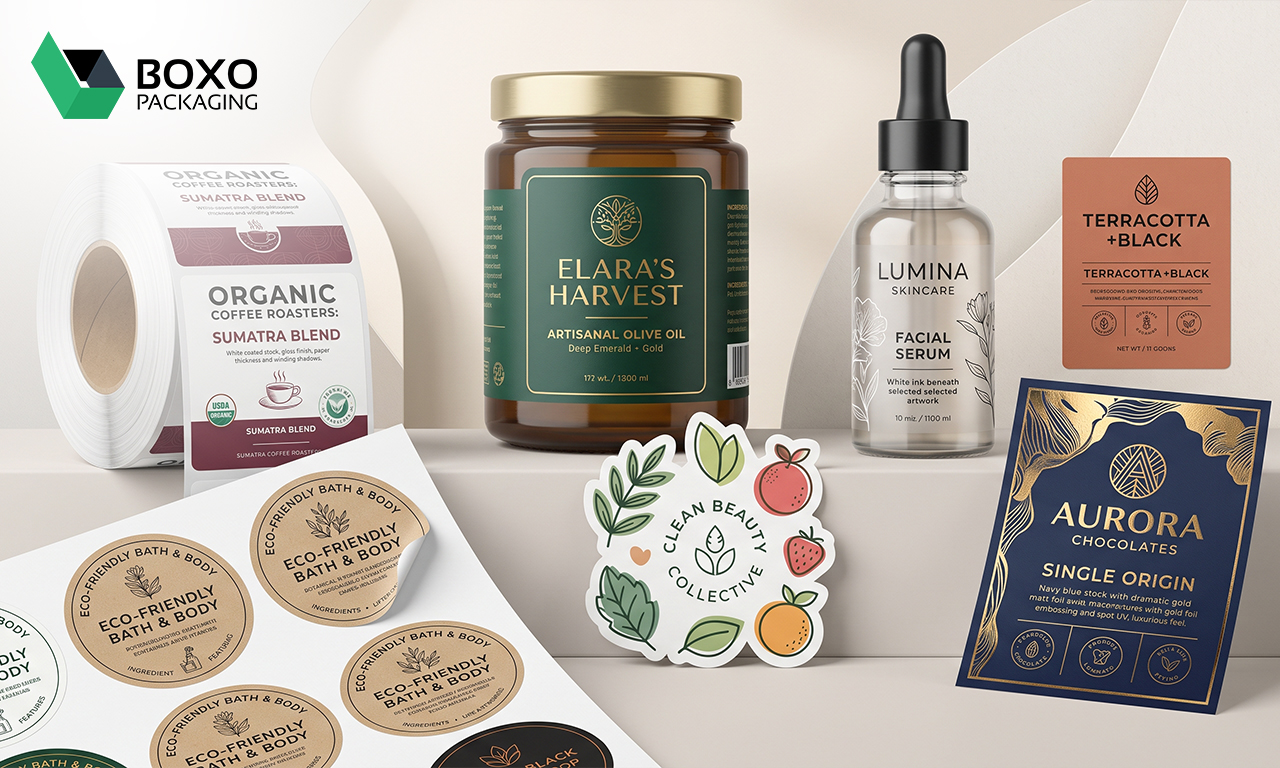

The first job of a product sticker is to identify the item accurately, not to fill an empty space with a logo. For a coffee range, Custom Printed Stickers can carry changing product names, formats, and other verified details while the base packaging remains consistent. Their layout should make the most useful distinctions obvious at a glance.
A decaffeinated coffee and its regular counterpart may share a brand and illustration, yet customers need to tell them apart immediately. Give that distinction a deliberate position. A small difference hidden among tasting notes is a weak way to identify two genuinely different products.
Build a proof around the longest real product name
Short placeholder text makes almost any layout look tidy. Replace it with the longest expected name, the actual quantity statement, and the details intended for the finished label. Then print the proof at its final size.
Check line breaks as carefully as spelling. A coffee name divided awkwardly across two lines can look like separate products. If a changing field repeatedly forces smaller type, redesign the field instead of shrinking each new version independently.
A changeover proof should settle these four questions:
- Is the product format clear without relying on its photograph?
- Can the longest verified name fit without compressed lettering?
- Is changing information separated from fixed brand artwork?
- Does every printed version match the approved product record?
Preprinted folding cartons and plain pouches with labels offer different ways to manage a changing range. Neither method excuses inconsistent naming. A small sleeve can carry an extended description if the primary label would otherwise become difficult to read.
Match the adhesive to the finished surface
The label material, adhesive, and receiving surface form a system. Avery Dennison identifies the face material, application surface, and exposure conditions as important inputs when selecting an adhesive. A paper sticker approved on an uncoated carton should not automatically be assumed suitable for a coated flexible bag.
Test the actual finished surface, including any varnish or laminate. Apply the label under the intended working conditions and inspect it after normal handling. Avery also advises keeping the application surface dry and free of residue that can interfere with bonding.
When briefing Boxo Packaging, provide a filled production-equivalent pack and the proposed label position. Explain whether the sticker identifies the product, carries a promotional message, or crosses an opening. Those functions create different requirements.
For Custom Printed Stickers, keep the approval trail connected to the physical item. An attractive design file is only one part of the result. The applied label must remain legible, sit where expected, and correspond to the coffee inside. That relationship becomes more important when the individual pack enters an outer carton with its own printed story.
Coffee Boxes That Keep the Outer Story Accurate
An outer carton should explain the purchase without contradicting or obscuring the information on the inner pack. With Coffee Boxes, useful content can include the product format, the purpose of a gift set, and guidance that applies to the complete purchase. The carton should not imply that its paperboard replaces the sealed coffee package’s barrier function.
Imagine a brewing gift containing one coffee bag, paper filters, and a folded recipe card. The carton describes a complete preparation experience, while the bag identifies the specific coffee. If the roast changes, the outer wording must still make sense.
Decide which claims can survive a substitution
A generic reference to “coffee and filters” may remain accurate across several approved variants. A printed origin, process description, or tasting note may not. Identify those dependencies before ordering a large quantity of outer cartons.
The same applies to pictures. An illustration of whole beans can mislead if the assembled kit contains ground coffee and the format is not otherwise clear. Review words and imagery together rather than treating artwork as a separate accuracy check.
Before releasing the carton, confirm these four relationships:
- The outer product description agrees with the bag label.
- The illustrated contents match the actual gift components.
- Preparation directions suit the supplied brewing accessories.
- Any changing coffee detail has an appropriate update method.
A neutral gift carton with an interchangeable belly band may suit a rotating assortment. A fully printed retail carton can suit a fixed product. A corrugated mailer provides another packaging level when the gift will be shipped, with its own protection requirements.
Make the reveal follow the customer’s questions
A recipient first wants to know what the purchase contains, then how to use it. Place the recipe card where it can be found before the filters are scattered across a table. Keep the bag label facing an accessible opening rather than trapping it beneath an insert.
Check the complete pack, including any valve on the coffee pouch. Coffee packaging guidance treats valve position, seals, bag construction, and distribution as connected decisions. An insert should not create an avoidable conflict with those features.
Open the finished sample as an unfamiliar recipient would. If the inner coffee differs from the exterior description, revise the information system before changing the decoration. For Coffee Boxes, coherence means that every packaging level tells the same product story, even when each level carries a different amount of detail.