

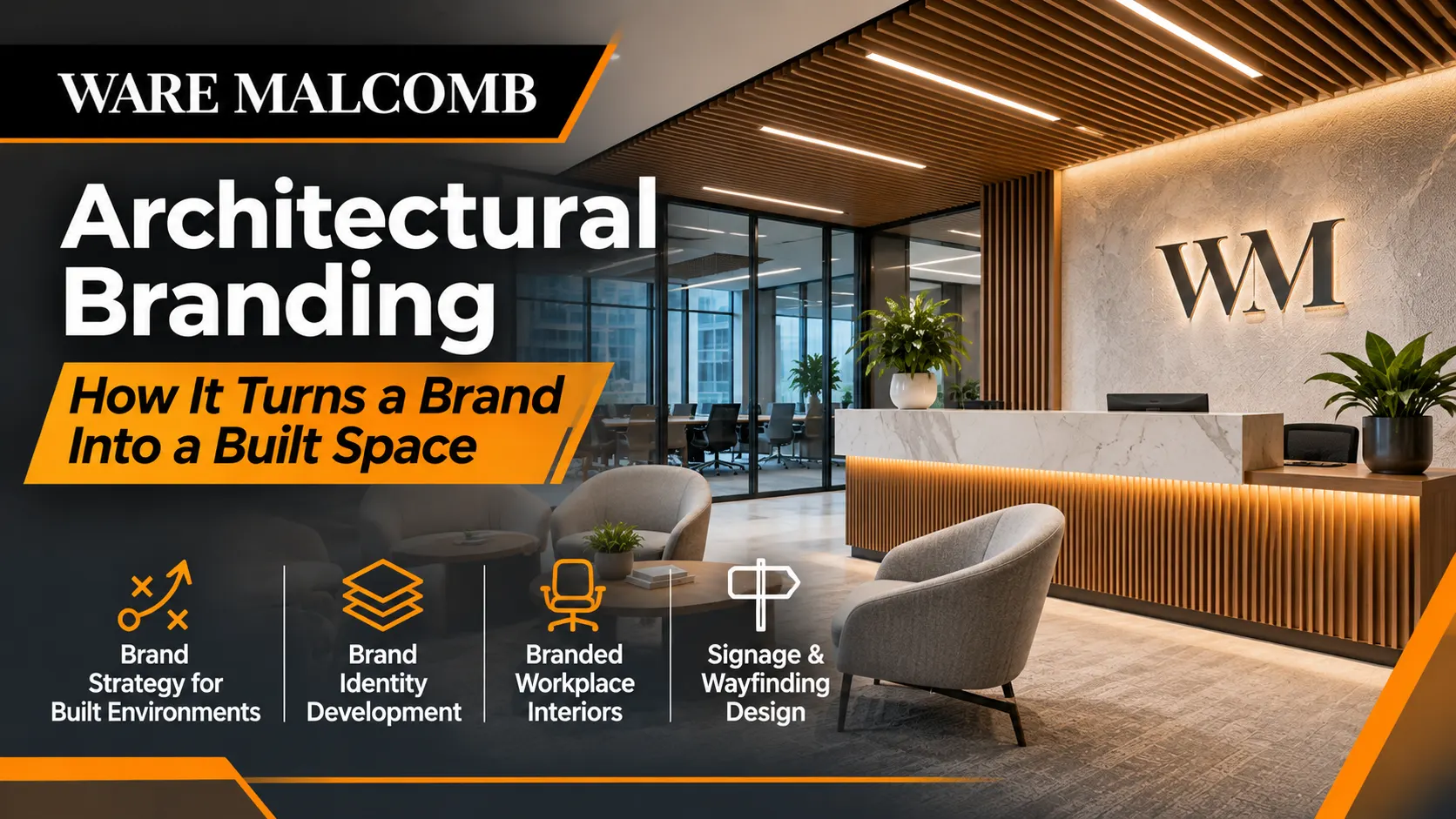

Architectural branding is the process of expressing an organization’s identity through the spaces people enter, use, and remember. Rather than applying logos after a building is designed, it considers how layout, materials, environmental graphics, and physical experience communicate what the organization stands for.
Ware Malcomb’s architectural branding practice brings together brand strategy, visual communication, architecture, and interiors. The purpose is to make identity legible through the built environment while keeping the space functional for its users.
What architectural branding means in practice
The term covers more than an attractive reception wall. It asks whether the organization’s purpose and personality can be understood consistently from arrival through daily use. The work may connect brand ideas to spatial sequences, colors, materials, imagery, graphics, and moments of orientation.
Effective brand strategy for built environments begins with a clear brief: whom the space serves, what the organization needs people to feel or understand, and which characteristics should remain consistent across locations.
One company might seek an approachable, collaborative atmosphere. Another may require a calm and highly legible visitor experience. These are illustrative directions, not claims about a particular client. The design team should test each direction against operational needs, not simply make every branded feature more visually prominent.
From brand identity development to spatial decisions
Brand identity development establishes recognizable ideas and visual elements. Translating those elements into a built project means choosing where a brand should be explicit and where it should be felt more subtly.
· Spatial organization: arrival, gathering, and transition areas reinforce the intended visitor experience.
· Materiality: finishes and textures express character without undermining maintenance or durability needs.
· Environmental graphics: messages and visual systems help communicate identity at the scale of a room or building.
· Experience consistency: repeated design cues support recognition across different touchpoints.
A useful test is to remove every logo from a concept presentation and ask whether the space still expresses the intended personality. If the answer is no, the brand may be functioning as decoration rather than informing the experience.
Brand strategy for built environments and the user journey
Brand strategy for built environments should follow how people actually move through and use a place. Someone arriving for a meeting experiences the entrance, reception, waiting area, and meeting space as one sequence. Staff experience a different sequence built around work, collaboration, and everyday wayfinding.
Mapping both journeys can reveal where brand expression is useful and where clarity matters more than visual impact. For example, a dramatic graphic treatment might suit a social space but distract from an instructional sign. Good brand integration considers both recognition and usability.
The sequence also matters for organizations managing multiple sites. The team can distinguish what should remain recognizable from what should adapt to a particular building, region, or audience. Consistency does not require copying an identical layout everywhere.
How branding connects with architecture and interiors
Brand expression is most persuasive when designers consider it early enough to influence spatial and material decisions. Architecture establishes the setting, while interiors determine much of the direct occupant experience. Environmental graphics and visual communication connect those disciplines to brand intent.
For branded workplace interiors, collaboration can help align functional workplace needs with a recognizable company identity. This is not a reason to cover every surface with brand graphics; the strongest expression may be a thoughtful sequence of spaces, materials, and selected visual moments.
Ware Malcomb describes its Branding Studio as a multidisciplinary practice connecting architecture, interior design, and graphic design. That is an approach to coordination, not a guarantee that every service is included in a particular project agreement.
The role of signage, wayfinding, and physical communication
People must be able to understand a building before they can appreciate its visual narrative. Signs, orientation cues, and environmental graphics can reinforce identity while helping users find destinations and understand where to go next.
A useful wayfinding system accounts for decision points: entry, intersections, vertical circulation, and destinations. It also needs to work with accessibility and other applicable project requirements, which vary by location and building type.
The planned companion article on signage and wayfinding design will explore this more closely. Keep that link inactive until the supporting page is live.
Common mistakes and key takeaways
· Treating branded space as a logo-placement exercise.
· Starting environmental graphics after major architectural decisions are fixed.
· Letting visual expression compromise navigation, accessibility, or the primary purpose of the space.
· Assuming that brand consistency requires every location to look identical.
The central takeaway is straightforward: an effective branded environment connects business identity, user needs, and the physical experience of a place. Design should convey a coherent story while still supporting daily operations.
Conclusion
A memorable built environment begins with a clear brand idea and a practical understanding of the people who use the space. Architectural branding connects those foundations to layout, material choices, graphics, and orientation. For a project conversation with a relevant office or studio, contact Ware Malcomb.
Standalone FAQ for schema
What is architectural branding?
Architectural branding translates an organization’s identity into physical environments through spatial design, materials, graphics, visual communication, and the experience of using a place.
Is architectural branding just adding signs and logos?
No. Signs and logos may be part of the work, but effective branding also considers spatial experience, design character, and how people understand the organization through the built environment.
When should branding specialists join a project?
They are most useful early enough to help shape key spatial, interior, and communication decisions rather than adding graphics only after design is finalized.
Can multiple offices share a brand identity without matching exactly?
Yes. A consistent set of recognizable design principles can be adapted to each location’s layout, users, and practical needs.


Join the conversation