

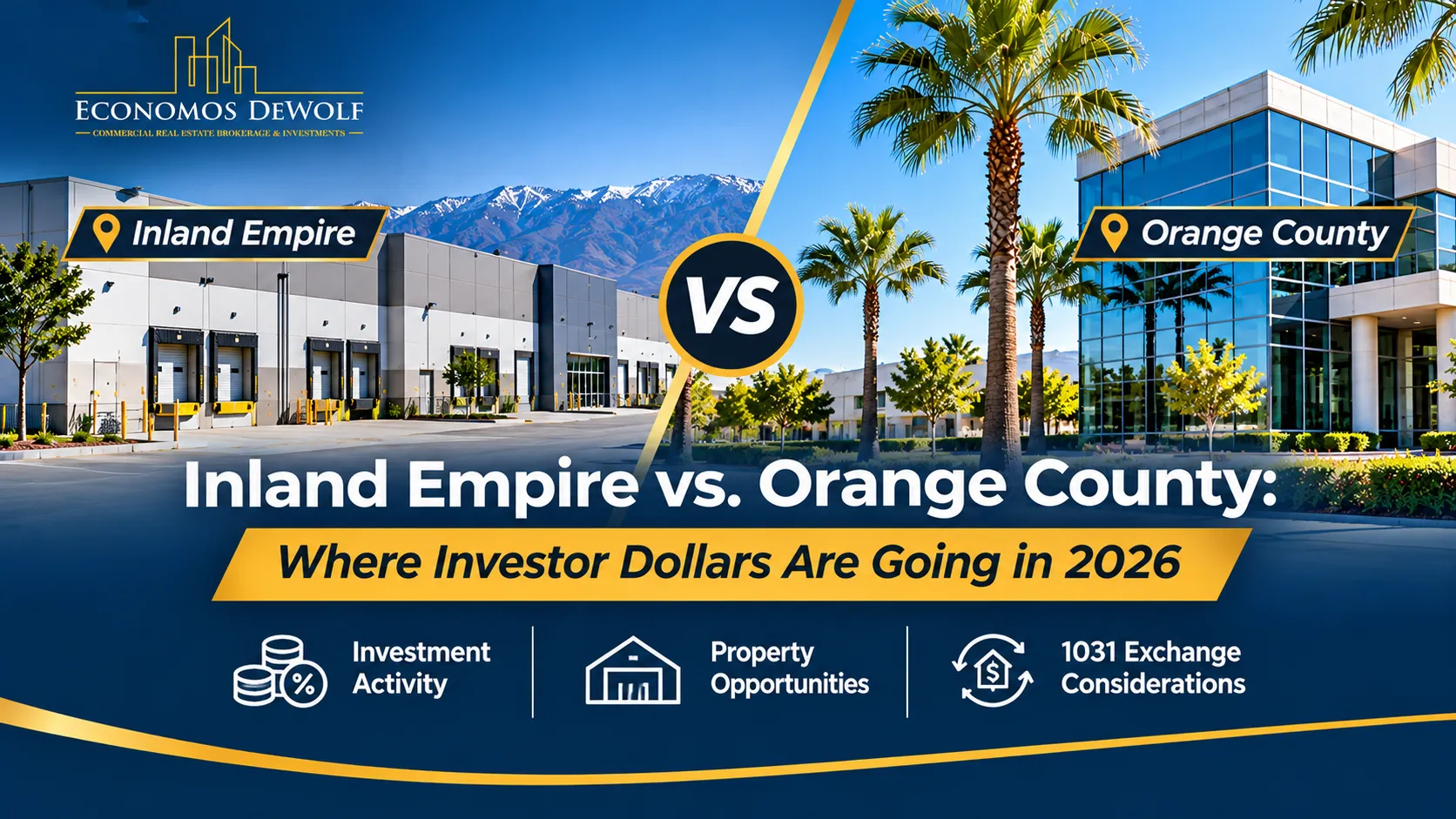

Southern California commercial real estate investors are reassessing where to place capital as property values, financing costs, and tenant demand evolve. Orange County continues to attract buyers interested in established commercial locations and properties where limited land availability constrains new supply. Meanwhile, the Inland Empire offers larger industrial facilities, logistics infrastructure, and opportunities for investors pursuing different income and growth objectives. For investors considering a 1031 exchange commercial real estate transaction, these differences can influence the selection of suitable replacement properties. Understanding where investment activity is occurring in 2026 requires examining actual transaction evidence alongside each market’s opportunities and risks.
Where Is Commercial Real Estate Investment Capital Going in 2026?
The Inland Empire and Orange County continue to attract commercial buyers, but the nature of their investment activity differs. Third-quarter 2026 industrial market reports indicate substantial transaction activity in the Inland Empire, supported by its established logistics and distribution network. Orange County’s industrial market operates with more limited development capacity and a different mix of smaller properties, owner-users, and investors. Recent data also shows that some Orange County industrial investment activity has slowed despite signs of improvement in occupier demand. Rather than declaring one region the winner, investors should evaluate which location offers property characteristics consistent with their objectives.
What the Latest Market Reports Show
Matthews reported approximately $1.69 billion in Inland Empire industrial property sales during Q3 2026, with trailing-12-month sales reaching $5.4 billion. The firm’s report also identified an average industrial capitalization rate of 5.18% and pricing around $248 per square foot. Cushman & Wakefield reported approximately $231 million in Orange County industrial investment sales during the same quarter, representing a decline from both the previous quarter and the previous year. Because the reports use different market definitions and transaction classifications, the figures should not be interpreted as a direct comparison of every commercial property sale. Nevertheless, they indicate that substantial industrial capital was active in the Inland Empire while Orange County investors faced a more selective environment.
1. Why Investors Are Examining the Inland Empire
The Inland Empire has become an important Southern California logistics region because of its transportation infrastructure and concentration of warehouse facilities. Cities such as Ontario, Fontana, Rancho Cucamonga, Riverside, and Moreno Valley offer different industrial property configurations and access to major distribution routes. Large buildings and extensive industrial districts can appeal to institutional investors and logistics operators seeking operational scale. However, industrial demand and vacancy conditions vary between the western and eastern portions of the region. Buyers should review specific submarkets instead of assuming that all Inland Empire properties share the same investment characteristics.
Larger Industrial Properties and Logistics Demand
Warehouse users often prioritize proximity to highways, distribution networks, and population centers. Properties with suitable clear heights, loading arrangements, and truck access may be attractive to businesses handling significant inventory volumes. Investors can evaluate these characteristics alongside tenant credit, lease duration, and maintenance requirements. However, larger facilities can create substantial financial exposure when major tenants leave or market rents decline. The strongest underwriting considers both the building’s functionality and its ability to attract replacement tenants.
2. Why Orange County Still Attracts Commercial Investors
Orange County presents a different investment environment because many established commercial districts have limited opportunities for new construction. Irvine, Anaheim, Costa Mesa, Santa Ana, and Newport Beach contain office, industrial, retail, and specialized commercial properties serving different tenant markets. Limited available land can support the competitive position of well-located existing buildings, although it does not guarantee rising values. Investors may prioritize access to established businesses, surrounding employment, and properties that meet specific operational requirements. Acquisition decisions should still reflect actual income, lease conditions, and financing costs.
Scarcity Can Support Value but Does Not Remove Risk
Supply limitations can make certain Orange County properties difficult to replace. However, a scarce building may still experience vacancy, deferred maintenance, or declining rental demand. Investors should assess whether the property’s physical characteristics remain relevant to modern tenants. Older office buildings, for example, may need significant improvements to compete with newer developments. Scarcity should be considered alongside financial fundamentals rather than used as a substitute for due diligence.
3. Industrial Investment Activity Is Different Across the Two Regions
Industrial real estate provides one of the clearest illustrations of the differences between the Inland Empire and Orange County. The Inland Empire offers extensive logistics-focused inventory, including facilities designed for regional distribution and large-scale warehouse operations. Orange County contains a more established mix of industrial properties, including manufacturing, research and development, and smaller warehouse facilities. These distinctions influence acquisition costs, tenant demand, and building functionality. Investors should compare similar asset types rather than evaluate a large distribution center against a small manufacturing building using price alone.
Comparing Investment Priorities
Investment considerationInland EmpireOrange CountyTypical industrial opportunitiesLarge warehouses and distribution facilitiesInfill industrial, manufacturing, flex, and smaller warehousesGeographic advantageRegional logistics infrastructureEstablished business and population centersDevelopment environmentMore industrial expansion opportunities in selected areasMore constrained new supplyBuyer considerationsLogistics demand, vacancy, building scaleLocation scarcity, functionality, acquisition costsKey risksLarge-building vacancy, tenant concentration, supply cyclesHigher entry costs, older buildings, limited expansionDue diligence focusLogistics access, tenant demand, supply pipelineBuilding condition, tenant retention, comparable sales
4. Pricing and Capitalization Rates Influence Buyer Decisions
Property acquisition prices can substantially affect the returns available from a commercial investment. Investors often compare price per square foot, net operating income, capitalization rates, and expected capital expenditures. However, a lower purchase price does not necessarily indicate better value because building quality and tenant characteristics may differ. The Inland Empire may provide opportunities involving larger properties and different income profiles, while some Orange County locations command premiums for their established positions. Comparisons should account for lease terms, vacancy exposure, and the cost of financing.
Understanding the Capitalization Rate Trade-Off
A capitalization rate measures a property’s net operating income relative to its purchase price or value. Higher capitalization rates can indicate greater current income relative to price, but may also reflect additional market or property risk. Lower capitalization rates may occur where buyers place greater value on perceived income stability or location advantages. These relationships are not universal, and individual transactions may differ considerably from market averages. Investors should review realistic cash flow projections rather than treating the capitalization rate as a complete measure of investment quality.
5. How 1031 Exchange Buyers Influence Regional Demand
Investors selling appreciated commercial property may investigate replacement opportunities through a 1031 exchange commercial real estate strategy. Under Section 1031 of the Internal Revenue Code, qualifying exchanges of real property held for investment or productive business use may allow recognition of certain gains to be deferred. The rules generally require replacement property to be identified within 45 days after the relinquished property is transferred. The exchange must ordinarily be completed within 180 days or by the applicable tax return deadline, including extensions, whichever comes first. Investors should coordinate the transaction with appropriate tax and exchange professionals before selling the original asset.
Why Exchange Timelines Affect Property Selection
Exchange buyers work within defined identification and acquisition periods that can place pressure on property searches. A buyer who has sold an Orange County asset may consider replacement properties in the Inland Empire when those opportunities satisfy the relevant investment requirements. Conversely, an investor selling a larger industrial property may evaluate smaller or differently configured Orange County assets. The decision must account for property eligibility, financing, available equity, and the exchange structure. A qualified intermediary and tax adviser should be involved to assess compliance and the tax consequences of the proposed transaction.
6. Orange County Buyers May Prioritize Different Property Characteristics
Some Orange County investors look for assets that provide access to established commercial locations and existing tenant demand. Properties near employment centers, transportation infrastructure, and concentrated business activity can offer practical advantages. However, the strength of an individual acquisition depends on current occupancy, lease income, tenant quality, and future capital requirements. Buyers should distinguish between stable operating performance and optimistic assumptions about appreciation. A detailed financial review helps identify whether the purchase price reflects realistic expectations.
Office and Specialized Commercial Opportunities
Orange County’s office market showed signs of renewed leasing activity during Q3 2026, according to several commercial real estate reports. However, performance continues to vary between building classes, submarkets, and property configurations. Well-located properties with suitable layouts may compete differently from older office buildings requiring modernization. Investors should evaluate tenant requirements, lease expirations, and potential improvement costs. The existence of a broader market recovery does not guarantee that every office investment will perform well.
7. Inland Empire Buyers May Focus on Scale and Operational Efficiency
The Inland Empire can appeal to investors and owner-users seeking larger industrial facilities. Access to distribution infrastructure is particularly relevant for logistics companies and businesses handling substantial inventory volumes. However, the operating requirements of these buildings can create significant maintenance and capital obligations. Investors must also consider competition from newly completed or planned facilities. A property offering attractive space and pricing today may face different conditions when its existing lease expires.
Understanding the Supply Pipeline
New industrial development affects the amount of space available to prospective tenants. A large development pipeline can create additional choices for occupiers and potentially pressure rents in certain submarkets. Conversely, slowing construction may help reduce future supply growth if demand remains sufficient. The Inland Empire’s development activity has moderated from earlier expansion periods, but vacancy and leasing conditions remain important variables. Investors should compare current inventory, projects under construction, and realistic tenant demand before making acquisition assumptions.
8. Compare Inland Empire and Orange County Investment Risks
Each region presents risks that should be evaluated according to property type and ownership strategy. Larger Inland Empire logistics facilities may involve tenant concentration and exposure to changing distribution requirements. Orange County properties may present higher acquisition costs, constrained expansion options, or substantial expenses associated with older buildings. Financing conditions can also influence transaction feasibility in both markets. A comprehensive due diligence process should examine physical conditions, income stability, environmental matters, and legal requirements.
Questions to Ask Before Investing
What is the property’s current net operating income?
How reliable are the existing tenants and their lease obligations?
What capital improvements are expected during the ownership period?
How does the asking price compare with recent relevant transactions?
What competing properties may affect future leasing?
Are the proposed financing terms sustainable under different scenarios?
Are there environmental, zoning, or operational restrictions?
What happens to cash flow if the property becomes vacant?
Does the transaction involve a time-sensitive exchange?
How will the property support the intended ownership strategy?
9. Why Local Submarket Research Matters More Than Headlines
Countywide and regional averages are useful for understanding general market conditions. However, they can conceal significant differences between individual neighborhoods, property classes, and tenant categories. A warehouse near Ontario International Airport may face different demand conditions from an industrial property in eastern Riverside County. Similarly, an office property in Irvine may not perform like a comparable-sized building in another Orange County city. Investors should therefore rely on transaction-level evidence and current local market information.
Evaluate Properties Against Their Actual Competition
A useful analysis begins by identifying buildings that compete for similar tenants or buyers. Comparable properties should be evaluated according to size, functionality, location, lease structure, and condition. Asking rents should be distinguished from completed lease transactions where reliable information is available. Investors should also consider the time required to lease vacant space and the incentives tenants may request. This approach helps prevent regional averages from creating unrealistic income expectations.
10. Choosing Between Income Stability and Growth Potential
Some investors prioritize predictable existing income, while others are prepared to undertake leasing or improvement projects. Stabilized properties may offer more visibility into near-term operating performance, although they still involve financial risks. Value-add acquisitions may provide opportunities to improve income through renovations, lease-up, or operational changes. However, these strategies can also involve construction costs, permitting delays, and uncertain tenant demand. The appropriate approach depends on the investor’s objectives, financial capacity, and tolerance for potential losses.
Avoid Assuming One Region Fits Every Strategy
The Inland Empire is not automatically the better choice for every growth-oriented investment. Orange County can also contain value-add opportunities involving repositioning, leasing, or property improvements. Likewise, Inland Empire properties may provide stable income when supported by suitable tenants and lease structures. Individual property characteristics should carry more weight than generalized regional labels. Investors should evaluate several realistic scenarios before deciding which location is appropriate.
11. How Economos DeWolf Helps Investors Compare Both Markets
Economos DeWolf works with buyers, sellers, and investors across Orange County and the Inland Empire. Its published research discusses differences in property pricing, industrial demand, land availability, and investment considerations between the two regions. Investors exploring commercial real estate inland empire opportunities can review the firm’s regional comparison to understand the factors influencing different market segments. The brokerage also discusses the role of exchange-driven capital in Orange County commercial property transactions. Local transaction expertise can help buyers evaluate opportunities using relevant evidence rather than broad market assumptions.
Understanding Exchange-Driven Capital in Orange County
Economos DeWolf’s article on 1031 exchange commercial real estate discusses how tax-deferred exchange activity can influence buyer decisions in Orange County. Exchange deadlines may encourage qualified buyers to identify suitable replacement properties within a relatively short period. However, the presence of exchange buyers does not establish that every Orange County property will receive competing offers. Pricing, property condition, income, and acquisition feasibility remain important. Investors should combine brokerage market knowledge with independent tax, legal, and financial advice.
Frequently Asked Questions
Is the Inland Empire Better Than Orange County for Commercial Property Investment?
Neither region is universally better for every investment objective. The Inland Empire offers extensive industrial inventory and access to established logistics networks. Orange County provides opportunities in supply-constrained locations with a different mix of commercial property types. Returns depend on acquisition costs, tenant performance, financing, and operating expenses. Investors should compare specific properties rather than rely on regional reputations.
Where Is Industrial Investment Activity Stronger in 2026?
Third-quarter 2026 research indicates substantial industrial transaction activity in the Inland Empire. Matthews reported $1.69 billion in sales for that quarter and $5.4 billion over the preceding twelve months. Cushman & Wakefield reported $231 million in Orange County industrial investment sales for the same quarter. These figures are drawn from different reporting methodologies and should not be interpreted as a complete comparison of all commercial investment. They nevertheless provide evidence of considerable industrial investor activity in the Inland Empire.
Can Investors Exchange Orange County Property for Inland Empire Property?
A qualifying Section 1031 exchange can involve investment or business real property located in different parts of the United States. The replacement property does not ordinarily need to be in the same county as the relinquished property. However, the transaction must satisfy applicable like-kind exchange rules, ownership requirements, and deadlines. Personal-use property and certain other assets do not qualify under the same rules. Investors should consult a qualified intermediary and tax adviser before proceeding.
Are Commercial Property Prices Lower in the Inland Empire?
Many Inland Empire industrial properties offer different pricing characteristics from Orange County infill industrial assets. However, price comparisons depend on building type, size, location, condition, and lease income. A large logistics facility should not be compared directly with a smaller manufacturing building using price per square foot alone. Financing expenses and future capital requirements can also affect the investment’s overall economics. Buyers should use current comparable transactions and property-specific analysis.
What Should Buyers Watch for in 2027?
Investors should monitor tenant demand, financing costs, industrial vacancies, and the development pipeline. Lease expirations and upcoming capital expenditures can also affect individual property performance. Orange County buyers may need to focus on building functionality and acquisition pricing, while Inland Empire buyers should closely examine competing industrial supply. Tax considerations and exchange deadlines may also influence transaction timing. Forecasts remain uncertain, so investment decisions should be based on updated evidence and realistic financial scenarios.
Conclusion
The Inland Empire and Orange County continue to attract commercial real estate investment, but their markets serve different property and buyer requirements. Third-quarter 2026 reporting shows substantial industrial sales activity in the Inland Empire alongside a more selective Orange County industrial investment market. Larger logistics assets, established infill locations, financing conditions, and tenant demand all influence where buyers deploy capital. Investors considering a 1031 exchange commercial real estate acquisition must also account for tax rules and strict transaction deadlines. Economos DeWolf helps Southern California buyers and sellers evaluate regional opportunities with attention to the characteristics of individual properties.
Explore Southern California Commercial Investment Opportunities
Economos DeWolf provides commercial brokerage and investment services across Orange County and the Inland Empire. Its experience includes working with property owners, investors, and business operators evaluating different asset types and transaction requirements. Investors researching commercial real estate inland empire opportunities can discuss market conditions, property availability, and acquisition objectives with the firm’s team. Visit Economos DeWolf to learn more about its commercial property services and regional expertise. Seek independent financial, legal, and tax guidance before committing to a property acquisition or exchange transaction.


Join the conversation