

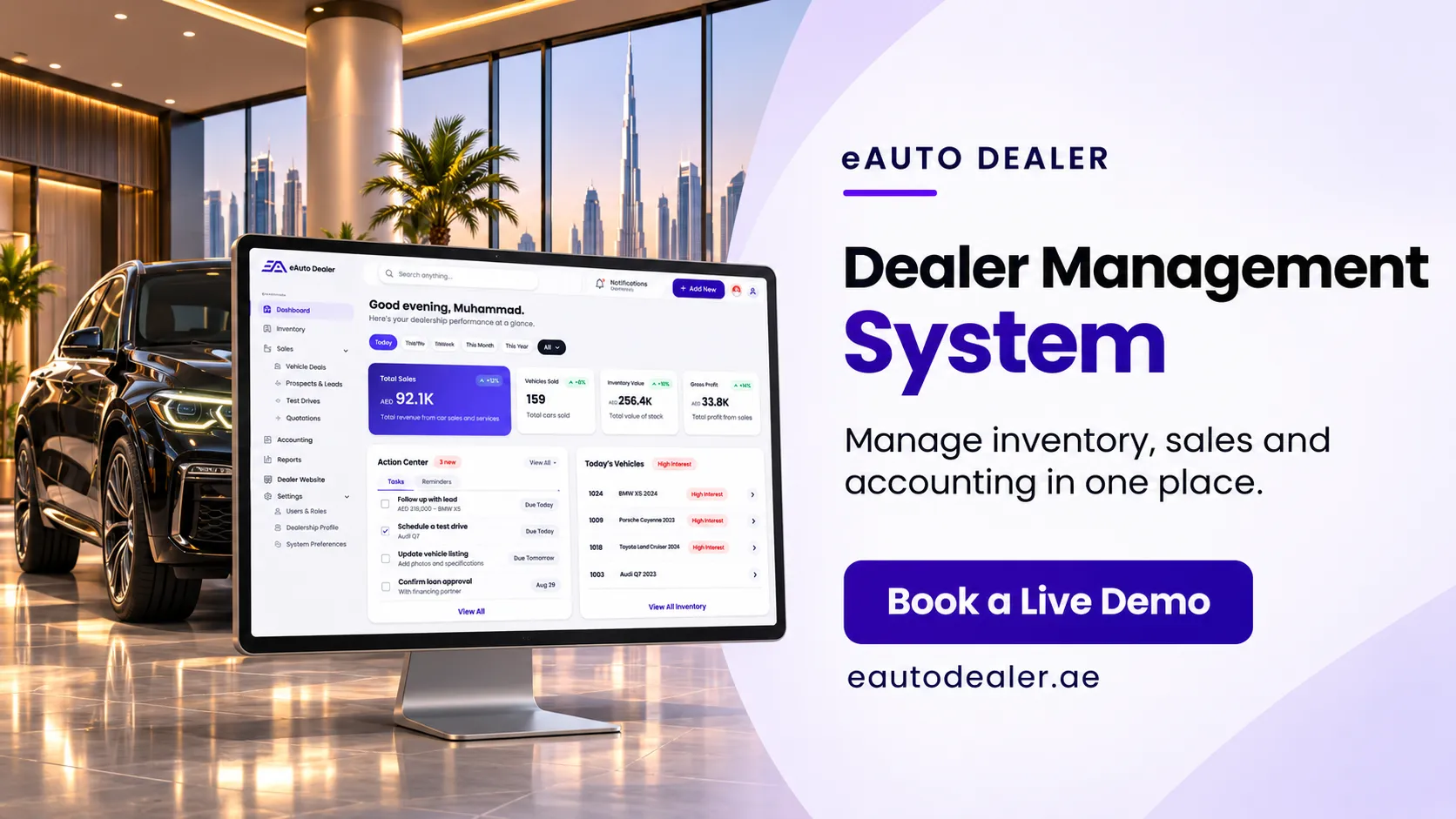

The automotive industry in the UAE is becoming increasingly competitive, with car dealerships managing larger inventories, more customer enquiries, and growing operational requirements. Many dealerships initially rely on Excel spreadsheets to record vehicle details, track sales, manage expenses, and maintain customer information. While spreadsheets can be useful for basic recordkeeping, they become difficult to manage as dealership operations expand.
This is why many businesses are considering a Dealer Management System to bring their daily activities into one organized platform. By connecting sales, inventory, customer management, purchasing, and accounting, dealerships can improve operational visibility and manage their business processes more efficiently.
Why Do UAE Car Dealers Use Excel?
Excel is commonly used by small and growing dealerships because it is familiar, accessible, and suitable for organizing basic business information.
Dealership employees can create spreadsheets to maintain vehicle stock lists, record purchase prices, calculate sales figures, and track customer details.
For a dealership handling a limited number of vehicles, this approach may initially be manageable. However, as the business grows, maintaining multiple spreadsheets can create challenges.
Common uses of Excel in car dealerships include:
- Recording vehicle details and stock numbers.
- Tracking vehicle purchase and selling prices.
- Maintaining customer contact information.
- Recording sales and expenses.
- Monitoring supplier payments.
- Preparing basic business reports.
Although these activities can be handled through spreadsheets, managing everything separately may become complicated when multiple employees and departments are involved.
Limitations of Using Excel for Car Dealership Management
Excel can support basic recordkeeping, but it is not specifically designed to manage the complete workflow of a car dealership.
As operations expand, several limitations can affect daily business activities.
1. Difficulty Managing Large Vehicle Inventories
Car dealerships regularly update vehicle information, including model, year, mileage, purchase price, selling price, and availability.
When inventory is maintained through spreadsheets, employees may need to update several records manually. This increases the possibility of outdated information and duplicate entries.
A dedicated system provides a more structured way to maintain vehicle records and monitor stock movements.
2. Manual Data Entry and Repeated Work
Excel requires employees to enter and update information manually. When the same vehicle or customer details are maintained across multiple spreadsheets, repeated data entry becomes time-consuming.
A connected dealership system can reduce this repetition by allowing relevant information to flow between different business functions.
3. Limited Sales and Customer Tracking
Customer enquiries are an important part of dealership operations. Sales representatives need to track customer requirements, vehicle interests, quotations, and follow-up activities.
Excel can store contact details, but managing the complete customer journey through spreadsheets is less convenient.
A dealership CRM system provides dedicated tools for organizing enquiries, assigning leads, maintaining communication records, and monitoring sales opportunities.
4. Challenges with Multiple Employees
When several employees access and update dealership records, maintaining consistent information becomes important.
Different spreadsheet versions, accidental changes, and unclear responsibilities can create confusion.
A Dealer Management System can provide user permissions and centralized records, helping employees work with more consistent information.
5. Limited Financial Management
Car dealerships handle several financial activities, including vehicle purchases, sales transactions, import expenses, supplier payments, and operating costs.
Managing these records through separate Excel files can make it difficult to maintain a complete financial overview.
Integrated accounting functionality can connect relevant financial activities and provide more organized reporting.
6. Time-Consuming Business Reporting
Dealership owners need to understand vehicle stock levels, sales performance, expenses, and outstanding payments.
Preparing reports manually from multiple spreadsheets can take considerable time. It may also become difficult to identify updated figures when information is maintained separately.
A dealership management platform can provide centralized reports and dashboards based on recorded business activities.
What Is a Dealer Management System?
A Dealer Management System (DMS) is specialized software designed to manage the operational requirements of vehicle dealerships.
It brings important dealership activities into a centralized business environment, helping employees manage information across different departments.
Depending on the software, a DMS may include:
- Vehicle inventory and stock management.
- Customer relationship management.
- Vehicle purchasing and import management.
- Sales and quotation management.
- Accounting and financial records.
- Garage and maintenance operations.
- Reporting and business analytics.
- Showroom and branch management.
Instead of maintaining separate spreadsheets for each activity, dealerships can use an integrated platform to organize their business information and workflows.
Excel vs Dealer Management System: What Is the Difference?
The main difference is that Excel is a general spreadsheet application, while a DMS is developed specifically for dealership operations.
| Business Activity | Excel Spreadsheets | Dealer Management System |
| Vehicle inventory | Manual stock records | Dedicated inventory management |
| Customer information | Separate contact sheets | Centralized customer profiles |
| Lead management | Manual tracking | Structured lead assignment and tracking |
| Sales management | Manual updates | Organized sales workflows |
| Accounting | Spreadsheet calculations | Integrated accounting features |
| Reporting | Manually prepared reports | Business dashboards and reports |
| Employee access | File-based sharing | User permissions and access controls |
| Branch management | Separate files may be required | Centralized branch management, depending on the system |
Excel remains useful for simple calculations and individual tasks. However, a DMS is generally more suitable when a dealership needs connected workflows across multiple departments.
Key Benefits of Switching to a Dealer Management System in the UAE
Moving from spreadsheets to specialized dealership software can help businesses improve several areas of their operations.
1. Centralized Vehicle Inventory Management
A DMS helps dealerships maintain organized vehicle records, including specifications, purchase details, selling prices, and stock availability.
Employees can access relevant inventory information without searching through multiple spreadsheet files.
This is particularly useful for dealerships managing different vehicle categories or larger stock volumes.
2. Better Customer Relationship Management
Customer enquiries, communication history, and follow-up activities can be managed through integrated CRM functionality.
Sales representatives can track potential buyers and maintain organized customer records throughout the sales process.
3. Improved Purchasing and Import Tracking
UAE car dealerships may purchase vehicles locally or import them from international markets.
Managing purchase information, supplier details, shipping expenses, customs-related costs, and vehicle records through disconnected spreadsheets can make tracking more difficult.
A suitable DMS can organize purchasing and import activities alongside inventory information.
4. Connected Accounting and Financial Management
Financial management is another important reason dealerships consider moving beyond Excel.
Integrated accounting functionality can help businesses manage sales transactions, purchase expenses, supplier payments, customer balances, and financial reports.
For UAE dealerships, the system should also support relevant VAT accounting workflows and appropriate financial recordkeeping.
5. Improved Management Visibility
A centralized system can provide dealership owners and managers with a broader view of daily business activities.
Depending on available reporting features, management can review:
This information helps managers understand business performance and identify areas that need attention.
Why UAE Dealerships Need Integrated Software for Growing Operations
The UAE automotive market includes independent used car dealers, new vehicle showrooms, vehicle importers, and multi-branch dealership businesses.
Each business model has different operational requirements, but many need to coordinate inventory, sales, purchasing, customer management, and accounting.
For example, when a dealership purchases an imported vehicle, its team may need to record supplier information, purchase costs, import expenses, vehicle specifications, and stock details. Later, when the vehicle is sold, customer information and financial transactions also become relevant.
Managing these activities through separate spreadsheets can create information gaps between departments.
An integrated DMS helps connect these workflows so that employees can work with more organized business information.
How to Choose the Right Dealer Management System in the UAE
Not every dealership requires the same software features. Before switching from Excel, businesses should evaluate their operational needs and select a system that supports their actual workflows.
Consider the following factors:
- Inventory management: Check whether the software supports vehicle records, stock availability, purchase prices, and selling prices.
- CRM functionality: Evaluate how it manages customer enquiries, lead assignments, and follow-ups.
- Accounting features: Look for financial reporting, expense management, payment tracking, and relevant UAE VAT support.
- Import management: Consider whether the system can organize international vehicle purchases and related costs.
- Multi-branch support: If your business operates from different locations, check whether centralized management and branch-level access are available.
- Reporting capabilities: Review dashboards covering inventory, sales, purchasing, and financial activities.
- Ease of use: Employees should be able to learn the system and perform daily tasks without unnecessary complexity.
- Data security: Understand user permissions, backup arrangements, and how business information is protected.
- Training and support: Check what assistance is available during implementation and regular usage.
Requesting a demonstration can help you understand how the system handles your dealership’s actual activities.
How eAuto Dealer Supports Dealership Management
Moving away from disconnected spreadsheets is not only about changing the way information is stored. It is also about connecting important dealership activities within a more organized business process.
eAuto Dealer provides dealership management capabilities designed around the operational requirements of UAE car dealerships.
Its connected functionality covers areas such as:
- Vehicle inventory and stock control.
- Sales and customer relationship management.
- Vehicle purchasing and import management.
- Accounting and financial management.
- Garage and maintenance operations.
- Showroom and branch management.
- Business reporting and dashboards.
By bringing these activities together, dealerships can manage customer information, vehicle records, sales transactions, and financial activities within a connected environment.
This approach can help businesses reduce their reliance on separate spreadsheets and maintain better visibility across dealership operations.
Common Mistakes to Avoid When Moving from Excel to a DMS
Switching to a dealership management system requires proper planning. Businesses should avoid rushing the process without reviewing their existing records and workflows.
Some common mistakes include:
- Transferring incomplete or duplicate vehicle records.
- Ignoring old customer and sales information.
- Selecting software without checking dealership-specific features.
- Failing to define employee responsibilities.
- Not training employees before implementation.
- Overlooking accounting and inventory integration.
- Choosing a system without considering future business growth.
Reviewing existing spreadsheets, organizing business records, and training employees can make the transition more manageable.
Final Thoughts
Excel can be a practical starting point for maintaining basic dealership records, but managing an expanding car dealership requires more connected processes. As vehicle inventories, customer enquiries, sales activities, and financial transactions increase, separate spreadsheets can become difficult to maintain and monitor.
A Dealer Management System provides a more structured approach by connecting inventory, CRM, purchasing, accounting, and other dealership operations. For UAE car dealers looking to improve business organization and management visibility, moving from Excel to specialized dealership software can be an important step toward supporting future growth.
The right system should match the dealership’s operational requirements, provide useful reporting, and make everyday activities easier for employees and management.
Frequently Asked Questions
1. Why are UAE car dealers moving from Excel to Dealer Management Systems?
Many dealerships are moving from Excel because managing large inventories, customer enquiries, sales records, and financial information through separate spreadsheets can become time-consuming. A DMS connects these activities within one organized platform.
2. Is Excel suitable for managing a car dealership?
Excel can be useful for basic vehicle records, calculations, and small inventory lists. However, dealerships with multiple employees, larger inventories, and complex workflows may benefit from specialized dealership management software.
3. What does a Dealer Management System do?
A Dealer Management System helps manage dealership activities such as vehicle inventory, sales, customer relationships, purchasing, accounting, and reporting through a centralized platform.
4. How does a DMS improve vehicle inventory management?
It helps dealerships maintain vehicle details, monitor stock availability, record purchase and selling prices, and organize inventory information more efficiently.
5. Can a Dealer Management System manage accounting and VAT?
Some DMS platforms include accounting features that support financial transactions, expense tracking, and VAT-related records. Dealerships should verify that their chosen solution supports applicable UAE accounting and VAT requirements.
6. Is a Dealer Management System suitable for small used car dealerships?
Yes. A suitable DMS can help small used car dealerships organize vehicle stock, customer enquiries, sales records, and financial activities. The selected system should match the dealership’s size and requirements.
7. Can multiple employees use a Dealer Management System?
Yes. Many DMS platforms support multiple users with different access permissions, allowing employees to manage their assigned responsibilities while management maintains oversight.
8. How long does it take to move from Excel to a DMS?
Implementation time depends on the dealership’s data volume, number of users, software configuration, and training requirements. Preparing and cleaning existing records can help make the transition smoother.
9. What should car dealers consider before choosing a DMS in the UAE?
Dealers should evaluate inventory management, CRM, accounting, purchasing and import features, reporting, multi-branch support, data security, ease of use, and technical assistance.
10. Can a Dealer Management System replace multiple Excel spreadsheets?
A DMS can replace many spreadsheets used for routine dealership activities by providing centralized records and connected workflows. Excel can still be useful for individual calculations and additional analysis.


Join the conversation