
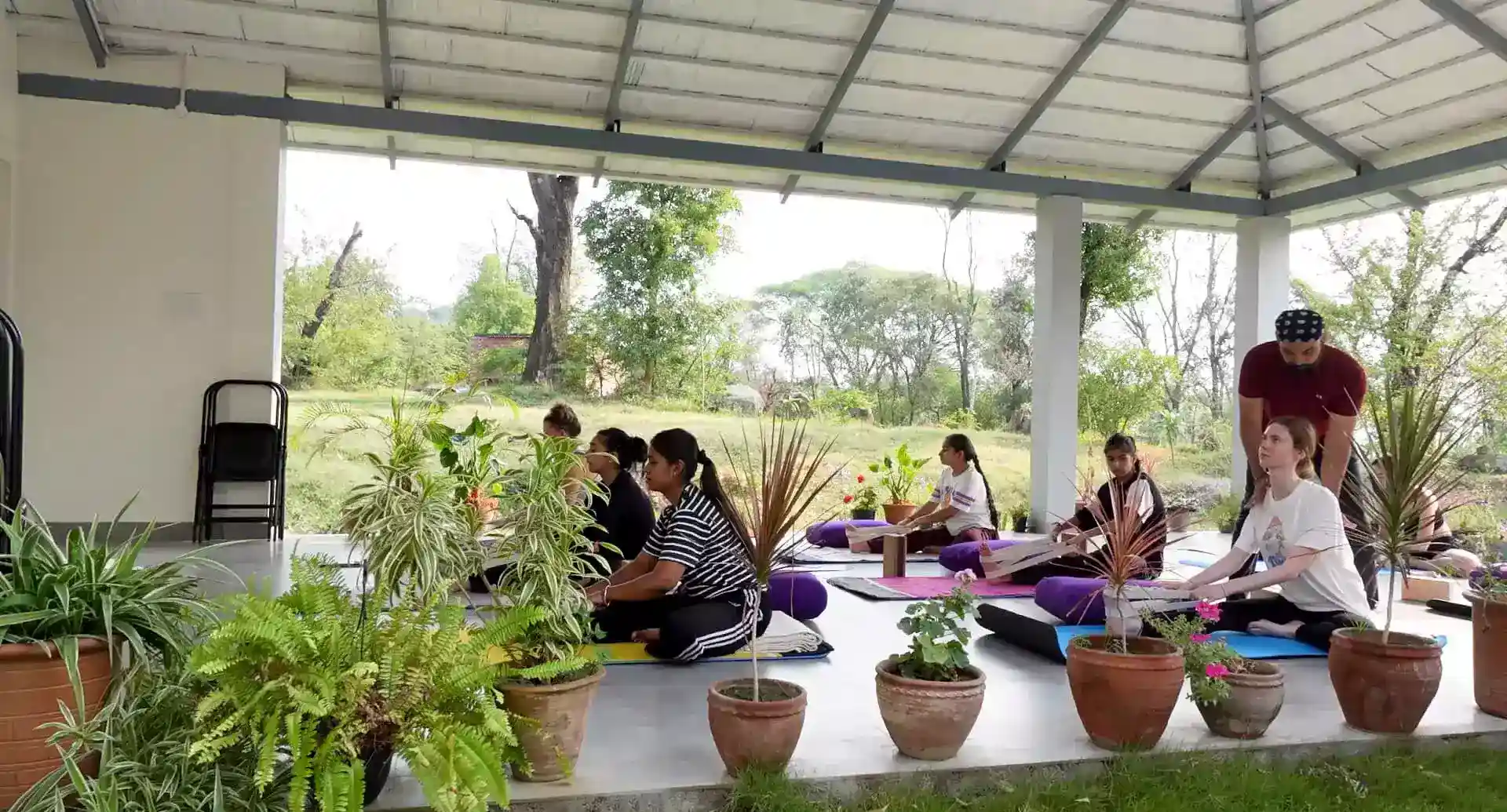

Teaching yoga often appears to be an exercise in movement instruction. A teacher demonstrates a posture, explains where to place the feet or hands, guides the breath, and then moves the class toward the next asana.
But some of the most meaningful moments in a yoga class may happen when the teacher stops speaking.
Silence can create space for students to observe their breathing, notice physical sensations, settle their attention, and experience stillness without constant external direction. Yet creating useful silence is not as simple as saying nothing.
For a yoga teacher, teaching stillness in yoga requires awareness, timing, confidence, and an understanding of what students may need at different points in a class.
Why Silence Can Feel Uncomfortable
A new teacher may feel pressure to keep talking.
There can be a natural concern that students will think something has been forgotten if the room becomes quiet. The teacher may begin filling every pause with another instruction, explanation, or reminder.
This can unintentionally prevent students from experiencing the very stillness that yoga practice is designed to explore.
Silence can initially feel uncomfortable because it removes external stimulation. When a teacher stops giving instructions, students are given more responsibility for observing their own experience.
That experience can be very different from simply following a sequence of verbal commands.
For teachers, learning to tolerate that silence is itself a teaching skill.
Silence Is Not the Same as Doing Nothing
Effective silence in a yoga class is intentional.
A teacher might provide instructions for entering a posture and then allow several breaths without speaking.
During those moments, the teacher can observe the room rather than immediately introducing another cue.
Students may notice their breathing, muscle tension, balance, thoughts, or emotional responses.
The teacher is still present even though they are not speaking.
This is an important distinction between silence and disengagement.
A teacher who becomes completely disconnected from the class is not necessarily creating a meaningful experience. Yoga teacher presence involves remaining attentive while allowing students enough space to experience the practice independently.
Holding Space for Students
The phrase “holding space” is often used in yoga and meditation teaching, but it can be difficult to define.
In practical terms, it can mean creating an environment where students have permission to slow down, observe themselves, and experience a period without pressure to perform.
The teacher establishes the framework.
The students then experience what happens within it.
For example, after guiding students into a comfortable seated position, a teacher might give a simple instruction about the breath and then remain quiet for several minutes.
There is no need to repeatedly explain breathing.
The silence itself becomes part of the practice.
When Silence Becomes a Teaching Tool
Silence can be especially useful during practices involving stillness, meditation, restorative postures, or longer holds.
Suppose students have settled into a comfortable position.
A teacher might initially explain:
“Allow the body to become still. Notice the natural rhythm of your breathing. There is nothing you need to force.”
After that, continuing to speak every few seconds could distract from the experience.
Instead, a period of quiet allows students to explore the instruction.
This demonstrates why silence in a yoga class should not necessarily be viewed as an absence of teaching.
Sometimes the instruction has already been given.
The next step is allowing students to experience it.
The Difference Between Silence and Awkward Pauses
Not every quiet moment is automatically beneficial.
There is a difference between intentional silence and a pause caused by uncertainty.
Intentional silence has a purpose.
A teacher knows why the room is quiet and remains attentive to what is happening.
An awkward pause may occur because the teacher has lost track of the sequence, forgotten the next instruction, or become unsure about what to say.
Students can often sense this difference.
This is one reason preparation matters. The more comfortable a teacher becomes with sequencing, timing, observation, and classroom management, the easier it becomes to use silence confidently.
Pacing Changes the Experience of a Class
Teaching is not only about what a teacher says. It is also about when they say it.
A class with constant instructions can feel very different from one with carefully planned pauses.
For example, during a dynamic sequence, concise cues may be necessary to help students move safely from one position to another.
During a slower practice, the same amount of talking may become unnecessary.
Good pacing allows instruction and experience to complement each other.
Teachers can think of their voice as one element of the class environment rather than the entire class itself.
Silence Can Encourage Self-Awareness
One of the benefits of reducing unnecessary verbal instruction is that students may become more attentive to their own internal experience.
If a teacher continuously tells students what they should be feeling, students may focus on matching the teacher’s description.
If the teacher instead provides a simple framework and allows quiet observation, students can discover their own sensations.
For example:
“Notice where you feel the breath moving most naturally.”
This is different from telling students exactly what they are supposed to feel.
The first approach encourages observation.
The second can unintentionally create expectations.
For a practice centered on awareness, that distinction matters.
Silence Requires Trust
A teacher must also trust the students.
If students have been given clear instructions and appropriate options, they can often manage a period of quiet without continuous supervision.
The teacher’s responsibility is to remain available and attentive.
This can be especially valuable in meditation or longer-held postures.
Rather than constantly interrupting the experience with new information, the teacher can allow students to remain with the practice.
Over time, students may become more comfortable with stillness and less dependent on external instruction.
Knowing When to Speak Again
Silence is useful, but it should not become a rigid rule.
There are moments when a teacher needs to speak.
A student may need a modification. The class may need to transition. A posture may require clarification. The teacher may need to remind students to release a position or return attention to the breath.
The skill is knowing when additional information is useful.
One practical question for teachers is:
“Does the next sentence help the student’s experience, or am I speaking because I feel uncomfortable with the silence?”
That simple question can change the way a teacher approaches pauses.
Silence and the Teacher’s Own Presence
Students often respond not only to instructions but also to the atmosphere created by the teacher.
A calm teacher who is comfortable with pauses can help establish a calmer environment.
This does not mean a teacher must have a particular personality. Different teachers can create different classroom atmospheres.
What matters is authenticity and attentiveness.
A teacher does not need to imitate a stereotypically quiet or serious yoga instructor.
Instead, they can develop a teaching style in which speech, silence, demonstration, and observation are used intentionally.
Learning to Teach Stillness
Teaching movement can feel easier to structure because there is always something visible to explain.
Stillness is less visible.
A teacher cannot always see what is happening inside a student’s mind or body.
This makes teaching stillness a subtle skill.
It requires understanding how to introduce a practice, establish expectations, provide appropriate guidance, and then step back enough for students to experience it.
Structured Yoga Teacher Training India programs can introduce practitioners to teaching methodology, sequencing, meditation, classroom communication, and other skills that extend beyond personal asana practice. These areas can help future teachers understand how different teaching methods work together rather than relying exclusively on continuous verbal instruction.
Silence Can Be Part of the Sequence

A useful way to think about silence is to treat it as part of the class design.
A sequence may contain:
Instruction → movement → observation → silence → transition.
In this structure, silence is not an accidental gap.
It is deliberately included.
For example, after guiding students into a seated meditation, a teacher might offer a short introduction and then allow several minutes of quiet. Near the end, the teacher can gradually bring students back by inviting them to notice the room, deepen the breath, and move slowly.
The silence becomes a bridge between instruction and direct experience.
The Teacher Does Not Need to Fill Every Moment
Perhaps the most important lesson is that teaching does not require constant talking.
A skilled teacher knows that students sometimes need information, while at other times they need space.
The challenge is recognizing the difference.
Poses can be demonstrated.
Alignment can be explained.
Sequences can be planned.
But stillness has to be experienced.
That is why teaching silence can be harder than teaching poses. A posture gives the teacher something visible to work with. Silence asks the teacher to trust the process, remain present, and resist the temptation to control every moment.
When used thoughtfully, silence can become one of the most powerful elements of a yoga class—not because the teacher has stopped teaching, but because the teacher understands when teaching requires stepping back.



Join the conversation