
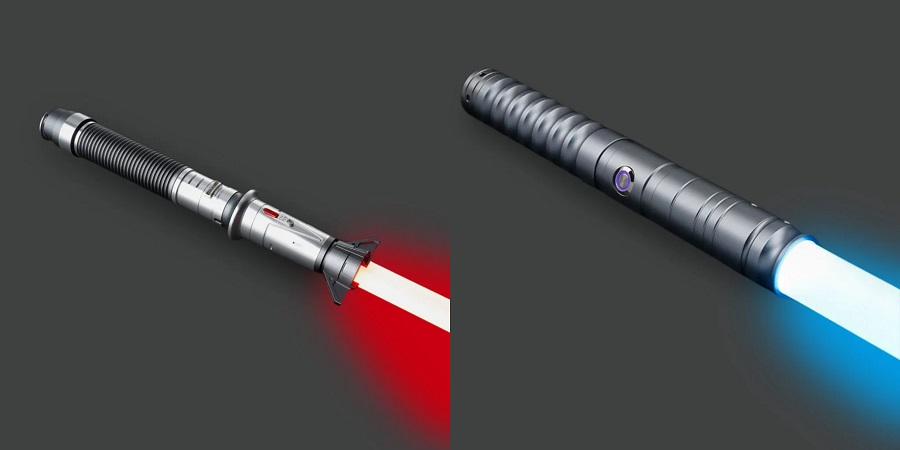

On a product page, plenty of sabers look nearly identical. Switch them on, and they still look pretty similar. It’s only when one gets swung into another that the differences show up — usually as a crack running down the blade.
Buying a combat-ready lightsaber means you’re paying for how it’s built, not how it looks sitting on a shelf, and getting that distinction straight early saves both money and disappointment down the line.
Blade Thickness Does the Heavy Lifting
Display blades stay thin because thin looks better lit. Thicker polycarbonate diffuses light slightly more, though it survives impacts that would split a display blade on the first proper clash.
Anyone shopping for combat ready light sabers should treat blade specification as the first filter, not an afterthought. Everything else matters less if the blade fails.
Where a Neopixel Combat Lightsaber Complicates Things
Pixel blades house an LED strip along their full length. That produces genuine ignition travel, blade-length clash effects, and colour shifts a single emitter LED simply cannot replicate.
It also means electronics are living inside the part getting hit. A neopixel combat lightsaber therefore needs proper internal protection — cushioning at the base, a robust blade tube, and a hilt built to absorb shock rather than transmit it.
Done well, the effect is worth it. Done cheaply, the strip fails after a handful of duels.
Hilt Construction Matters as Much
Shock travels down the hilt into whatever sits inside. Loose internals rattle, connections work freely, and a saber that felt solid in month one develops faults by month four.
Combat builds use heavier construction for that reason. The weight increase is real and noticeable, which some duelists welcome, and others take time adjusting to.
Choosing Between Cores
Xenopixel V2 and Xeno3 cores sit at different price points, with Proffie offering deeper customisation for anyone willing to tinker with sound fonts and settings. Basic RGB costs the least and allows colour switching, though it never matches pixel ignition.
BM Lightsabers sells cores separately as well as installed, including thin neck and crossguard variants, which suit anyone building from an empty hilt rather than buying a complete one. The shop started with a single saber back in 2019 before opening to the public in 2021, and its FAQ is refreshingly direct about what these products actually do.
Practical Points before Ordering Combat Ready Light Sabers
The combat range on the homepage spans roughly £94 to £430, depending on the hilt and core. Staff and double-bladed builds climb considerably higher, with Darth Maul configurations reaching into the £700s.
That spread makes sense once construction gets factored in. A combat ready lightsaber carries more material, better protection, and sturdier internals than a lightweight display saber at half the price.
Practical Points before Ordering
Check whether the blade is included or sold separately. Spare blades are worth having if dueling happens regularly.
Battery life drops with pixel blades, particularly on double-bladed builds where two strips draw power simultaneously. Charging arrangements and spare cells belong in the calculation.
Sound fonts affect the experience more than most buyers expect. Hum, clash, and swing effects on the premium cores layer properly rather than triggering flatly.
Light Dueling Versus Heavy Contact
Worth being honest about intent. Choreographed sparring at moderate speed asks far less of a saber than full-force contact.
The FAQ describes these builds as suited to light dueling and cosplay, which is a fair description. Anyone planning genuinely aggressive combat should expect to replace blades periodically regardless of quality.
Conclusion
Decide how hard the saber will actually get used, then buy to that standard rather than to the photograph. Blades are consumable, hilts should not be, and the gap between a shelf piece and a sparring saber shows up the moment two of them meet.



Join the conversation