

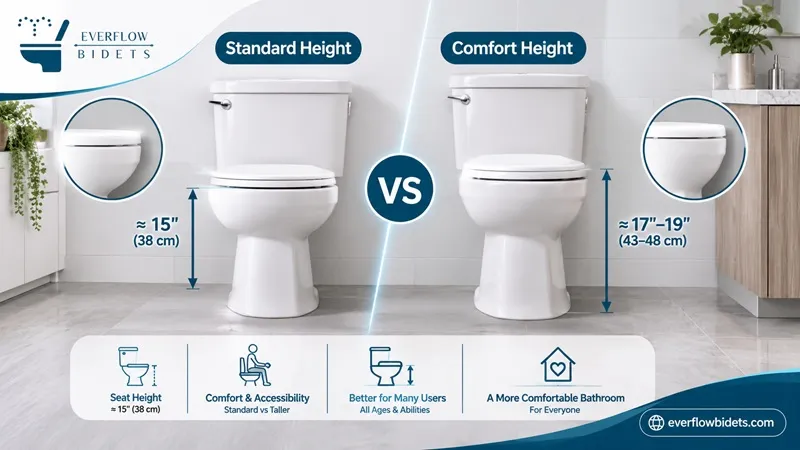

Toilet height is an important factor in bathroom design because it directly influences seating posture, accessibility, and everyday usability. Although standard-height and comfort-height toilets perform the same basic function, their dimensions create noticeable differences in how users sit, stand, and transfer on and off the fixture. These differences become particularly relevant when selecting bathroom fixtures for households with varying mobility requirements.
Modern bathroom planning also involves considering additional features such as electronic bidet seats, heated seating, and warm water cleansing. A comfort height bidet combines an ergonomically elevated toilet configuration with bidet functionality, offering an approach that addresses both seating comfort and personal hygiene. Understanding the technical differences between toilet heights helps buyers select a fixture that suits their physical requirements and bathroom layout.
Understanding Standard Height Toilets
Standard-height toilets generally have a finished seat height of approximately 15 to 16 inches from the floor. Measurements should account for the installed seat because manufacturers may specify bowl height separately from the complete seating height.
This configuration has been widely used in residential bathrooms and remains suitable for many users, particularly those who prefer a lower seating position.
Key Characteristics of Standard Height Toilets
Lower seating position: The reduced height allows users to sit closer to the floor.
Traditional dimensions: Standard-height models are common in conventional residential bathroom layouts.
Accessibility considerations: Some individuals with limited mobility may find standing up from a lower seat more physically demanding.
Compatibility: Many electronic bidet seats are available for standard-height toilets, provided the bowl shape and mounting dimensions are compatible.
A standard-height toilet may also accommodate a toilet warm water bidet seat, allowing users to introduce electronic cleansing functionality without replacing the complete toilet.
Understanding Comfort Height Toilets
Comfort-height toilets feature a taller seating position than conventional standard-height models. Their seat height is generally around 17 to 19 inches from the finished floor, although exact dimensions vary by manufacturer and model.
This elevated configuration is designed to make sitting down and standing up easier for many adults. It is particularly relevant in bathrooms intended to support aging in place or accommodate individuals who experience difficulty with lower seating positions.
Technical Characteristics of Comfort Height Toilets
Several design considerations distinguish comfort-height models:
Elevated bowl geometry: The bowl is engineered to provide a higher finished seating position.
Improved transfer positioning: The additional height may reduce the distance users need to lower themselves when sitting.
Ergonomic considerations: A higher seat may provide a more manageable position for individuals with certain mobility limitations.
Fixture dimensions: The overall height must be evaluated alongside bathroom clearances, seat thickness, and user requirements.
A comfort height bidet can be particularly useful when ergonomic seating and electronic washing functions are both priorities. However, the complete installed height should always be checked before purchasing.
How Toilet Height Influences Posture and Accessibility?
Toilet height affects the angle of the knees and hips during sitting. On a lower toilet, users generally experience greater knee flexion. On a taller toilet, the knees remain at a relatively higher position compared with the hips.
However, a taller toilet is not automatically more ergonomic for everyone. Some users may find a higher seat less comfortable because their feet do not rest firmly on the floor.
Important considerations include:
Knee and hip positioning: Seat height changes the relative angles of the lower body.
Foot support: Proper foot contact with the floor contributes to stability while seated.
Transfer assistance: Elevated seating may reduce the physical effort required by certain users when standing.
Individual proportions: Height, leg length, joint mobility, and posture all influence the appropriate seating position.
For individuals planning an accessible bathroom, a comfort height bidet should be selected according to actual user needs rather than relying on height specifications alone.
Integrating Electronic Bidet Seats with Different Toilet Heights
An electronic bidet seat introduces additional functionality, including water-based cleansing, adjustable spray pressure, temperature control, and heated seating. However, compatibility depends on more than the toilet’s height.
Important Compatibility Factors
Before installing a bidet seat, evaluate the following:
Bowl shape: Confirm whether the toilet uses a round, elongated, or another compatible bowl configuration.
Mounting dimensions: Check bolt spacing, mounting surface dimensions, and available clearance.
Seat height: Account for the additional height introduced by the electronic seat.
Water connection: Verify the required water supply connection and installation clearances.
Electrical access: Confirm the availability of a suitable electrical outlet and compliance with manufacturer installation requirements.
A toilet warm water bidet seat may be compatible with either standard-height or comfort-height toilets, provided the specific toilet and seat dimensions meet the manufacturer’s requirements.
The Role of Warm Water Technology in Bidet Comfort
Water temperature is another important consideration when evaluating modern bathroom fixtures. Electronic bidet seats use different heating configurations to provide warm water during cleansing.
Tank-Based Water Heating
Tank-based systems store heated water in an internal reservoir. The available warm water depends on the tank’s capacity and heating recovery time. Once the stored water is depleted, the system may require time to reheat.
Instantaneous Water Heating
Instantaneous heating systems warm water as it passes through an internal heating element. This configuration can provide a more continuous supply of warm water within the unit’s rated heating capacity and operating conditions.
A toilet warm water bidet seat may use either technology, depending on its design. Buyers should compare water temperature settings, heating capacity, electrical requirements, and expected performance before selecting a model.
Choosing the Right Toilet Configuration for Your Bathroom
Selecting between standard-height and comfort-height toilets requires evaluating physical requirements, installation conditions, and long-term usability.
Consider these factors before making a decision:
User height and proportions: Evaluate whether the seating position allows comfortable sitting and standing.
Mobility requirements: Consider whether an elevated seat would make bathroom transfers easier.
Foot positioning: Ensure users can maintain stable foot contact with the floor.
Bidet compatibility: Check whether the selected electronic seat fits the toilet’s dimensions.
Installation clearances: Account for mounting space, electrical access, and plumbing connections.
Long-term usability: Choose a configuration that supports everyday comfort without compromising stability.
Combining an appropriately sized toilet with a compatible comfort height bidet can create a practical bathroom arrangement that addresses seating ergonomics and personal hygiene.
Conclusion
Standard-height and comfort-height toilets differ primarily in their finished seating dimensions, but those differences have important implications for posture, accessibility, and everyday comfort. Standard-height models remain suitable for many users, while elevated configurations may provide easier sitting and standing transitions for individuals with certain mobility requirements.
When incorporating electronic washing technology, buyers should also evaluate seat compatibility, heating systems, electrical requirements, and installation dimensions. Whether selecting a comfort height bidet or pairing an existing toilet with a toilet warm water bidet seat, the right choice depends on individual ergonomics and technical compatibility. A carefully selected configuration provides a more functional bathroom environment while supporting reliable everyday use.



Join the conversation