

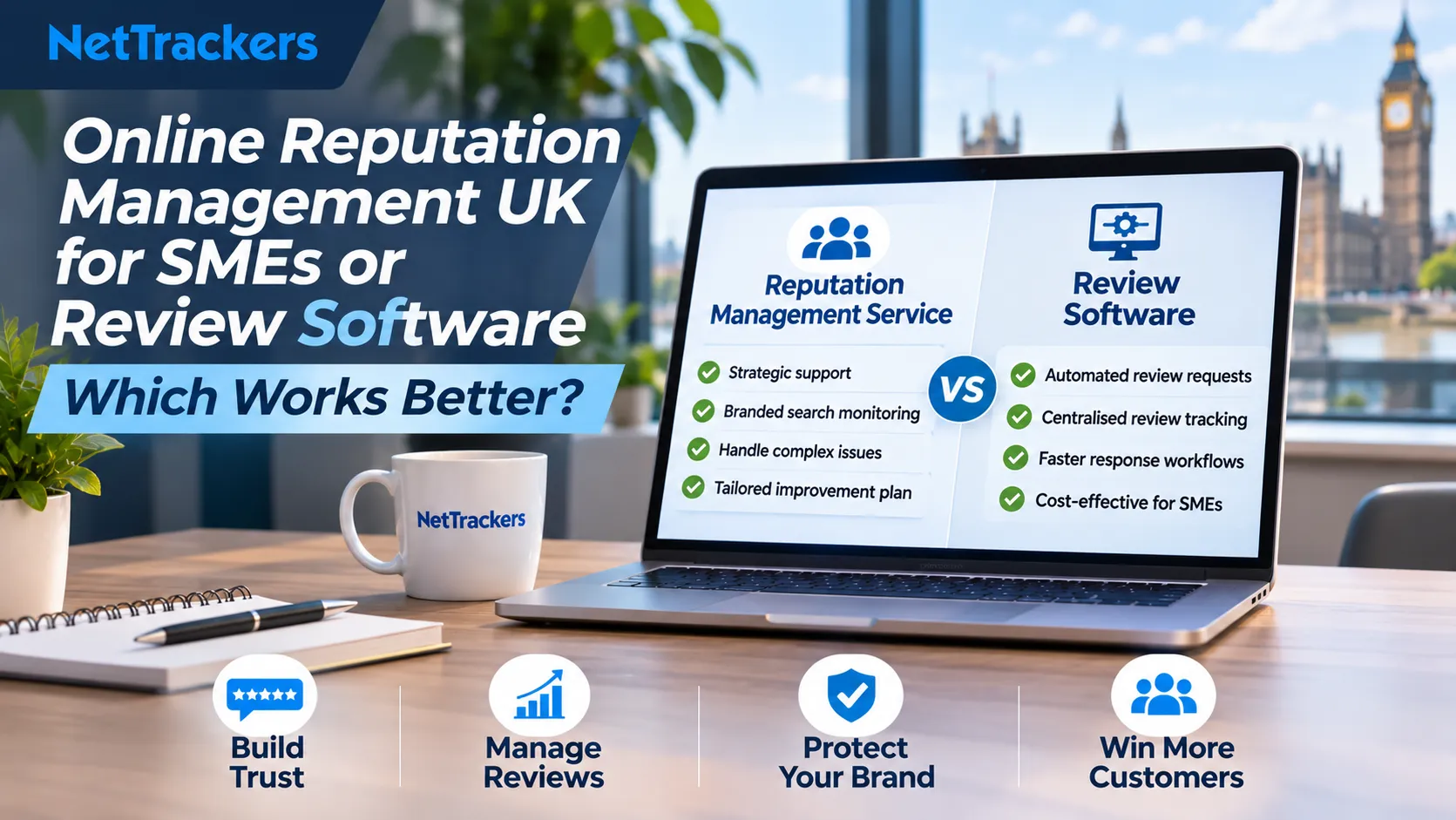

Choosing between online reputation management UK services and review management software is an important decision for small and medium-sized enterprises (SMEs). Both approaches can help businesses monitor customer feedback, respond to reviews and understand how their brands appear online. However, software primarily supports repeatable monitoring and administrative tasks, while a managed reputation service can address wider problems involving search results, brand credibility and damaging content. The right choice depends on whether a company needs a tool to manage everyday reviews or specialist assistance with a broader reputation problem. Understanding this distinction can prevent businesses from paying for capabilities they do not need or expecting software to solve problems beyond its scope.
For UK businesses, online reviews can directly influence how customers evaluate products, services and local providers. Potential customers frequently examine Google ratings, independent review platforms and branded search results before making an enquiry. Negative feedback is not necessarily evidence of poor business practices, but repeated complaints or unanswered concerns can affect trust. Businesses must also comply with UK consumer protection requirements and relevant platform policies when collecting, displaying and responding to reviews. This guide compares the two approaches through cost, capabilities, compliance, staff workload and measurable business outcomes.
Online Reputation Management UK vs Review Software — Understanding the Difference
Review management software helps businesses organise tasks associated with customer feedback. Depending on the product, this may include review notifications, request automation, response workflows, sentiment analysis and reporting across supported platforms. A managed reputation service can include these activities while also examining branded search results, media mentions, misleading content and wider reputation risks. Neither approach guarantees positive reviews or the removal of legitimate criticism. The key question is whether the business needs routine review administration or strategic intervention involving several reputation channels.
What Review Management Software Does
Review software can centralise feedback and reduce the amount of time employees spend checking different platforms. Some products offer automated review invitations, response suggestions and notifications when new ratings appear. These features can be particularly helpful for businesses receiving regular feedback across several locations. However, automation still requires human oversight to ensure messages are accurate, appropriate and compliant. The software cannot independently resolve the underlying customer service problems that cause complaints.
What Managed Reputation Services Provide
Managed services involve professionals who monitor reputation signals and recommend or implement agreed responses. Their work may extend to review strategy, branded search monitoring, content development, platform reporting and response planning. More complex engagements can address damaging search results or coordinate communications during a reputation incident. However, providers cannot legitimately guarantee removal of truthful third-party material or control Google’s rankings. The value of professional support depends on the scope, expertise and quality of execution.
1. When Review Software Is Enough for an SME
Review management software is often a practical starting point for businesses with a stable reputation and predictable customer feedback. A local retailer, restaurant or service company may primarily need to notice new reviews and respond consistently. If employees can handle customer concerns and the business has no significant branded search problems, specialist services may be unnecessary. Software can support these tasks at a manageable operational cost. The company should still assign responsibility for reviewing notifications and handling sensitive complaints.
Businesses With Regular Customer Feedback
Companies receiving reviews every week may benefit from a central dashboard and standardised response procedures. Automated notifications can reduce delays and help staff identify dissatisfied customers promptly. Management teams can examine recurring topics without manually checking every review platform. However, software-generated summaries may misinterpret context or overlook important details. Significant complaints should always receive a careful human review.
Multi-Location Businesses
Businesses operating several eligible locations may need to coordinate feedback across individual Google Business Profiles and other relevant platforms. Software can help staff identify which branches require attention and whether service issues are recurring. Centralised reporting may also make it easier to compare response times and customer feedback trends. Each location should retain accurate information and follow applicable review policies. Automation should support genuine local service improvements rather than artificially influence ratings.
2. When a Managed Reputation Service Is More Appropriate
Some reputation challenges extend well beyond the review platforms supported by ordinary software. A business may face prominent negative search results, misleading online allegations, impersonation or a damaging public dispute. In these situations, automated review requests do little to address the actual problem. The organisation may need a coordinated investigation involving search visibility, communications and appropriate platform procedures. A specialist service becomes more relevant when judgement and several different capabilities are required.
Negative Branded Search Results
When prospective customers search for a company’s name, they may encounter news articles, directory listings, reviews and third-party commentary. The business cannot directly control every result appearing in that search. A reputation specialist can assess the visibility, accuracy and relevance of those results and recommend appropriate actions. These may include correcting inaccurate information, requesting removal of policy-violating material or improving legitimate owned content. Suppression outcomes remain uncertain and should never be promised as guaranteed.
Reputation Problems Across Several Platforms
A business may discover that customer complaints are appearing across social media, review websites and branded search results simultaneously. Handling each channel independently can produce inconsistent messages or overlook the underlying cause. Managed support may help organise monitoring, escalation procedures and communications responsibilities. However, customer service or operational teams must still investigate and resolve genuine service failures. Reputation management is not a substitute for improving the experience customers actually receive.
3. Compare the Costs Without Ignoring Staff Time
Price comparisons can be misleading when businesses examine only software subscription fees and agency retainers. Software may be less expensive to purchase but still require staff time for monitoring, responses, training and customer issue resolution. A managed service generally costs more because it includes human analysis and delivery responsibilities. However, that additional expense is not justified if the business needs only basic review notifications. The appropriate comparison is the total cost of completing the required work.
Typical Software Expenses
Review software is commonly priced through monthly subscriptions, although charges vary according to locations, users, supported platforms and features. Some providers also charge for messaging, integrations or advanced reporting. SMEs should confirm whether a package includes the actual review sources they need to monitor. They should also assess data access and cancellation terms before adopting a platform. A low introductory price can be misleading when necessary capabilities require additional subscriptions.
Typical Managed Service Expenses
NetTrackers’ September 2026 UK reputation management cost guide provides indicative ranges of £200–£600 per month for basic review monitoring and responses. It places broader monitoring and review generation services around £500–£1,500 per month, with more comprehensive reputation programmes potentially costing £1,000–£3,000 or more. These are published market estimates rather than a fixed NetTrackers quotation or guaranteed industry rates. The actual fee depends on the complexity of the work, the number of relevant platforms and the agreed responsibilities. Businesses should request a written proposal before comparing providers.
4. UK Review Regulations Are a Deciding Factor
The UK’s Digital Markets, Competition and Consumers Act 2024 introduced specific rules addressing fake reviews and concealed incentivised feedback. The relevant consumer protection provisions took effect on 6 April 2025. The Competition and Markets Authority’s guidance explains that businesses must not engage in prohibited review practices and that those publishing reviews may have additional responsibilities. These requirements apply regardless of whether an SME uses software or hires an agency. Outsourcing review activity does not remove the need to ensure that the business acts lawfully.
Avoid Fake and Misleading Reviews
Businesses must not commission fake customer experiences or use misleading review information to influence prospective customers. The rules also address concealed incentivised reviews and obligations affecting businesses that publish consumer reviews. Review software should not be used to manufacture positive feedback or conceal genuine negative experiences. Companies should understand how their chosen platform collects and presents customer information. Where legal obligations are unclear, specialist advice may be appropriate.
Follow Google Review Policies
Google prohibits incentivised reviews and attempts to manipulate ratings through selective solicitation of positive feedback. Businesses can request genuine feedback without offering rewards or attempting to control what customers say. Staff should not discourage dissatisfied customers from leaving honest reviews. Automated invitation tools must therefore be configured carefully to avoid inappropriate filtering or incentives. The same standards apply when an outside provider manages the process.
5. Can Software Handle Negative Reviews?
Review platforms and management tools can make it easier to identify and respond to negative feedback. Some tools also provide suggested responses, templates and internal escalation features. However, responding publicly requires an understanding of the customer’s experience and the business’s obligations. An automated message can make a difficult situation worse when it appears dismissive or inaccurate. The most useful technology supports consistent communication while leaving sensitive decisions to responsible staff.
Respond Without Revealing Private Information
Public responses should acknowledge relevant concerns without discussing confidential customer information. This is particularly important for businesses handling medical, financial, legal or other sensitive services. A company can invite the reviewer to continue the conversation through an appropriate private channel when necessary. Responses should not speculate about the reviewer’s identity or accuse them of dishonesty without evidence. The objective is to address concerns professionally and demonstrate responsible service standards.
Know When to Escalate
Complaints involving safety, discrimination, allegations of misconduct or significant financial disputes may require more than a routine review response. The business should establish who investigates these issues and who is authorised to make public statements. Software can flag the review and assign a task, but it cannot determine the correct legal or operational response independently. In serious cases, management may need support from legal or communications professionals. Appropriate escalation protects both the customer and the business.
6. What About Fake or Malicious Reviews?
Businesses sometimes encounter reviews that appear unrelated to genuine customer experiences. However, an unfamiliar reviewer or an inaccurate complaint is not automatically proof of deliberate manipulation. Platform reporting mechanisms generally require relevant evidence and an explanation of how content violates policy. A managed service may help assemble that evidence and follow the appropriate procedures. Neither an agency nor a software provider can legitimately guarantee that a platform will remove disputed content.
Use Official Reporting Channels
Google allows businesses to report reviews that violate its policies. These may include fake engagement, conflicts of interest or other prohibited content, depending on the circumstances. Reviews should not be reported merely because they are critical or contain an unfavourable opinion. Businesses should document the specific concern and preserve relevant records where appropriate. Removal decisions ultimately remain with the platform or other competent authority.
7. How to Measure Reputation Management Results
An increasing average rating can be encouraging, but it does not explain the complete commercial impact of reputation management. Review volume, recent feedback, customer complaint patterns and branded search visibility provide additional context. Businesses should also examine whether reputation improvements coincide with better-quality enquiries or stronger conversion performance. These relationships may be relevant without proving that reputation activity caused every increase in sales. A useful report distinguishes operational performance from measurable commercial outcomes.
Metrics Worth Tracking
Review response time: How quickly relevant customer feedback receives an appropriate response.
Review volume and recency: Whether genuine customer feedback remains current.
Ratings and sentiment: Changes in feedback patterns without attempting to suppress negative experiences.
Recurring complaints: Service issues that appear repeatedly across customer interactions.
Branded search results: Relevant information visible when customers search for the business.
Customer enquiries: Changes in qualified enquiries, calls and contact-form submissions.
Operational improvements: Confirmed actions taken to resolve common customer complaints.
These indicators should be assessed together rather than reduced to a single reputation score. A business can improve response times while continuing to experience underlying service problems. Conversely, an increase in honest reviews may temporarily reduce an average rating while providing more representative customer information. Reporting should explain such changes without treating every lower rating as failure. The strongest outcome is a more trustworthy customer experience supported by accurate public information.
8. Choosing Online Reputation Management UK Services or Software
The choice depends largely on the number of reputation channels, the complexity of existing problems and the business’s internal capacity. Software is usually appropriate when the principal requirement is monitoring, collecting genuine reviews and maintaining consistent responses. A managed service becomes more relevant when the business needs specialist investigation, search-result strategy or structured support during a reputational challenge. For some SMEs, combining software with limited professional oversight provides a practical middle ground. The correct solution should match a clearly identified problem rather than an assumed need for the most comprehensive package.
Choose Software When
A review platform may be sufficient if the business receives regular customer feedback and has staff available to respond. It is also suitable when the main objective is organising reviews across supported platforms and locations. The business should have clear policies for customer communication and appropriate escalation. Automation can reduce repetitive administration without replacing accountability. Cost and ease of use should be considered alongside compliance and integration requirements.
Choose Managed Support When
Professional assistance may be justified when negative branded search results or complex reputation concerns affect customer confidence. It may also help businesses without sufficient internal expertise to coordinate monitoring, content strategy and sensitive communications. Providers should explain which actions they can undertake and where outcomes depend on third-party decisions. A contract should define reporting, responsibilities, exclusions and realistic expectations. Avoid agencies promising guaranteed review removal or fabricated positive ratings.
Consider a Hybrid Approach
A hybrid model can combine review software with periodic strategic support. Internal staff may manage routine responses while an external specialist reviews search visibility, emerging reputation risks and difficult cases. This arrangement can prevent SMEs from paying for full-service management when their needs are relatively limited. However, responsibilities must remain clear so important complaints are not overlooked. The model works best when both the software and specialist support serve defined business objectives.
9. How NetTrackers Approaches Reputation Management
NetTrackers provides reputation management services covering review management, branded search monitoring, damaging content concerns and the development of a stronger online presence. Its offering goes beyond ordinary review notifications by considering what prospective customers encounter when they search for a business online. The company also provides a confidential initial reputation assessment covering relevant search results, ratings and brand mentions. The appropriate response depends on the nature of the reputation issue and the opportunities available through legitimate channels. No ethical provider should promise complete control over independent search results or third-party commentary.
Start With a Reputation Assessment
Before purchasing software or engaging an agency, examine how the business currently appears across the platforms customers actually use. Identify the most important issues and separate operational review-management tasks from wider search reputation concerns. Consider whether internal employees can manage the work effectively with suitable tools. Where specialist assistance is needed, request clear recommendations and an explanation of expected limitations. An assessment can help prevent unnecessary expenditure while identifying risks that require attention.
Request a Confidential Review
NetTrackers offers an initial reputation audit for businesses seeking to understand their branded search presence and review performance. This provides a starting point for identifying potential concerns and discussing appropriate next steps. Businesses can request information about the scope of services and the responsibilities included in any proposal. The goal is to establish whether software, specialist support or a combined arrangement would be appropriate. Explore NetTrackers’ reputation management services or contact the team.
Frequently Asked Questions
Is Review Management Software Enough for a Small Business?
It can be sufficient when the business mainly needs review notifications, organised responses and routine monitoring. Staff must still investigate complaints and ensure that review requests comply with relevant policies. Software does not independently repair underlying service problems or control third-party search results. A small business facing a more serious reputation issue may require additional expertise. The decision should depend on the actual problem rather than business size alone.
Can Reputation Management Agencies Remove Negative Google Reviews?
An agency may help identify reviews that violate platform policies and submit appropriate reports. However, Google makes removal decisions under its own rules. Legitimate criticism is not automatically eligible for removal because it damages a company’s rating. Agencies should not guarantee deletion of authentic negative feedback. Ethical management focuses on evidence, accurate information and professional responses.
Is It Legal to Offer Discounts for Positive Reviews in the UK?
UK consumer protection law prohibits fake reviews and concealed incentivised reviews, among other misleading review practices. Google separately prohibits offering incentives in exchange for posting, revising or removing reviews on its platform. Businesses should not use discounts or gifts to obtain favourable Google ratings. Any review collection process must comply with the rules of the relevant platform and applicable law. Seek professional advice if a proposed incentive scheme raises compliance questions.
Which Option Is Better for a Business With Multiple Locations?
Software can help centralise monitoring and reporting across multiple eligible business locations. It may be cost-effective when customer feedback is frequent and staff can manage responses. Managed support may be valuable when locations face recurring service concerns or wider reputational risks. A hybrid arrangement is another possibility when local teams need central strategic oversight. The best option depends on review volume, operational resources and the seriousness of the issues involved.
How Long Does Reputation Management Take to Show Results?
Review response improvements can be implemented relatively quickly once responsibilities and processes are established. Changes in customer feedback patterns may take longer because they depend on actual customer experiences. Branded search-result changes can be unpredictable and may require sustained work. Neither software nor an agency can guarantee a specific rating or ranking by a fixed date. Progress should be assessed using agreed indicators and documented actions.
Conclusion
Choosing between online reputation management UK services and review management software requires a clear understanding of the business’s challenges. Software can provide an efficient way to organise routine reviews, notifications and responses, while managed support can address complex branded search and reputation concerns. For many SMEs, a combination of automation and human expertise offers the most practical balance. Regardless of the approach, genuine customer feedback, compliance with UK rules and improvements to the customer experience must remain central. The strongest reputation strategy is one that builds trust through accurate information and responsible action rather than attempting to manufacture positive sentiment.
NetTrackers supports UK businesses that want to understand how their brands appear across search results and review platforms. Its approach combines monitoring, reputation analysis and appropriate strategies for improving online credibility. Businesses should begin by identifying what is actually affecting customer confidence before committing to software or ongoing services. A focused assessment can reveal whether the problem is administrative, operational or more complex. Visit NetTrackers to explore its digital marketing services and discuss your reputation management requirements.




Join the conversation