

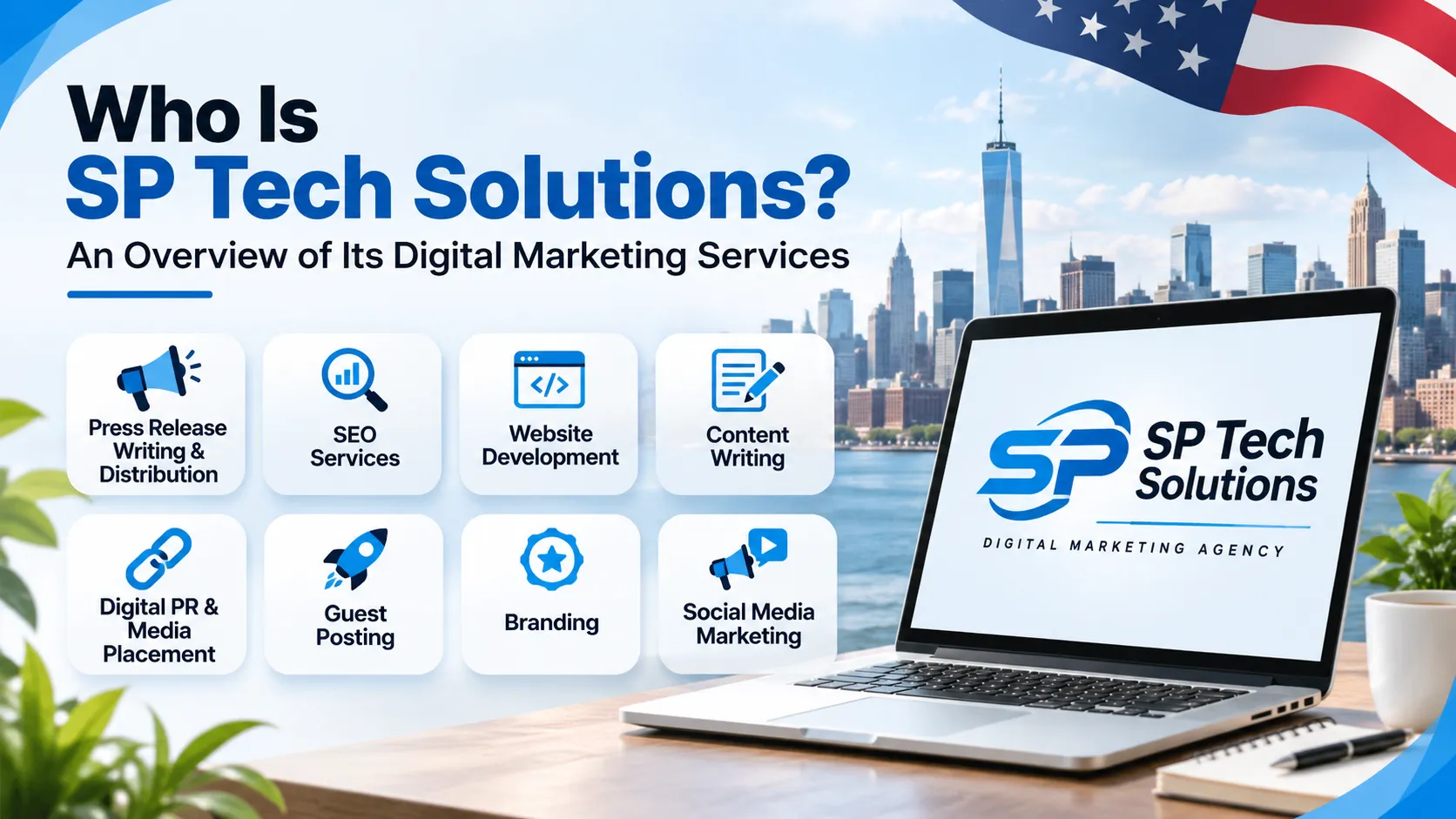

Digital marketing services has become an essential part of how businesses communicate with customers, build brand recognition, and compete in increasingly crowded markets. From search engine visibility to online media coverage, companies now rely on multiple digital channels to establish credibility and reach their target audiences.
However, digital marketing is not limited to social media posts or paid advertisements. It includes a broad range of strategies involving website development, search engine optimization (SEO), content creation, public relations, branding, and digital communications.
SP Tech Solutions is a digital marketing agency that works across several of these areas, with an emphasis on content marketing, SEO, website development, and press release writing and distribution. Understanding the company’s services provides insight into how businesses can use different digital marketing approaches to support their online presence.
Understanding the Role of a Digital Marketing Agency
A digital marketing agency typically helps businesses develop and execute strategies across online channels. The exact services offered vary depending on the agency’s expertise, the client’s industry, and its marketing objectives.
Some businesses need help improving their search rankings, while others may be focused on launching a new website, increasing brand awareness, generating leads, or communicating important company announcements.
A coordinated digital marketing strategy can address these objectives through several complementary activities:
- Improving website visibility through search engines
- Creating informative and relevant content
- Building a consistent brand identity
- Reaching audiences through digital advertising
- Developing websites that provide better user experiences
- Communicating company news through digital media
The effectiveness of these activities depends on how well they align with a company’s audience, goals, budget, and available resources. Businesses should evaluate digital marketing services based on their actual needs rather than selecting every available channel.
1. Search Engine Optimization (SEO)
Search engine optimization is one of the most important components of long-term digital marketing. It involves improving a website’s content, structure, technical performance, and relevance so search engines can better understand its pages and users can discover useful information.
SEO generally consists of several interconnected areas.
Technical SEO
Technical SEO focuses on the underlying structure and performance of a website. Common considerations include page loading speed, mobile responsiveness, crawlability, indexing, website security, XML sitemaps, and structured data.
For example, a website with slow-loading pages or broken navigation may create problems for both visitors and search engine crawlers. Identifying and correcting these issues can help improve the site’s accessibility and overall usability.
On-Page SEO
On-page SEO involves optimizing individual pages to make their content more relevant to specific search queries.
This may include:
- Improving title tags and meta descriptions
- Organizing headings logically
- Using relevant keywords naturally
- Adding descriptive internal links
- Optimizing images and alternative text
- Creating clear and informative page content
The objective is not simply to include keywords repeatedly. Instead, a page should provide useful information that directly addresses the questions or needs of its intended audience.
Keyword Research
Keyword research helps businesses understand how potential customers search for information, products, or services.
Search terms can reveal customer concerns, purchasing considerations, and opportunities to develop educational content. A business offering accounting software, for instance, may create content around bookkeeping processes, financial reporting, business expenses, and software comparisons.
Keyword research is most useful when combined with search intent. A person searching for an explanation may need educational content, while someone comparing providers may be closer to making a purchasing decision.
2. Content Writing and Content Marketing
Content marketing is based on creating and distributing valuable information to attract and engage a defined audience. Rather than relying entirely on advertisements, businesses can use informative content to demonstrate knowledge, answer questions, and build familiarity with their brand.
Content formats include:
- Blog articles
- Educational guides
- Website service pages
- Case studies
- Industry reports
- Product descriptions
- Frequently asked questions
- Press releases
The quality of content is important because readers increasingly expect accurate, clear, and practical information. Articles should explain concepts, provide useful examples, and avoid unnecessary claims.
For businesses targeting audiences in the United States, content may also need to account for local terminology, regional preferences, industry regulations, and differences in customer expectations.
Content writing is closely connected to SEO, but the two disciplines have different objectives. SEO helps content become discoverable, while content writing ensures that the information is meaningful and useful after someone reaches the page.
3. Press Release Writing and Distribution
Press releases are structured announcements used to communicate news about organizations, products, services, events, partnerships, leadership changes, research, or other developments.
Digital public relations can help businesses communicate important information beyond their owned websites and social media accounts.
A typical press release includes:
- A clear headline
- A concise opening paragraph
- Relevant supporting details
- Quotes from authorized representatives
- Background information about the organization
- Contact information for media inquiries
Distribution is another important consideration. Businesses may use newswire platforms, industry publications, regional media outlets, or direct outreach to relevant journalists.
However, publication does not automatically guarantee meaningful media attention. A press release should contain genuinely newsworthy information, and distribution decisions should be based on the relevance of the announcement, the intended audience, and the publication’s editorial standards.
Organizations such as SP Tech Solutions provide services involving press release preparation, distribution, and digital media visibility as part of a broader digital marketing offering.
For businesses, the primary value of digital PR is often communication and brand visibility. Media coverage can help introduce a company to new audiences, establish context around its activities, and create additional opportunities for people to discover its website and services.
4. Digital PR and Guest Posting
Digital PR and guest posting are two approaches businesses use to expand their online visibility through third-party websites.
Digital PR typically focuses on developing stories, announcements, research, expert commentary, or other information that may be relevant to journalists and publishers.
Guest posting involves contributing original articles to another website. When done appropriately, it can allow subject-matter experts to share knowledge with an audience that may not regularly visit their own website.
The most important consideration is editorial relevance.
A technology company contributing an article about cybersecurity to a technology publication is more likely to provide meaningful value than publishing unrelated content on a website simply because it offers a backlink.
Businesses should assess potential publications based on:
- Audience relevance
- Editorial quality
- Topic alignment
- Website credibility
- Content standards
- Transparency about sponsored content
Links should be considered part of a broader content and audience strategy rather than the sole reason for publishing an article.
5. Website Design and Development
A company’s website serves as a central destination for information about its products, services, brand, and operations. Website design and development therefore play an important role in digital marketing.
A well-designed website should be accessible, responsive, easy to navigate, and capable of supporting the company’s business objectives.
Website development may include:
Responsive Design
Responsive websites adapt to different screen sizes, including desktops, tablets, and mobile devices. This is particularly important because many users browse and research businesses through smartphones.
User Experience
User experience, commonly referred to as UX, concerns how people interact with a website.
Clear navigation, readable text, organized information, accessible forms, and intuitive page layouts can help visitors find what they need without unnecessary friction.
Website Performance
Website performance involves factors such as loading speed, stability, and responsiveness. Large images, unnecessary scripts, inefficient code, and poorly configured hosting can affect the user experience.
Content Management Systems
Content management systems such as WordPress allow businesses to manage website pages, blog articles, media, and other content without requiring developers to update every individual page manually.
Choosing an appropriate website architecture depends on the organization’s requirements, technical resources, content publishing needs, and future plans.
6. Social Media Marketing
Social media marketing helps organizations communicate with audiences through platforms where people share information, interact with businesses, and discover products or services.
A social media strategy may include:
- Developing a content calendar
- Creating educational posts
- Publishing company updates
- Sharing industry insights
- Responding to audience questions
- Monitoring brand conversations
- Reviewing engagement and reach
Different platforms serve different purposes. LinkedIn may be particularly relevant for business-to-business communication, while Instagram may be more suitable for visual storytelling. Other platforms may support communities, entertainment, short-form video, or customer interaction.
Businesses should choose platforms based on where their intended audiences are active rather than trying to maintain a presence everywhere.
Consistency also matters. A realistic publishing schedule that supports useful communication is generally more sustainable than posting frequently without a clear strategy.
7. Branding and Graphic Design
Branding influences how people recognize and understand a business. It includes more than a logo; it encompasses the visual identity, communication style, messaging, and overall experience associated with an organization.
Graphic design supports branding by creating visual materials that communicate information consistently.
Common branding and design elements include:
- Logo design
- Typography
- Color palettes
- Brand guidelines
- Social media graphics
- Marketing materials
- Website visual assets
- Presentation templates
Consistency across digital channels can make a business easier to recognize. For example, using similar typography, colors, and messaging on a website, social media profiles, and marketing materials can help reinforce a company’s identity.
Branding is especially important for newer businesses that are establishing themselves in competitive industries. A clear identity helps communicate what the company does, whom it serves, and what customers can expect from its products or services.
8. Paid Digital Advertising
Organic marketing strategies such as SEO and content marketing often require time to produce results. Paid advertising offers businesses another way to reach targeted audiences through advertising platforms.
Paid campaigns may use search advertisements, social media advertising, display advertising, or other formats.
The process usually involves several stages:
- Identifying campaign objectives
- Defining the target audience
- Developing advertising messages
- Selecting appropriate platforms
- Establishing budgets
- Monitoring performance
- Adjusting campaigns based on results
Advertising performance should be measured using metrics that align with the campaign’s objectives.
For example, a campaign designed to generate website traffic may focus on clicks and landing-page engagement. A lead-generation campaign may prioritize qualified inquiries, conversion rates, and cost per lead.
Simply measuring impressions or clicks does not necessarily indicate whether a campaign is contributing to business growth.
How Digital Marketing Services Work Together
One of the most important aspects of digital marketing is understanding how different services complement one another.
Consider a small software company launching a new product in the United States.
Its website provides information about the product and allows visitors to request demonstrations. SEO helps potential customers discover relevant pages through search engines. Blog articles explain industry challenges and product-related concepts. Social media distributes these resources to interested audiences.
A press release communicates the product launch, while digital advertising helps reach specific groups of potential customers. Website analytics provide information about which channels are generating engagement and inquiries.
In this example, each service has a different role, but they contribute to a shared objective.
A disconnected strategy may produce inconsistent messaging or duplicate effort. A coordinated strategy can create a more consistent experience across the customer journey, from initial discovery to research and eventual contact with the business.
Measuring Digital Marketing Performance
Businesses should establish measurable objectives before beginning a digital marketing campaign. Without clear goals, it can be difficult to determine whether activities are producing meaningful results.
Common performance indicators include:
| Marketing Activity | Potential Metrics |
|---|---|
| SEO | Organic traffic, rankings, impressions, clicks |
| Content marketing | Page views, engagement, time on page |
| Digital PR | Relevant media placements, referral traffic, brand mentions |
| Social media | Reach, engagement, audience growth |
| Paid advertising | Cost per click, conversions, cost per lead |
| Website development | Page speed, conversion rate, user engagement |
| Email marketing | Open rates, click rates, conversions |
Metrics should be interpreted within their context. An increase in website traffic may be positive, but traffic quality matters. Similarly, a high number of social media impressions may not translate into inquiries or sales.
Businesses can use analytics tools to evaluate performance, identify patterns, and make informed adjustments. Regular reporting helps organizations understand what is working and which areas may require additional attention.
Choosing the Right Digital Marketing Services
Not every business requires the same combination of digital marketing services. A local service provider may prioritize local SEO and website improvements, while a technology startup may focus on content marketing, digital PR, and lead generation.
Before selecting an agency or developing a marketing plan, businesses should consider several factors.
Business Objectives
Marketing activities should support clearly defined goals. These may include increasing website traffic, improving brand recognition, generating qualified leads, launching a new product, or reaching a new market.
Target Audience
Understanding the intended audience helps determine which channels and content formats are most appropriate. Businesses should consider customer demographics, interests, search behavior, purchasing habits, and the problems their products or services solve.
Budget and Resources
Digital marketing requires investment in time, expertise, tools, content, and sometimes advertising. Businesses should establish realistic budgets and prioritize activities that align with their objectives.
Experience and Transparency
When evaluating an agency, businesses should review its experience, service scope, communication practices, reporting methods, and approach to campaign management.
Clear expectations and transparent reporting are important for understanding the work being performed and evaluating its effectiveness.
Long-Term Strategy
Digital marketing is rarely a single activity. Website improvements, content development, SEO, branding, and audience engagement often require ongoing attention.
Businesses should consider whether their marketing strategy can adapt as their audience, industry, competition, and objectives evolve.
The Importance of an Integrated Digital Strategy
Digital marketing continues to evolve as search engines, social media platforms, advertising technologies, and consumer behavior change. Businesses must therefore evaluate their online strategies regularly rather than relying on outdated approaches.
SEO, content marketing, website development, public relations, social media, and branding can each contribute to a company’s digital presence. Their effectiveness depends on execution, relevance, consistency, and the ability to measure meaningful outcomes.
Understanding the role of each service makes it easier for businesses to make informed decisions about their marketing investments.
For organizations exploring digital marketing options, examining the services, methodologies, and areas of specialization offered by different providers can be a useful starting point. A clear understanding of business objectives and audience needs remains the foundation of any effective digital marketing strategy.



Join the conversation