

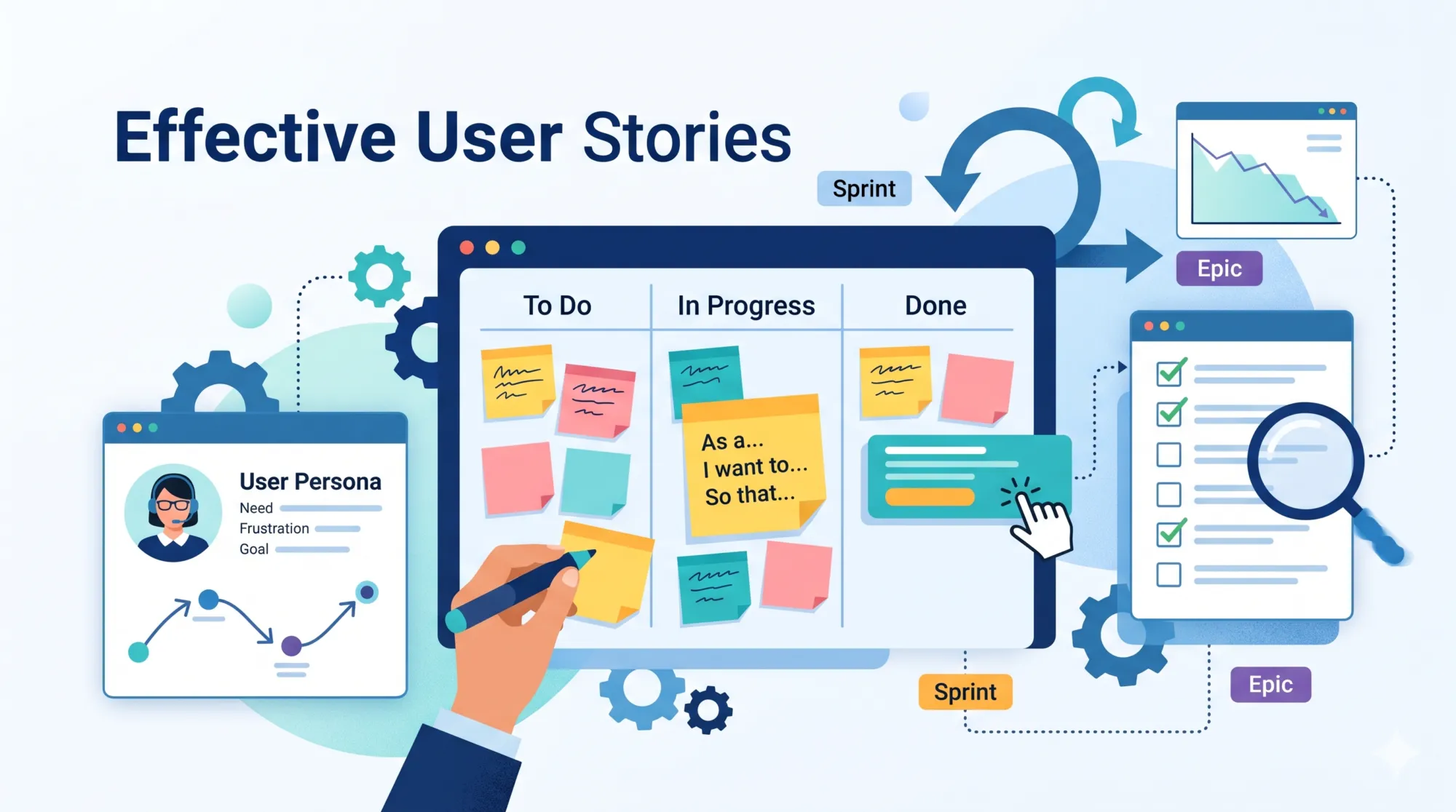

In Agile project management, understanding what customers need is very important. A user story helps the development team understand what a user wants and why they need it.
Writing clear and effective user stories helps teams build the right product, avoid confusion, and deliver better results.
In this blog, let’s understand what a user story is, how to write one, and some simple tips to make it effective.
What Is a User Story in Agile?
A user story is a short and simple description of a feature from the user’s point of view. It explains what the user wants and why it is useful.
For example:
“As a customer, I want to reset my password so that I can access my account if I forget it.”
This tells the team:
Who: The customer
What: Wants to reset the password
Why: To access the account again
User stories help the team focus on customer needs instead of only technical tasks.
Why Are User Stories Important?
User stories play an important role in Agile development. Here are some key benefits:
Clear understanding: They help the team understand what the customer expects.
Better communication: Developers, testers, Product Owners, and other team members can discuss the same requirement.
Customer focus: They keep the team focused on delivering value to users.
Easy prioritisation: The Product Owner can arrange stories based on business value.
Better planning: The team can estimate and select user stories during Sprint Planning.
How to Write Effective User Stories
Follow these simple steps to write useful user stories.
1. Understand the User’s Needs
Before writing a user story, understand who the user is and what problem they want to solve.
For example, an online shopping customer may want to track an order after placing it.
Talk to users, collect feedback, and understand their expectations before writing the story.
2. Follow the User Story Format
A common format for writing user stories is:
As a [type of user], I want [some goal], so that [some benefit].
Example:
“As a shopper, I want to save products to my wishlist so that I can buy them later.”
This format makes the user’s role, need, and reason clear.
3. Keep It Simple and Clear
Use simple words and avoid unnecessary technical details. Everyone on the team should be able to understand the story.
A user story should explain the user’s need, not describe every technical step required to build the feature.
4. Add Acceptance Criteria
Acceptance criteria are the conditions that must be met for a user story to be considered complete.
For example, for a password reset story:
The user can enter their registered email address.
The system sends a password reset link.
The link allows the user to create a new password.
The user sees a confirmation message after resetting the password.
Clear acceptance criteria help developers and testers understand what needs to be delivered.
5. Make Sure the Story Is Small
A user story should be small enough for the team to understand, estimate, and complete within a Sprint.
If a story is too large, break it into smaller stories.
For example, instead of one large story called “Manage Online Orders”, create smaller stories such as:
6. Discuss the Story with the Team
A user story should not be written and handed over without discussion.
The Product Owner, Scrum Master, developers, and testers can discuss the story to clear doubts and identify missing details.
Team discussions help everyone understand the expected outcome.
7. Prioritise User Stories
Not all user stories have the same importance. The Product Owner should prioritise stories based on customer needs, business value, urgency, and dependencies.
Important stories can be considered earlier during Sprint Planning.
What Makes a Good User Story? (INVEST Principle)
The INVEST principle is a useful way to check whether a user story is well written.
Independent
The story should be as separate from other stories as possible.
Negotiable
The details can be discussed and improved by the team.
Valuable
It should provide value to the user or business.
Estimable
The team should be able to estimate the effort.
Small
It should be small enough to complete within a Sprint.
Testable
There should be clear conditions to check whether it works.
Following the INVEST principle can help teams write better user stories.
Common Mistakes to Avoid
While writing user stories, teams should avoid these common mistakes:
Writing stories that are too large or complicated.
Focusing only on technical work instead of user needs.
Forgetting to add acceptance criteria.
Using unclear or confusing language.
Writing stories without discussing them with the team.
Adding too many details before the team has discussed the requirement.
Avoiding these mistakes makes the backlog easier to understand and manage.
Example of a Good User Story
Let’s take an example of a food delivery application.
User Story:
“As a customer, I want to track my food order so that I know when it will arrive.”
Acceptance Criteria:
The customer can view the current order status.
The app displays the estimated delivery time.
The customer can see when the order is out for delivery.
The app updates the status when the order progresses.
This example clearly explains what the customer needs and how the team can check whether the feature works correctly.
Conclusion
Writing effective user stories is an important part of Agile development. A good user story should be simple, clear, valuable, and easy to test.
By understanding user needs, following the standard user story format, adding acceptance criteria, and discussing stories with the team, you can improve communication and deliver better products.
If you want to build your knowledge of Scrum and Agile practices, HelloSM, a Scrum training institute in India, can help you understand these concepts and learn how to apply them in real projects.



Join the conversation