

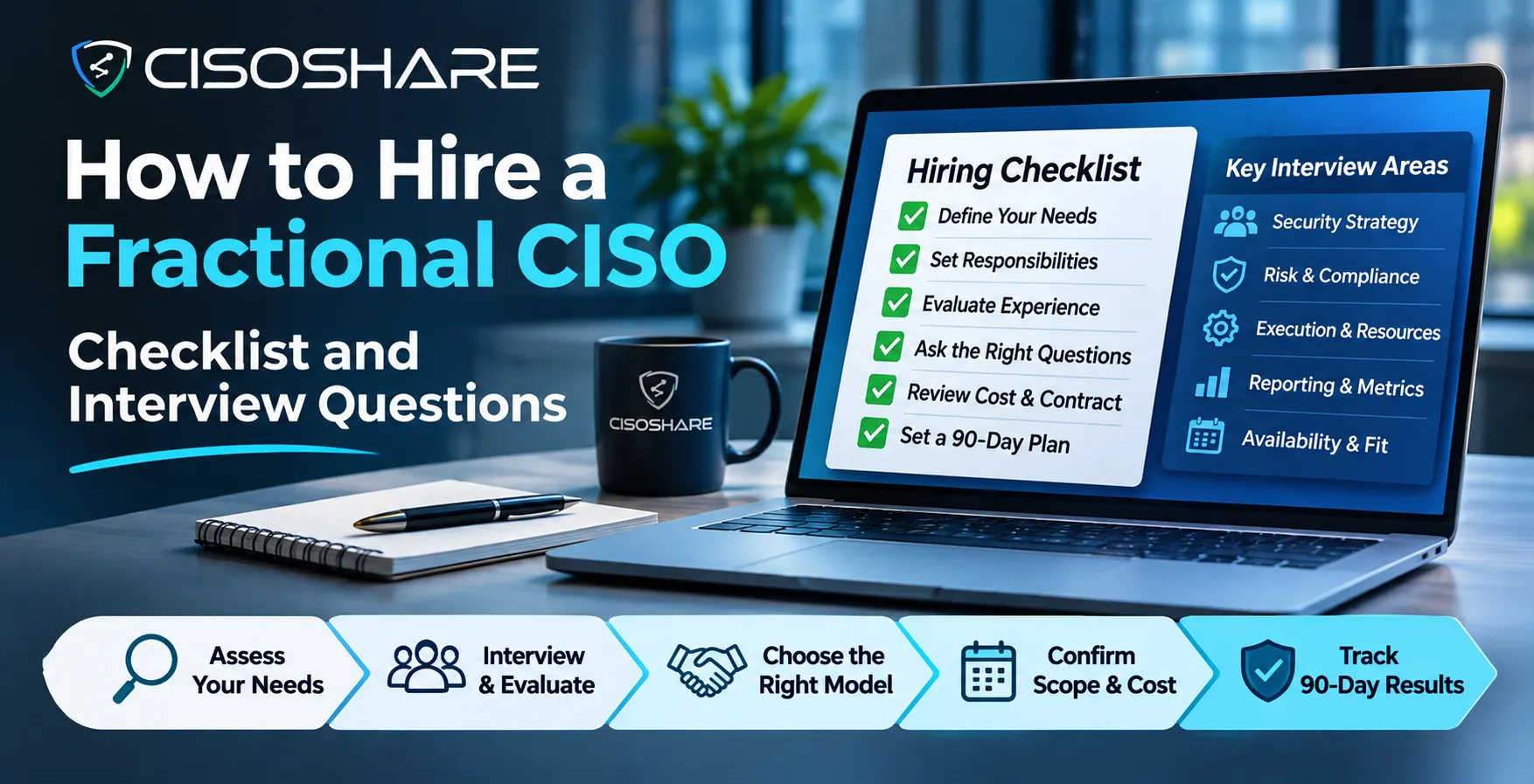

Hiring cybersecurity leadership is a major decision for any growing organization. The wrong engagement can produce reports and policies without meaningful implementation, while the right security leader can establish priorities, clarify risk ownership, and connect cybersecurity activities to business objectives.
Many businesses need executive-level security guidance but cannot justify hiring a full-time Chief Information Security Officer. Others already have IT personnel who manage infrastructure and security tools but lack someone responsible for organizational security strategy.
A part-time security executive may address that gap. However, job titles alone do not establish what an individual will deliver, how much authority they will have, or whether technical implementation is included.
Understanding how to hire a fractional CISO requires a clear evaluation of your organization’s existing capabilities, expected responsibilities, and measurable outcomes.
This guide provides a practical hiring checklist, interview framework, and first-90-day evaluation plan to help organizations select the right cybersecurity leader.
How to Hire a Fractional CISO for Your Organization
Before reviewing resumes or service proposals, determine why the organization needs senior cybersecurity leadership.
A fractional CISO typically provides part-time executive security leadership instead of occupying a permanent, full-time position. Depending on the arrangement, this person may work directly with internal teams, participate in executive meetings, and oversee security strategy and risk management.
The structure can be especially useful when an organization needs experienced direction but does not require a dedicated executive every day.
However, the role must be clearly defined. Some organizations use the term for an embedded part-time leader, while others use it interchangeably with an outsourced virtual CISO.
CISOSHARE distinguishes between part-time leadership, outsourced strategic guidance, and broader service models that include dedicated execution resources.
The most important question is therefore not which title sounds appropriate, but whether the proposed engagement provides the leadership, availability, and implementation capacity the organization actually needs.
Step 1 — Identify the Security Leadership Gap
Begin by examining what the organization already has.
An internal IT team may manage identity systems, endpoint protection, infrastructure, and security monitoring. However, technical administration does not automatically provide executive-level risk governance or a coordinated security program.
Common gaps include missing security policies, unclear risk ownership, inconsistent vendor assessments, and limited reporting to executive leadership.
Other organizations may need assistance preparing for SOC 2 examinations, ISO 27001 certification, or customer security assessments.
Questions to Ask Internally
Who currently owns cybersecurity risk decisions?
Does the organization have a documented security roadmap?
Are security policies reviewed and maintained?
Who coordinates vulnerability remediation?
Can leadership identify the highest business-critical risks?
Are compliance responsibilities clearly assigned?
Who manages security incidents and escalation?
Does the existing team have sufficient implementation capacity?
These questions help establish whether the primary requirement is strategic leadership, operational support, or both.
For example, a business with experienced IT administrators may need someone to develop governance processes and report to the board. A company without dedicated cybersecurity personnel may require a broader managed service.
Step 2 — Define Responsibilities and Decision-Making Authority
A common hiring mistake is defining the position too broadly.
An organization may expect the security leader to manage compliance, respond to incidents, configure tools, conduct penetration tests, write policies, and attend executive meetings within a limited monthly commitment.
That scope may be unrealistic for one part-time professional.
Instead, define responsibilities across strategic and operational categories.
Strategic Responsibilities
These typically include security program planning, enterprise risk assessment, governance, executive reporting, compliance oversight, and security budgeting.
The leader should help management understand where resources are needed and which risks deserve priority.
Operational Responsibilities
These may include coordinating vulnerability management, developing policies, reviewing vendors, maintaining evidence, and supporting incident response planning.
Some leaders may perform selected operational tasks directly. Others will supervise internal teams or coordinate external specialists.
Authority and Accountability
The agreement should identify who can approve security changes, accept risks, authorize spending, and make decisions during incidents.
Even when cybersecurity leadership is outsourced, executive management retains responsibility for organizational decisions.
A successful engagement needs clear authority, escalation procedures, and documented accountability.
Step 3 — Choose the Appropriate Security Leadership Model
Several service models can provide access to experienced cybersecurity leadership, but their scope and delivery arrangements may differ.
A part-time embedded leader can support organizations that need senior oversight for a defined number of hours each week.
A virtual CISO generally provides outsourced strategic direction, often working remotely and coordinating with internal resources.
CISO-as-a-Service may combine executive leadership with additional specialists who help implement and maintain a cybersecurity program.
CISOSHARE’s vCISO services distinguish strategic leadership support from its broader CISO-as-a-Service offering.
Match the Model to Internal Resources
If your organization has experienced security personnel but lacks a senior decision-maker, a leadership-focused arrangement may be sufficient.
If the organization has no security team, selecting an advisory-only service may leave important implementation tasks incomplete.
Before making a decision, clarify which tasks the provider performs, which tasks require internal personnel, and whether additional specialists are available.
For a detailed comparison, read CISOaaS vs vCISO vs fractional CISO to understand how different arrangements affect leadership and execution responsibilities.
Step 4 — Evaluate the Candidate’s Experience
Technical qualifications matter, but senior security leadership requires more than familiarity with security products.
Candidates should demonstrate experience evaluating business risks, communicating with executives, coordinating technical teams, and building sustainable governance processes.
Relevant industry experience is also valuable.
A healthcare organization may need leadership familiar with HIPAA obligations and protected health information. A SaaS provider may prioritize SOC 2 readiness, cloud security, and customer assurance requirements.
What to Verify
Ask candidates to describe security programs they have developed or improved.
Look for evidence of practical prioritization, implementation oversight, and executive communication.
Professional certifications such as CISSP, CISM, or relevant audit qualifications can support an evaluation, but certifications alone do not demonstrate effective leadership.
References and examples of prior deliverables may offer additional insight.
The strongest candidates should explain how they adapted their approach to organizations with different risk profiles and resource constraints.
Step 5 — Ask the Right Fractional CISO Interview Questions
A structured interview should evaluate judgment, communication, security program experience, and the candidate’s ability to operate within limited resources.
The following fractional CISO interview questions can help identify whether the candidate understands both cybersecurity and business priorities.
Security Strategy
1. How would you assess our security maturity during the first month?
Look for an approach involving stakeholder interviews, documentation review, asset and risk identification, and practical prioritization.
2. How would you build a security roadmap with limited resources?
A strong candidate should connect proposed improvements to business impact, implementation effort, compliance needs, and available personnel.
3. How do you decide which cybersecurity risks require immediate attention?
The answer should explain risk evaluation rather than simply recommending the latest security tools.
Governance and Compliance
4. How have you supported SOC 2, ISO 27001, or other applicable requirements?
Look for experience developing controls, assigning owners, collecting evidence, and supporting readiness activities without promising guaranteed certification.
5. How would you communicate cybersecurity risk to our executive team?
Candidates should be able to translate technical findings into business impact, ownership, and decisions requiring management approval.
6. How do you handle a risk that management chooses not to remediate immediately?
Look for documented risk acceptance, appropriate escalation, compensating controls where relevant, and clear accountability.
Incident Response and Execution
7. What would you do during a significant security incident?
A useful response should identify escalation, communication, coordination, evidence preservation, and decision-making responsibilities.
8. Which security activities would you perform personally, and which would you delegate?
This question helps clarify the practical limits of the engagement.
9. How would you coordinate with our existing IT team?
Look for a collaborative approach that establishes ownership without unnecessarily duplicating technical responsibilities.
Measurement and Availability
10. What deliverables should we expect after 30, 60, and 90 days?
Candidates should describe an assessment, prioritized roadmap, ownership structure, and evidence of initial implementation progress.
11. How much time can you commit, and what happens during an emergency?
Confirm availability, response expectations, escalation procedures, and backup resources.
12. What metrics would you report to our board?
Useful measures may include risk remediation progress, control coverage, critical vulnerabilities, compliance readiness, and the completion of priority security initiatives.
Strong interview answers should demonstrate practical experience rather than relying on generic security terminology.
Step 6 — Evaluate Pricing and Contract Terms
Cost is an important consideration, but the lowest hourly rate does not necessarily provide the best value.
Engagements may use hourly billing, fixed monthly retainers, project-based fees, or hybrid arrangements.
The most appropriate structure depends on how predictable the workload is and whether the organization needs ongoing operational support.
What Influences the Price?
Major cost drivers include the organization’s size, regulatory environment, technology complexity, required availability, and expected deliverables.
A company requiring monthly board reporting and limited advisory support may need fewer resources than one pursuing multiple certifications while building a security program from the beginning.
CISOSHARE’s published pricing guidance describes monthly arrangements ranging from approximately $1,000–$5,000 for some smaller organizations to $5,000–$10,000 or more for mid-market environments. These are indicative examples, not binding CISOSHARE quotations.
For more detailed pricing considerations, review fractional CISO cost.
Contract Questions Worth Asking
Confirm whether the proposed fee includes security assessments, policy development, executive meetings, technical implementation, and incident response availability.
The contract should also explain additional charges, reporting frequency, confidentiality, termination conditions, and ownership of documents.
Ask how the provider will transfer knowledge and documentation if the organization eventually hires an internal CISO.
A clearly defined engagement reduces the risk of unexpected costs and gaps between strategy and execution.
Step 7 — Establish a 90-Day Success Plan
A hiring decision should include specific expectations for the first three months.
The objective is not to eliminate every security weakness immediately. It is to establish a clear understanding of risk and demonstrate progress against agreed priorities.
Days 1–30 — Assess and Prioritize
The security leader should meet stakeholders, evaluate existing documentation, review important assets, and identify high-priority risks.
Expected outputs may include a baseline assessment, an initial risk register, and a list of urgent actions.
Days 31–60 — Plan and Assign Ownership
The second month should focus on developing a security roadmap, clarifying responsibilities, and establishing appropriate governance processes.
The organization may begin updating policies, assigning control owners, and defining recurring reporting requirements.
Days 61–90 — Implement and Measure
During the third month, the team should begin operating agreed security processes and tracking remediation progress.
Expected outputs may include executive reporting, updated risk documentation, operational procedures, and a plan for the following quarter.
Progress should be measured against the agreed scope, not the number of meetings or documents produced.
Common Hiring Mistakes to Avoid
One mistake is expecting an advisory engagement to include unlimited technical implementation.
Another is hiring based only on certifications without assessing communication skills, business understanding, and relevant experience.
Organizations may also choose a provider before defining their internal security resources, creating confusion about who performs essential work.
Other problems include unclear emergency availability, insufficient reporting requirements, and contracts without measurable deliverables.
A fractional leadership arrangement should provide continuity and accountability, not simply periodic advice disconnected from day-to-day business needs.
How CISOSHARE Supports Security Leadership
CISOSHARE provides outsourced cybersecurity leadership through service models designed for different organizational requirements.
Its vCISO offering provides strategic guidance that integrates with existing security teams, helps establish priorities, and supports executive-level reporting.
For organizations requiring a broader execution capability, CISOSHARE also offers CISO-as-a-Service, combining leadership with additional security resources.
These arrangements can support activities such as governance development, risk management, policy documentation, vulnerability management, and third-party risk assessments, depending on the agreed scope.
The appropriate model depends on the organization’s maturity, resources, and business objectives.
CISOSHARE can help organizations evaluate these requirements and determine whether dedicated strategic leadership or a more comprehensive engagement is appropriate.
Frequently Asked Questions
How do I know whether my business needs part-time security leadership?
Consider whether the organization has documented security priorities, clear risk ownership, and someone qualified to report cybersecurity matters to executives. A leadership gap may exist even when an IT team is already operating security tools.
What are the most important qualifications for a candidate?
Relevant security leadership experience, risk management skills, executive communication, industry knowledge, and the ability to build practical programs are important. Certifications may provide supporting evidence but should not be the sole selection criteria.
What should I ask during the interview?
Focus on real-world examples, assessment methods, risk prioritization, executive reporting, incident escalation, and implementation responsibilities. The most useful fractional CISO interview questions reveal how a candidate approaches competing priorities and limited resources.
Is an outsourced security executive responsible for compliance?
The leader may oversee compliance readiness, control development, and reporting, but the organization remains accountable for meeting applicable requirements. Hiring an external specialist does not guarantee regulatory compliance or certification.
Can an outsourced security leader work with our existing IT team?
Yes. A properly structured engagement can provide strategic direction while internal IT or security personnel handle operational implementation. Clear responsibilities are essential.
How many hours per month are required?
The appropriate commitment depends on the organization’s size, maturity, risk exposure, and current projects. Candidates should recommend an engagement structure based on assessed needs rather than an arbitrary number of hours.
Should we hire an individual or a managed security provider?
An individual may be sufficient when the organization already has capable technical resources. A managed provider may be more appropriate when additional implementation capacity, specialist expertise, or operational coverage is required.
What happens when we eventually hire a permanent CISO?
A well-managed engagement should support knowledge transfer, documentation handover, and continuity of important security processes. Transition arrangements should be established in the contract.
Conclusion — Hire for Business Outcomes, Not Just a Job Title
Understanding how to hire a fractional CISO begins with defining the organization’s security leadership needs.
A successful engagement should provide clear direction, realistic priorities, executive visibility, and accountability for security improvements.
Organizations should evaluate the candidate’s experience, ask structured interview questions, clarify implementation responsibilities, and establish measurable expectations for the first 90 days.
Cost matters, but the engagement’s scope and ability to support the organization’s security goals are more important than the hourly rate alone.
CISOSHARE provides outsourced security leadership options for organizations that need strategic guidance, dedicated execution resources, or a combination of both.
Ready to evaluate your security leadership options?
Schedule a call with CISOSHARE to discuss your current cybersecurity program, organizational priorities, and the appropriate engagement model.



Join the conversation