
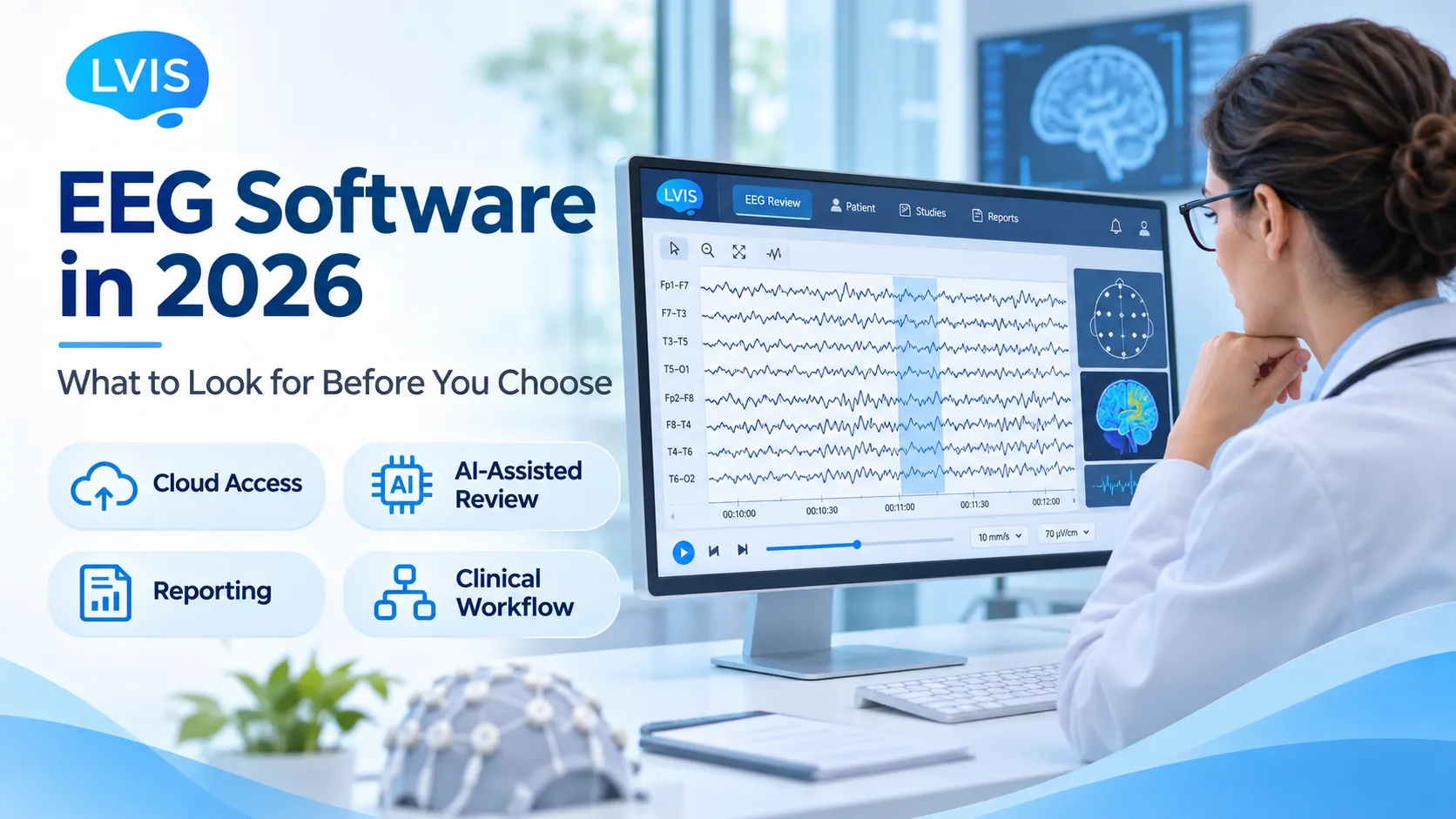

Choosing the right electroencephalography (EEG) platform can influence how efficiently neurologists, epileptologists, EEG technologists, and hospital teams review recordings, collaborate, and prepare clinical reports. With increasing demand for long-term monitoring, ambulatory EEG services, and remote neurological assessment, healthcare organizations must evaluate more than the basic ability to display brainwave recordings.
Modern platforms may offer automated event detection, artifact reduction, cloud-based access, longitudinal reporting, and advanced visualization tools. However, not every system provides the same capabilities, compatibility, or regulatory authorization.
The most appropriate solution depends on the clinical setting, recording volume, existing equipment, interpretation requirements, and available technical support. A platform designed primarily for routine outpatient studies may not satisfy the same operational requirements as a hospital epilepsy monitoring unit.
This guide explains the essential capabilities to evaluate before selecting a system in 2026, including technical compatibility, clinical review features, cybersecurity, and physician oversight.
How to Evaluate EEG Software for Clinical Use
Selecting eeg software should begin with understanding the clinical problems the organization needs to solve. A hospital reviewing continuous EEG recordings may prioritize remote access, efficient event navigation, and multi-physician collaboration. An outpatient neurology practice may place greater emphasis on straightforward data retrieval, report generation, and compatibility with existing acquisition systems.
Rather than comparing products solely by the number of advertised features, healthcare organizations should assess how each capability fits into the actual clinical workflow.
An effective evaluation begins by identifying the types of EEG studies performed, the recording formats currently used, and the roles of clinicians, technologists, and IT administrators.
The next step is to determine whether the proposed platform can support these requirements without introducing unnecessary complexity.
The central buying principle is straightforward: Choose software that supports reliable clinical interpretation, efficient data access, and appropriate professional oversight—not simply the product with the longest feature list.
1. EEG Data Compatibility and Vendor Independence
Compatibility is one of the first technical requirements to investigate. EEG recordings may originate from different acquisition systems, each with its own file formats, metadata, annotations, and storage methods.
An organization using equipment from multiple manufacturers should verify whether a prospective platform can import and display the recordings it needs.
Questions to Ask About Compatibility
Which EEG acquisition systems and recording formats are supported?
Can existing recordings be imported without losing important annotations?
Does the platform support synchronized video where required?
Can users export data for clinical review or authorized research?
Will historical recordings remain accessible after a software migration?
Vendor independence can help reduce unnecessary restrictions when hospitals upgrade acquisition equipment or collaborate across facilities.
However, compatibility claims should always be validated using real recordings from the organization’s existing systems. A demonstration using a prepared sample file may not expose problems involving metadata, annotations, video synchronization, or unusually large studies.
LVIS Corporation discusses these challenges in its article on EEG vendor lock-in, including how proprietary systems can affect workflow flexibility and long-term costs.
2. Clear Signal Visualization and Efficient Review
Clinical EEG interpretation requires more than displaying waveforms. Physicians need to navigate recordings, inspect relevant signal characteristics, evaluate annotations, and review events within the broader clinical context.
A practical EEG review and analysis platform should support appropriate waveform displays, navigation controls, filtering, montage selection, and access to relevant study information.
Reviewers should be able to inspect suspicious events without losing the context needed to interpret them accurately.
For longer recordings, efficient navigation becomes especially important. A system that makes event discovery or record retrieval unnecessarily difficult may increase the time required for clinical review.
Features Worth Testing
During a demonstration, ask the vendor to show how a clinician moves from a study overview to a specific event.
Evaluate whether the reviewer can inspect the original signal, adjust relevant display settings, examine annotations, and return to the broader recording.
Also consider the ease of reviewing multiple studies from the same patient.
Longitudinal accessibility can help clinicians compare findings over time when this is relevant to the patient’s care.
3. AI-Assisted Seizure and Spike Detection
AI-assisted event detection is an important area of development in neurodiagnostic software.
Automated algorithms may help identify portions of lengthy EEG recordings that deserve closer inspection, including possible seizure activity and epileptiform spikes.
These features can support more focused review, particularly when clinicians work with recordings containing many hours of signal data.
However, automated detection must not be confused with an independent clinical diagnosis.
Algorithms may produce false-positive or false-negative findings, and performance can vary according to patient characteristics, recording conditions, and the type of event being assessed.
What to Check Before Choosing an AI Feature
Healthcare organizations should examine the intended use of each detection function and the evidence supporting it.
Important questions include whether the system allows physicians to verify detected events, how it presents confidence or supporting signal data, and whether the vendor provides appropriate clinical validation information.
It is equally important to establish the feature’s regulatory authorization in the intended market.
A capability included in promotional demonstrations may not necessarily be authorized for clinical use in every jurisdiction.
Clinical responsibility remains with qualified healthcare professionals. AI-generated findings should be reviewed and interpreted in the context of the complete EEG recording and relevant patient information.
4. Artifact Reduction Without Losing Clinical Context
EEG recordings frequently contain activity unrelated to the brain signals being evaluated.
Eye movements, muscle activity, electrode disturbances, and environmental interference can complicate waveform interpretation.
Artifact reduction features are designed to make relevant signal information easier to inspect.
However, healthcare professionals should understand how these tools process recordings and whether the original signal remains available for comparison.
A useful demonstration should show the clinician how to compare processed and unprocessed information where supported.
Artifact reduction does not guarantee that every clinically important event becomes visible, nor does it eliminate the need to evaluate signal quality.
The objective is to support interpretation while preserving the ability to inspect the evidence underlying a clinical judgment.
5. Cloud-Based Access and Remote Collaboration
Cloud-based platforms can change how neurological teams access recordings and coordinate their work.
Traditional workflows may depend on dedicated reading stations, local storage infrastructure, or transferring recordings between departments.
Browser-based access may allow authorized clinicians to review relevant EEG information from different locations without relying on the same physical workstation.
This can be valuable for organizations with multiple clinical sites or specialist physicians who support remote services.
Evaluate Collaboration Capabilities
Ask how clinicians share access to studies, record annotations, and maintain consistent review information.
Consider whether the platform supports multiple authorized users and how responsibilities are assigned.
Remote collaboration should make clinical information easier to access without weakening data governance or introducing uncertainty about which version of a report is current.
Internet connectivity requirements, system availability, and disaster recovery processes should also form part of the evaluation.
6. Data Security, HIPAA, and Access Controls
EEG recordings and associated patient information require appropriate safeguards.
For US healthcare organizations, HIPAA compliance and relevant contractual obligations are important considerations when evaluating cloud-based systems.
A vendor’s security claims should be supported by documentation and an explanation of how responsibilities are divided between the provider and the healthcare organization.
Security Questions for IT Teams
Ask whether the system supports multi-factor authentication, role-based access controls, encryption, access logging, and appropriate backup arrangements.
Organizations should also examine data retention, authorized sharing, incident response, and any necessary business associate agreement.
The presence of a security feature does not automatically guarantee that an entire deployment meets all applicable privacy requirements.
A suitable assessment involves the organization’s clinical, compliance, procurement, and IT teams.
7. Automated Reports and Longitudinal Review
Report preparation is another important part of EEG workflows.
Clinicians may need to summarize findings, document relevant events, compare studies, and prepare information for the patient’s medical record.
Software that supports structured reporting and efficient data organization may help reduce repetitive administrative work.
However, automated reports must remain subject to appropriate professional review.
Reporting Features to Compare
Consider whether the system supports customizable reports, physician annotations, electronic signatures, and review of previous studies.
Assess whether the reporting process fits the organization’s documentation requirements.
The ability to compare findings across recordings can be valuable when monitoring changes over time.
For large clinical teams, clear reporting workflows may also reduce confusion when several authorized professionals participate in reviewing the same patient’s recordings.
8. Advanced Visualization and Source Localization
Some modern systems offer advanced visualization features that go beyond conventional waveform review.
These may include three-dimensional brain models, source localization, temporal trends, and other tools intended to support investigation of neurological activity.
Such capabilities can provide additional ways to examine recorded findings, but their usefulness depends on the clinical setting and the evidence supporting their intended applications.
Source localization is not equivalent to directly observing the source of brain activity. It involves computational estimates influenced by recording quality, electrode configuration, modeling assumptions, and other factors.
Healthcare organizations should therefore ask vendors to explain both the available functions and their limitations.
Regulatory authorization must also be checked separately for advanced features rather than assumed from the clearance of the platform as a whole.
9. Understanding LVIS NeuroMatch as an Example
LVIS NeuroMatch is a cloud-based neurological diagnostic platform developed by LVIS Corporation.
According to its official product information, NeuroMatch provides browser-based EEG access, tools for reviewing and analyzing recordings, remote collaboration capabilities, artifact reduction, longitudinal patient reporting, and automated reporting.
The product page also describes AI-assisted seizure and spike detection, as well as advanced visualization and source-localization capabilities.
These features illustrate several categories that healthcare organizations may want to examine when evaluating modern clinical platforms.
However, buyers should confirm which functions are available in their market, which are included in their proposed configuration, and which carry the necessary regulatory authorization.
LVIS states that NeuroMatch has obtained regulatory clearance in the United States and South Korea, including US FDA clearance K250239. The company also explicitly notes that certain features shown on its website are not yet cleared in the United States.
That distinction should be reviewed with the vendor before any advanced capability is considered for clinical use.
10. Compare Total Ownership Costs, Not Just Licensing
Software pricing is only one component of the overall investment.
A healthcare organization may also incur expenses for implementation, data migration, staff training, system integration, support, and additional infrastructure.
Cloud-based systems and locally installed platforms may have different operating cost structures.
Neither approach is automatically less expensive in every clinical environment.
What to Include in a Procurement Review
A practical cost assessment should consider initial setup, recurring subscriptions, supported users, data storage, advanced feature charges, integration work, and technical support.
Ask whether additional modules require separate licensing and whether usage-based charges apply.
Organizations should also examine how the cost may change as recording volumes increase.
For a growing practice, scalability and predictable operational expenses may be as important as the initial quotation.
11. Run a Real-World Clinical Evaluation Before Purchasing
Product demonstrations are useful, but they should not replace testing with representative clinical workflows.
Before choosing a platform, involve physicians, EEG technologists, IT staff, and administrative stakeholders.
Select sample recordings that reflect the organization’s real workload, including longer studies, complex events, and relevant acquisition formats.
Ask reviewers to perform ordinary tasks such as finding an annotated event, inspecting waveforms, reviewing trends, and preparing a report.
Record issues involving usability, data compatibility, processing, or unnecessary workflow steps.
The evaluation should also assess training needs and the availability of vendor support.
A well-structured pilot is more informative than a comparison based exclusively on feature checklists or promotional claims.
How to Use a List of EEG Software Options Effectively
When reviewing a list of eeg software options, avoid treating every product as a direct substitute.
Some solutions emphasize EEG acquisition and patient monitoring. Others focus on review, automated analysis, cloud collaboration, or specialized clinical workflows.
The correct comparison depends on the organization’s requirements.
A platform supporting continuous monitoring in an intensive care unit may need capabilities that differ from those required for outpatient ambulatory recordings.
A fair evaluation should therefore compare products according to supported clinical workflows, compatibility, regulatory status, security, implementation requirements, and total ownership cost.
Our next article in this series will examine established EEG platforms, including options from Persyst, Natus, Cadwell, and LVIS Corporation, using these considerations as the basis for comparison.
Frequently Asked Questions
What is the most important feature when selecting an EEG platform?
There is no single feature that matters most for every organization. Compatibility with existing recordings, appropriate clinical review capabilities, data security, and the intended clinical workflow should be considered together.
Can AI automatically diagnose seizures from an EEG?
AI-assisted detection can help identify possible events for review, but it does not replace interpretation by qualified clinicians. The intended use, validation evidence, and regulatory authorization of each feature must be verified.
Is cloud-based EEG review appropriate for hospitals?
Cloud-based systems may support remote collaboration and efficient access to recordings. Hospitals should still assess privacy, security, integration, connectivity, governance, and relevant regulatory requirements before deployment.
What does artifact reduction do?
Artifact reduction is designed to reduce distracting signal components such as muscle activity or eye-movement interference. Clinicians should be able to evaluate the original recording and understand the limitations of the processing method.
Does FDA clearance cover every advertised feature?
Not necessarily. Regulatory clearance applies to particular devices, functions, and intended uses. Buyers should verify the authorization status of individual features rather than assuming that every capability shown on a product website is cleared for US clinical use.
Should a hospital replace its acquisition system when upgrading review software?
Not automatically. Some review systems may support recordings from multiple acquisition platforms. Compatibility should be tested with the hospital’s existing files before decisions about replacing equipment are made.
What is the difference between recording software and eeg analysis software?
Recording software focuses on acquiring and storing EEG signals, while analysis-oriented applications emphasize reviewing, processing, navigating, and interpreting recorded data. Some platforms combine several of these functions.
Conclusion — Choose a Platform That Fits Clinical Practice
Choosing eeg software in 2026 requires a careful assessment of the complete clinical workflow.
Advanced visualization and AI-assisted tools may be useful, but they should not overshadow fundamental requirements such as recording compatibility, reliable access, security, efficient reporting, and appropriate clinical oversight.
The strongest procurement process begins with real clinical needs and tests proposed capabilities using representative recordings.
Healthcare organizations should also examine how a platform will perform as recording volumes increase and clinical teams expand.
Explore LVIS NeuroMatch
For hospitals, neurology practices, and epilepsy monitoring teams evaluating cloud-based EEG review and analysis, LVIS NeuroMatch offers an opportunity to explore browser-based access, collaboration, automated reporting, and the product capabilities described by LVIS Corporation.
Request a product demonstration to evaluate compatibility, workflow requirements, available features, and applicable regulatory authorizations.
Website: https://lviscorp.com/en/neuromatch
Email: sales@lviscorp.com
Phone: +1 (415) 997-7337
Clinical and Regulatory Disclaimer
This article is intended for professional education and procurement planning, not as medical advice or an independent validation of any software product. Automated event detection, artifact reduction, and source-localization outputs require appropriate clinical interpretation. LVIS Corporation states that NeuroMatch has regulatory clearance in the United States and South Korea, but certain features displayed on its product website are not yet cleared in the United States. Healthcare organizations should confirm current indications for use, feature-level regulatory status, and local requirements directly with the manufacturer before clinical deployment.
5 Additional FAQs About EEG Software
1. How does EEG software help neurologists review long-term recordings?
EEG platforms help neurologists navigate lengthy recordings, review waveforms, identify annotated events, and examine relevant signal patterns. Some systems offer AI-assisted seizure and spike detection to highlight sections that may require closer inspection. These capabilities can support more efficient review, but automated findings still require verification and interpretation by qualified clinicians.
2. Can EEG software detect seizures automatically?
Some EEG platforms use algorithms to identify possible seizure activity and epileptiform spikes. However, automated detection can produce false positives and false negatives, so it should not be treated as a standalone diagnosis. Healthcare organizations should assess the clinical validation, intended use, and regulatory clearance of each detection feature before adopting it.
3. What should hospitals consider when switching EEG software providers?
Hospitals should evaluate file-format compatibility, historical data migration, integration with existing acquisition systems, user training, cybersecurity, and technical support. Testing the new platform with actual clinical recordings is particularly important. Organizations should also confirm whether annotations, synchronized video, and relevant patient information can be transferred accurately.
4. How can cloud-based EEG software support remote neurological care?
Cloud-based EEG platforms can allow authorized clinicians to access recordings from different locations, supporting collaboration between hospitals, neurologists, and EEG technologists. Potential benefits include easier access to studies, centralized data management, and streamlined reporting workflows. However, healthcare organizations must verify access controls, HIPAA-related safeguards, system availability, and data protection requirements before deployment.
5. Is LVIS NeuroMatch suitable for hospitals and epilepsy monitoring units?
LVIS NeuroMatch is designed to support neurological diagnostic workflows through browser-based EEG access, review and analysis capabilities, collaboration tools, and reporting features. Hospitals and epilepsy monitoring units should evaluate compatibility with their existing systems, clinical requirements, and security policies before adoption. Certain NeuroMatch features are not yet cleared for clinical use in the United States, so organizations should confirm the regulatory status of each required capability directly with LVIS Corporation.
For product information, visit LVIS NeuroMatch.



Join the conversation