
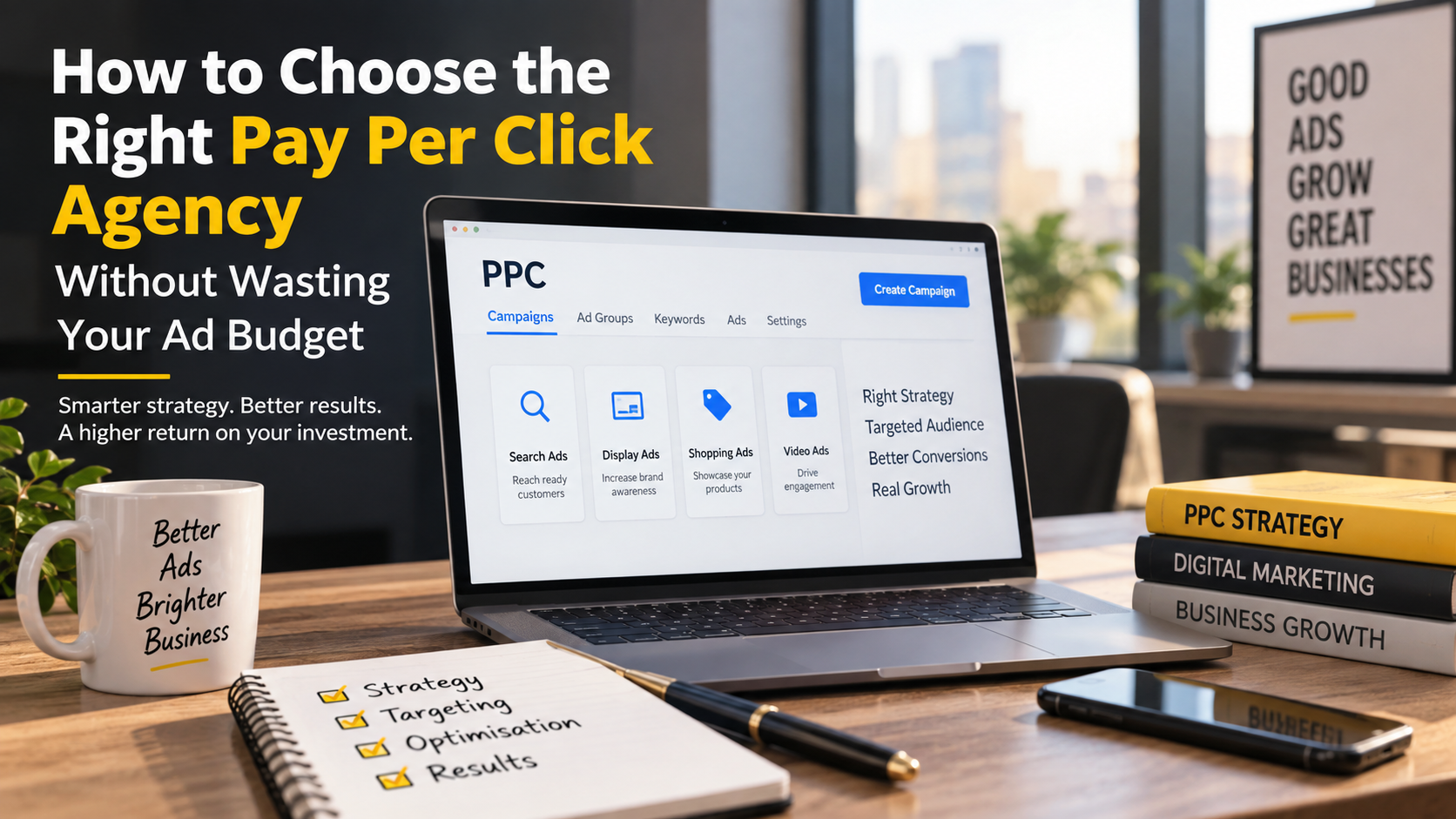

The right pay per click agency should make paid search easier to understand, easier to measure and easier to improve. The decision should not rest on a polished pitch alone. It should rest on whether the agency can explain the account structure, define what success means for your business, show how it will manage spend and report decisions in language you can use.
For UK businesses, that distinction matters because paid media is an operating system, not a one-off campaign launch. A strong agency relationship should give you visibility into what is being tested, where budget is being concentrated, what is being paused and what happens next. If those answers are vague before the contract starts, they are unlikely to become clearer afterwards.
Start With the Business Goal Before Comparing a Pay Per Click Agency
A pay per click agency can only manage toward a useful outcome when the outcome has been defined. Before comparing proposals, decide what the advertising is expected to produce. That may be qualified enquiries, ecommerce sales, booked consultations, demo requests or another action that can be traced back to the campaign.
This sounds basic, but it changes the entire agency conversation. A proposal centred on clicks and impressions may look busy while saying little about commercial intent. A better discussion connects campaign structure to the action a real prospect is expected to take after the click. It also identifies what the agency can control, what depends on the website or offer, and how both sides will review progress.
- Define the primary conversion before discussing campaign volume.
- Agree which secondary actions matter and which are only diagnostic signals.
- Clarify the geographic markets, products or services that deserve priority.
- Decide who owns landing-page changes, tracking checks and approval of new creative.
- Set a reporting rhythm that supports decisions rather than simply producing a monthly document.
This is also where different forms of pay per click services become easier to compare. One provider may focus on campaign execution while another includes landing-page input, tracking reviews and ongoing experimentation. Neither model is automatically right or wrong; the important point is to know what is included and whether it matches the work your account actually needs.
Look Beyond Setup and Examine Pay Per Click Management Services
Good pay per click management services should describe what happens after campaigns go live. Initial setup matters, but long-term performance depends on repeated decisions. The agency should be able to explain how it reviews search terms, bids, budgets, ad messages, audiences, landing-page alignment and conversion data without hiding behind a generic promise to optimise.
Ask what the management cycle looks like
A useful answer describes a cycle: review evidence, identify a constraint or opportunity, make a controlled change, observe the result and document the next decision. That does not mean every account needs constant large changes. It means there should be a reason for action and a reason for restraint. An agency that changes everything at once can make learning harder because it becomes difficult to tell which change mattered.
Ask how budget decisions are made
Budget management should be connected to priorities. If one campaign represents a higher-value service or stronger commercial intent, the agency should know that before it starts reallocating spend. Likewise, if demand is seasonal or certain regions matter more, those constraints should be visible in the plan. The management process should reflect the business rather than force the business into a standard account template.
Check What a Pay Per Click Advertising Agency Will Actually Own
A pay per click advertising agency may work inside your existing advertising account, create a new account, or manage supporting assets around it. Ask explicitly who owns the account, who has administrator access and what happens if the relationship ends. Your business should be able to retain access to its campaign history, conversion configuration and learning.
Ownership is also about decision rights. Determine who approves new campaigns, who signs off creative, who can change daily budgets and who is responsible for resolving tracking problems. Clear roles prevent small operational issues from turning into long delays. They also make the relationship easier to audit because everyone knows which actions belong to the agency and which belong to the client.
- Advertising account ownership and administrator access
- Conversion tracking responsibilities
- Landing-page access and change approval
- Creative and messaging approval process
- Budget-change permissions
- Reporting access and data retention after the engagement
Judge Pay Per Click Marketing Services by the Quality of Reporting
Pay per click marketing services should give you enough context to make decisions, not just a screen full of platform metrics. A useful report explains what changed, why it changed, what the agency learned and what it plans to do next. It should also distinguish between activity metrics and business outcomes so that higher traffic is not automatically presented as success.
Ask to see how the agency would explain a difficult month. That is often more revealing than asking for a best-case report. A credible reporting process should make room for underperformance, uncertainty and corrective action. You should be able to understand where the account is constrained without needing to become a platform specialist yourself.
If you are already spending on Google Ads and suspect the account is inefficient, review the signs of a Google Ads account wasting budget before deciding whether the problem is campaign management, tracking, landing-page fit or a combination of factors.
Compare Pay Per Click Advertising Services on Fit, Not Promises
The best comparison is not which proposal sounds the most confident. It is which pay per click advertising services are most aligned with your commercial model, internal resources and tolerance for experimentation. A business with a capable in-house marketing team may need a specialist operator. A smaller team may need more strategic support, more explanation and closer coordination around landing pages and tracking.
During evaluation, ask each agency to describe what it would need from you in the first month. Strong answers tend to surface dependencies early: access, conversion definitions, geographic priorities, exclusions, sales feedback and approval timelines. That is useful because it turns the sales conversation into a working conversation before you sign.
Common Mistakes to Avoid When Hiring a PPC Partner
- Choosing on headline price without comparing the scope of management.
- Treating clicks or impressions as the final business objective.
- Failing to confirm account ownership and administrator access.
- Accepting reporting that lists metrics without explaining decisions.
- Allowing campaigns to launch before conversion actions and tracking responsibilities are clear.
- Expecting the agency to fix offer, website and sales-process issues that sit outside campaign management without discussing those dependencies.
Key Takeaways
- Start with the business outcome and work backwards to campaign activity.
- Assess the ongoing management process, not just the initial setup.
- Confirm ownership, access and decision rights in writing.
- Use reporting to understand decisions and next steps, not merely activity.
- Choose a partner whose scope matches the capabilities your internal team already has.
FAQ
What should I ask a pay per click agency before hiring them?
Ask how it defines conversions, manages budgets, reviews campaigns, reports decisions, handles account access and coordinates tracking or landing-page work. The answers should show a repeatable management process rather than a one-time setup plan.
What do pay per click management services usually involve?
The exact scope varies by provider. In the context of this brief, compare campaign monitoring, budget decisions, search-term review, ad testing, conversion tracking responsibilities, reporting and the process for approving changes.
Should my business own its PPC account?
It is sensible to clarify account ownership and administrator access before work starts. The business should understand how it will retain access to campaign history, configuration and reporting if the agency relationship ends.
How do I know whether PPC reporting is useful?
Useful reporting connects campaign activity to the agreed business objective, explains what changed and why, identifies constraints and states the next action. A list of platform metrics without interpretation is harder to use for management decisions.
Choosing a pay per click agency is ultimately a process question. Look for clear goals, clear ownership, disciplined management and reporting that explains decisions. Kings Digital’s PPC page provides the mapped next step for businesses that want to review the scope of pay per click services against their current advertising setup.


Join the conversation