
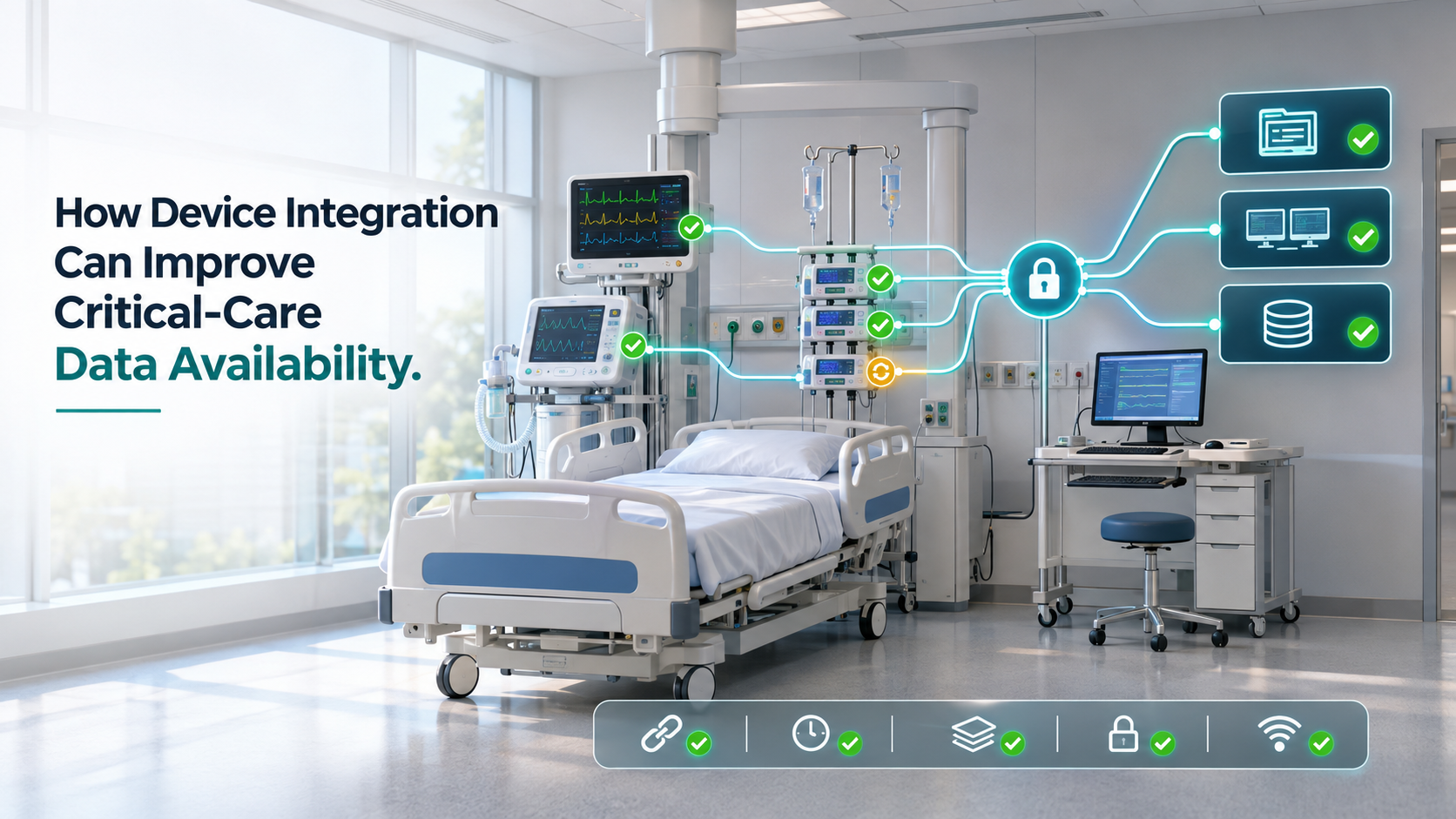

Critical-care environments generate a continuous stream of information.
Bedside monitors capture physiological measurements. Ventilators produce settings and respiratory data. Infusion pumps, dialysis machines, point-of-care devices, and other systems generate their own readings, alarms, and operational states.
Yet the presence of data does not mean that the information is readily available to the people and systems that need it.
Some measurements may be visible only on the device. Others may be entered manually into an electronic health record. High-frequency data may reach a central monitoring station but remain unavailable to operational or analytical platforms. Device information may also lack a reliable connection to the correct patient, encounter, location, or time.
Device integration can help close these gaps. However, connecting a device to the hospital network is only the first step. Hospitals must also establish reliable identity, timing, terminology, security, workflow, and governance controls.
What Does Critical-Care Data Availability Mean?
Data availability is more than the ability to retrieve a value from a device.
For critical-care information to be operationally useful, it should be:
- Associated with the correct patient and encounter
- Linked to the device that produced it
- Captured with an accurate timestamp
- Expressed using understood units and terminology
- Delivered within the required operational timeframe
- Available in the appropriate clinical or operational workflow
- Traceable to its source
- Protected from unauthorized access or alteration
- Accompanied by indicators of quality, status, or uncertainty where relevant
A technically successful connection may still fail several of these conditions.
For example, a monitor may transmit heart-rate data to an integration platform. If the monitor is assigned to the wrong bed, its clock is inaccurate, or the receiving application cannot interpret the measurement code, the data is connected but not reliably available for use.
Why Critical-Care Device Data Becomes Fragmented
Intensive and critical-care units often contain devices from several manufacturers and product generations. These devices may support different communication methods, data models, update frequencies, and security capabilities.
A single patient may be connected to multiple devices, while equipment is regularly moved between beds, units, and patients. This creates a highly dynamic environment for integration.
Fragmentation can occur when:
- A device has no supported electronic interface.
- A device sends data only to its manufacturer’s central station.
- Information is available through a proprietary protocol.
- The receiving system supports only selected measurements.
- Staff must associate the device with a patient manually.
- Device clocks and hospital systems are not synchronized.
- Measurement names or units differ across manufacturers.
- High-frequency data exceeds the capacity of the receiving application.
- Data reaches a repository but not the clinician’s working view.
- Integration failures are not visible to clinical or technical teams.
Solving these problems requires an end-to-end data pathway rather than an isolated device connection.
Begin With the Critical-Care Data Use Case
A hospital should not begin by attempting to send every available device value to every clinical system.
The first question should be: What decision, documentation process, operational activity, or governed analysis requires the information?
Potential use cases include:
- Populating selected EHR flowsheet fields
- Supporting retrospective review of physiological trends
- Making ventilator settings available to an approved clinical view
- Providing device status to clinical engineering teams
- Supporting capacity and equipment-location workflows
- Making approved data available for quality or research analysis
- Delivering specific events to an existing clinical workflow
Each use case has different requirements for frequency, latency, resolution, retention, presentation, and validation.
A flowsheet may require periodic validated observations. A retrospective analysis may need more granular measurements. A waveform repository may require high-frequency storage that would be unsuitable for the EHR.
The intended use should determine the integration design.
Map the Complete Device-to-Use Path
An effective assessment should follow data from the physical device to its final destination.
The path may include:
- Medical device
- Bedside or manufacturer gateway
- Network connection
- Device-integration platform
- Patient and encounter association service
- Terminology and unit normalization
- Interface engine or API layer
- EHR, data platform, monitoring system, or operational application
- User-facing workflow
For each stage, document:
- The responsible owner
- Supported interface and protocol
- Data provided
- Data frequency and expected latency
- Patient-association method
- Transformation rules
- Failure behaviour
- Retry and reconciliation process
- Security controls
- Monitoring and support arrangements
This mapping helps the hospital distinguish a device limitation from a gateway, network, configuration, terminology, or downstream workflow problem.
Patient-to-Device Association Is Foundational
Device data cannot be treated as reliable patient information unless the hospital can associate it with the correct patient and encounter.
Relying only on a bed or room number is often insufficient. Patients move, equipment is exchanged, and devices may continue transmitting after a transfer or discharge.
A governed association process should define:
- Who can assign a device to a patient
- Which patient and encounter identifiers are used
- How the assignment is verified
- When the association becomes active
- How reassignment is handled
- What happens when a patient moves
- How the association is ended
- How conflicting assignments are detected
- How unassociated data is stored or rejected
The user experience matters. If association requires a complex series of steps across different systems, staff may bypass the process or delay it.
Automation can support association, but uncertain matches should not be silently accepted. The system should make ambiguity visible and require human confirmation where appropriate.
Preserve Time, Units, and Meaning
Critical-care data is highly time-dependent.
The integration pathway should preserve the time of measurement, the time of transmission, and the time the receiving system processed the information. These timestamps are not interchangeable.
All participating systems should use a controlled approach to clock synchronization. The hospital should also define what happens when a device clock differs from the enterprise time source or when data arrives late.
Measurement meaning must be preserved as carefully as timing.
Different devices may use different codes, labels, units, precision levels, or reference conventions. Normalization should document:
- Original device code and label
- Standard or enterprise code
- Original and normalized units
- Conversion rules
- Data precision
- Measurement method
- Device identity and model
- Validation status
- Quality or error indicators
The HL7 FHIR Observation resource can represent measurements such as vital signs, device readings, and ventilator parameters, with references to the device that generated them. FHIR also provides Device and DeviceMetric resources, although the adopted version, implementation guide, profile maturity, and local regulatory context must be considered.
Using a standard structure does not automatically guarantee semantic consistency. Hospitals still need approved profiles, terminology mappings, unit rules, and validation procedures.
Do Not Send Every Data Point Into the EHR
Medical devices can produce more data than an EHR is designed to store or display effectively.
Hospitals should distinguish among:
- Periodic discrete measurements
- Continuously sampled measurements
- Waveforms
- Device settings
- Alarm events
- Technical device status
- Configuration and calibration information
- Derived calculations
Each category may require a different destination.
Selected discrete observations might be appropriate for the patient record. High-frequency data and waveforms may be better suited to a specialized repository. Technical status may belong in a clinical-engineering platform, while approved events may need to reach a clinical workflow or monitoring application.
The integration design should avoid flooding the record with repetitive values or presenting raw device data without the context needed for interpretation.
Clinical governance teams should define which values enter the permanent record, whether staff must review or validate them, and how corrections are managed.
Make Integration Health Visible
Device integration can fail without producing an obvious warning to the end user.
A cable may be disconnected. A gateway may stop receiving data. A certificate may expire. A mapping change may cause values to be rejected. A patient association may remain open after the device is moved.
The integration environment should therefore expose operational indicators such as:
- Connected and disconnected devices
- Unassociated devices
- Stale data streams
- Timestamp drift
- Rejected measurements
- Unknown codes or units
- Interface queue depth
- Failed transformations
- Delayed delivery
- Duplicate observations
- Unsuccessful write-backs
- Devices running unsupported software
Alerting should be routed according to ownership. A network problem, device fault, patient-association issue, and terminology failure may require different teams.
Hospitals should also define which failures require notification to clinical users and which should be handled through technical support processes.
Design for Downtime and Recovery
Critical-care operations cannot assume uninterrupted connectivity.
The hospital should determine how each component behaves when the network, gateway, interface engine, EHR, or destination repository is unavailable.
Important questions include:
- Does the device continue its primary function independently?
- Does the device or gateway buffer data?
- How much information can be stored locally?
- Is buffered data transmitted after recovery?
- How are duplicate values prevented?
- Can late-arriving data be distinguished from real-time data?
- What information must staff document manually during downtime?
- How is manually documented information reconciled later?
- Who confirms that integration has returned to normal?
A recovery process should not simply restore the technical connection. It should also verify patient associations, time alignment, queued information, and downstream data integrity.
Treat Cybersecurity as Part of Availability
Connecting a device increases its interaction with the hospital’s broader technology environment.
In 2025, the U.S. Food and Drug Administration issued a safety communication concerning vulnerabilities in certain patient monitors that could allow unauthorized remote control, device malfunction, network compromise, or removal of patient information. The FDA stated that it was not aware of related incidents, injuries, or deaths at the time, but the communication illustrates why connectivity and cybersecurity must be considered together.
The FDA’s current medical-device cybersecurity resources state that manufacturers and healthcare delivery organizations both have responsibilities for putting appropriate mitigations in place.
Controls may include:
- Complete device and software inventory
- Network segmentation
- Restricted outbound connectivity
- Strong authentication where supported
- Role-based administrative access
- Certificate and credential management
- Secure configuration baselines
- Vulnerability monitoring
- Patch and compensating-control processes
- Vendor remote-access controls
- Centralized logging
- Incident-response and isolation procedures
- Procurement requirements for supported security capabilities
Requirements vary by jurisdiction and device classification. Clinical engineering, cybersecurity, IT, compliance, and device manufacturers should jointly evaluate proposed changes because an integration or security control must not interfere with the device’s intended function.
Create Shared Governance for Device Integration
Device integration crosses several organizational boundaries.
Clinical engineering understands the equipment and its maintenance requirements. ICU clinicians understand how information is used at the bedside. Informatics teams understand documentation and workflow. Integration teams manage data exchange. Cybersecurity teams evaluate technical exposure, while data-governance teams define permitted use and retention.
A cross-functional governance group should approve:
- Intended use of integrated data
- Device and data standards
- Patient-association processes
- Destination systems
- Frequency and retention
- Validation requirements
- Cybersecurity controls
- Downtime procedures
- Change-management responsibilities
- Vendor and support expectations
The FDA’s interoperability guidance emphasizes defining the purpose of an interface, the information exchanged, applicable standards, timeliness requirements, functional expectations, and limitations. Although the guidance is directed toward medical-device manufacturers in the United States, these questions are also useful for hospital integration governance.
Start With a Narrow, Observable Pilot
A hospital should begin with a defined device category, unit, data set, and destination.
For example, a pilot might integrate selected bedside-monitor observations into an approved review workflow for one critical-care unit. The team can validate patient association, timestamps, units, latency, failure detection, downtime behaviour, and user presentation before expanding the scope.
Useful operational measures include:
- Percentage of eligible devices connected
- Percentage of data associated with the correct patient and encounter
- Time from measurement to availability
- Number of unassociated or rejected observations
- Frequency of manual transcription
- Data gaps by device, bed, or shift
- Time required to detect and resolve integration failures
- Number of mapping or unit exceptions
- Successful recovery after simulated downtime
These measures assess whether integration is improving availability and reliability. Clinical outcome claims require separate, suitable evidence and should not be inferred from connectivity metrics alone.
Availability Depends on the Whole Path
Device integration can reduce the distance between bedside equipment and the systems used for documentation, coordination, and analysis. But the value does not come from network connectivity alone.
Data must remain associated with the right patient, preserve its timing and meaning, reach an appropriate destination, and remain visible when the integration pathway fails. Security, downtime, and clinical governance must be designed into the architecture from the beginning.
The most useful first step is not to connect every device. It is to select one important data flow and map the complete path from measurement to use.
As part of healthcare digital transformation, this approach helps hospitals build a device-integration foundation that improves critical-care data availability without confusing connectivity with clinical decision-making.


Join the conversation