
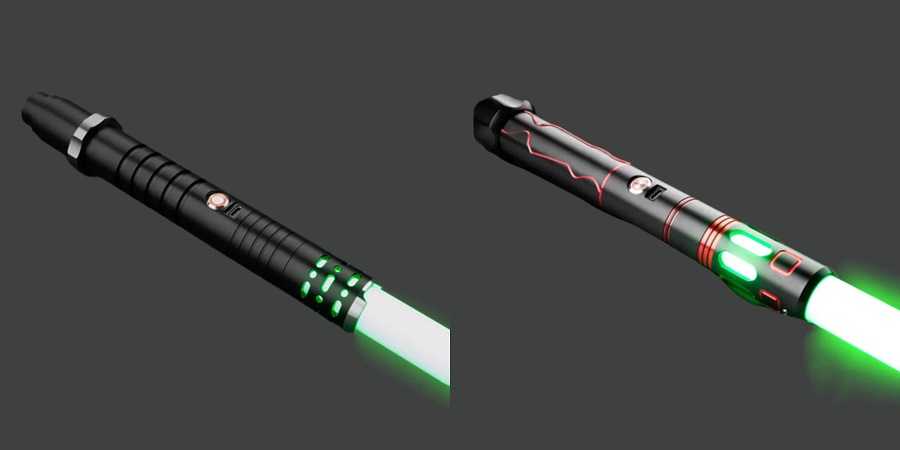
Green occupies a strange middle ground among saber colours. Common enough that everyone recognises it, distinctive enough that it never quite blends into a convention hall full of blue and red.
Anyone browsing the green lightsaber category quickly finds two very different routes open — buy something built to match a specific screen appearance, or build something nobody else owns.
The Star Wars Luke Green Lightsaber Route
Character categories exist because hilt fidelity takes work. Emitter shape, grip detailing and pommel proportions all get scrutinised by people who know the source material intimately.
A star wars luke green lightsaber falls into this camp, with the Skywalker Legacy range covering related territory. Worth checking hilt details closely before ordering, since the design shifted across films and the differences matter to anyone assembling an era-specific costume.
Pricing reflects that detail work. A Yoda combat saber runs roughly £296 to £431, while Qui-Gon builds sit around £314 to £353.
Why Green Photographs Well
Some colours fight the camera. Green generally does not.
It keeps its saturation outdoors, where paler shades tend to wash right out, and it still reads clearly under most indoor venue lighting. That’s what makes a green lightsaber such a practical pick for anyone whose saber gets photographed more often than it just sits on a shelf.
Brightness still matters. Weak output pushes green toward a flat lime tone, which pixel blades avoid far better than a single emitter firing through a diffuser.
Building a Custom Green Lightsaber Instead
Empty hilts and etched designs open up genuinely distinctive builds. Etched options run roughly £198 to £318 depending on complexity, covering everything from Viking to Elven-styled patterns.
A custom green lightsaber assembled this way lets a collector match blade colour to an original character rather than to a film. Cores sold separately make that possible — Xenopixel V2 sits around £74, crossguard variants closer to £94, and Xeno3 RGB near £60.
BM Lightsabers keeps hilts, cores, blades and accessories split into their own sections, which suits anyone who’d rather build up their kit gradually than buy it all at once. The shop’s roots are modest — it started with a single saber bought in 2019 and didn’t open to the public until 2021 — and its FAQ still doesn’t dress up what these products actually are.
Core Choice Shapes the Result
Pixel construction runs an LED strip along the entire blade. Ignition travels rather than simply switching on, clashes flash at the point of contact, and colour holds evenly from emitter to tip.
Basic RGB costs less and allows switching between shades, which suits anyone undecided about colour. Proffie appeals to those happy configuring fonts and effects personally.
Battery drain climbs noticeably with pixel blades, particularly across a full convention day.
Display Versus Dueling
The specification changes entirely depending on intent. Display builds can use thinner blades and lighter internals, putting more budget into hilt finish.
Combat and custom dueling ranges add thicker polycarbonate and reinforced construction. Weight increases, though blades survive contact that would crack a display piece on the first proper clash.
Homepage combat sabers span roughly £94 to £430 depending on hilt and core.
Small Things Worth Confirming
Check whether a blade comes included or sells separately, and budget for spares if regular sparring is planned.
Sound carries more weight than most first-time buyers expect, since hum, clash and swing effects on premium cores layer properly rather than firing flatly.
Conclusion
Replica or custom, the deciding question stays the same — where will this saber actually spend its time? Answer that honestly and the core, blade and hilt decisions tend to follow without much agonising.



Join the conversation