
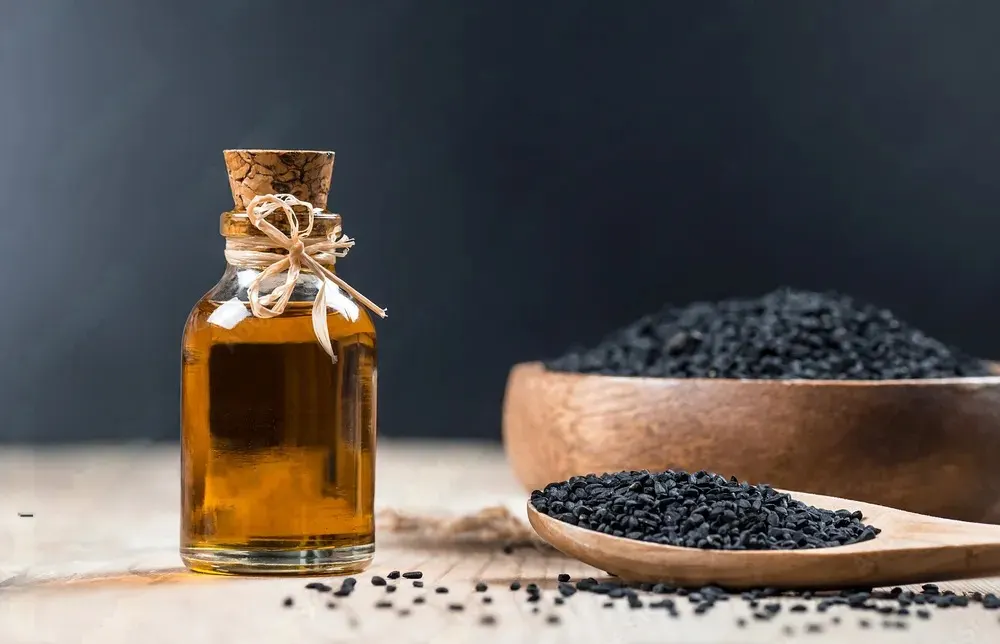

What Is Black Seed Oil (Nigella sativa Oil)?
Black seed oil (also called black cumin seed oil or kalonji oil) is a fixed plant oil pressed from the small black seeds of Nigella sativa. These seeds contain roughly 30–35% fixed oil. Unlike an essential oil, black seed oil is a carrier/vegetable oil rich in fatty acids (chiefly linoleic, oleic, and palmitic acids) and minor bioactive compounds. Thymoquinone is the most notable phytochemical, typically 0.5–2% in cold-pressed oil. The oil has a dark reddish-amber color and a peppery aroma when unrefined. Historically used in Middle Eastern and Mediterranean cuisines and remedies, today it is marketed for topical and ingestible products. Its nutritional profile includes mostly unsaturated fats: linoleic acid ~55–67%, oleic acid ~20–25%, palmitic acid ~9–14%, stearic acid ~2–4%. (See Table below.)
Cold-Pressing: Process, Yield, Pros and Cons
Cold pressing is a mechanical extraction method: cleaned Nigella seeds are crushed in a press without added heat or solvents. The process yields oil (~30–35% of seed mass) that retains natural color, aroma, and nutrients. A typical cold-pressing workflow is:
Yield: Cold pressing typically recovers ~30–32% of oil. Pressing the seed cake with solvents can extract an additional ~13%, but cold-pressed oil emphasizes purity.
Advantages: Cold pressing avoids chemical solvents and high heat, preserving delicate compounds like thymoquinone and natural antioxidants. The oil remains unrefined, retaining its pungent flavor and full nutrient profile.
Drawbacks: Cold pressing may give lower yield than solvent extraction. Also, cold-pressed oil can have a high peroxide value (PV) and acid value (AV) if the seeds or oil oxidize easily. Unrefined black seed oil supplier often exhibits PV and free fatty acid (FFA) levels that would necessitate refining for certain uses. (Refining steps can reduce PV and AV but also remove some beneficial compounds.) Careful seed storage and processing is needed to limit initial FFA/PV.
Process Note: Cold pressing is done below ~40°C, as higher temperature degrades thymoquinone. Any added heat or solvent extraction must be reported, as it alters the oil’s classification.
Sourcing and Traceability
Origins: Nigella sativa is native to the Eastern Mediterranean and Middle East and is now cultivated worldwide (e.g. Turkey, Egypt, Ethiopia, India, Pakistan, Iran). Seed origin affects oil composition; for example, Ethiopian highland oils have been reported with higher thymoquinone than some other regions. Typical seed oil content is ~30–35%, and this can vary by genotype and growing conditions.
Organic vs. Conventional: Certified organic black seed oil exists. Certified suppliers ensure seeds are grown without prohibited pesticides or fertilizers. natural lots often have accompanying records and labeling. If natural certification is needed, buyers should request organic certificates and COAs for each batch.
Traceability: Responsible suppliers provide lot traceability from farm to oil. This includes documentation of seed origin, harvest data, and processing. (For example, one supplier notes that “natural status is confirmed per qualified lot, with applicable pure records and shipment documentation”.) Buyers should request supply-chain records and visit the manufacturer or audit their facility to ensure honest labeling. Transparent suppliers use batch numbers and provide Certificates of Analysis (COA) tied to specific lots.
Purity and Quality Testing
Certificate of Analysis (COA): Every wholesale batch should ship with a COA detailing key parameters and tests. At minimum, COAs often include:
- Fatty acid profile: Confirms the oil is Nigella sativa. Typical (cold-pressed) profiles: linoleic ~55–67%, oleic ~20–25%, palmitic ~9–14%, stearic ~2–4%, with minor α-linolenic. Deviations (e.g. unusually high palmitic or linoleic outside these ranges) may signal adulteration.
- Thymoquinone (TQ) content: Measured by HPLC or GC-FID. Good quality cold-pressed oil is about 0.5–2% TQ (5–20 mg/g). Bulk grades may advertise TQ by weight. Unrefined oils range ~0.4–1.5%; heat/SCO₂ methods can boost it higher.
- Peroxide Value (PV): An indicator of oxidation (rancidity). Fresh cold-pressed oil should have PV under ~10–15 meq O₂/kg. Higher PVs imply poor seed storage or old oil.
- Acid Value (AV) / Free Fatty Acids (FFA): High values indicate degraded oil. Cold-pressed black seed oil should have AV <3–4 mg KOH/g oil.
- Moisture/Volatile Matter: Should be low (typically <0.2–0.5%).
- Iodine Value, Saponification Value: Optional, general fixed oil tests (ensure expected unsaturation).
- Solvent Residue: Must be non-detectable for cold-pressed oils (hexane or other solvents violate the “solvent-free” claim).
- Heavy Metals and Contaminants: Standard tests for Pb, As, Cd, Hg (below EU/FDA limits) and for pesticides/mycotoxins if required. Black seed oil should meet food-grade limits (e.g. Pb <0.2 ppm etc.).
- Microbial: Not usually significant in sealed oil, but some COAs include total plate count or absence of pathogens as assurance.
- Sensory Check: (Not in COA text) Color (dark amber-red), taste (peppery), and odor should be characteristic. Oils that are pale/yellow or scentless have likely been refined or diluted.
Quality Standards: There is no dedicated Codex for Nigella oil, but it must comply with general edible oil standards (Codex CXS 210:1999) regarding contaminants and definitions. Pharmacopeial limits (e.g. in national monographs) may exist in some countries for “Nigella sativa oil”. For example, ranges for fatty acids and tests like UV absorption are used to flag adulteration.
Independent Testing: To verify supplier COAs, buyers may send samples to third-party labs (HPLC for TQ, GC for FA profile). Digital COAs like SDS often accompany each shipment for label use. A credible supplier will allow sample lab analysis and transparently report results.
Table: Quality Test Parameters
| Parameter | Typical Specification | Rationale/Notes |
|---|---|---|
| Fatty Acid Profile | Linoleic 55–67%<br>Oleic 20–25%<br>Palmitic 9–14%<br>Stearic 2–4%<br>Others trace | Confirms Nigella oil authenticity. Deviations (e.g. high C16:0 or C18:2 outside range) suggest adulteration. |
| Thymoquinone (TQ) | 0.5–1.5% (5–15 mg/g) for standard cold-pressed; High-grade 1.5–2.5%; <0.3% if refined | Key bioactive marker. Low TQ may indicate old oil or dilution; high for targeted high-potency grades. |
| Peroxide Value (PV) | Fresh oil < 10–15 meq O₂/kg | Indicates oxidation; higher means rancidity onset. |
| Acid Value (AV) | < 3–4 mg KOH/g | Reflects free fatty acids (FFA). Low AV means fresh, well-handled seed. |
| Moisture | < 0.5% | Excess moisture can cause hydrolysis and spoilage. |
| Solvent Residues | None (ND) | Cold-pressed oils must not have detectable hexane or other solvents. |
| Heavy Metals | Meet regulatory limits (e.g. Pb < 0.2 ppm, Cd <0.1 ppm etc.) | Standard edible oil limits; often tested to ensure safety. |
| Microbes | Usually not detected (<10 CFU/g) | Oil is low-water, but COA may report microbial safety or absence of pathogens. |
| Sensory | Dark amber color; peppery aroma | Organoleptic clues: pale or odorless may indicate refinement or adulteration. |
Storage and Packaging Best Practices
Once extracted, black seed oil must be protected from light, heat, and oxygen to prevent oxidation. Best practices include:
- Packaging Materials: Use dark amber or stainless steel containers (coated inside) to block light. Food-grade HDPE or other inert materials are used for drums/IBC. BlackSeedSource (producer) advises keeping oil in “a cool, dark place in food-grade packaging, away from heat and light”.
- Bottling: Retail/private-label products typically use amber glass bottles (with inert liners) to minimize UV exposure. Bulk drums (e.g. 55-gallon steel) and IBC totes are standard for large orders.
- Headspace: Fill containers as fully as practical. Minimal air above the oil reduces oxidative exposure.
- Shelf Life: Unopened high-quality cold-pressed black seed oil generally lasts 12–18 months if stored cool (10–20°C) and dark. Once opened, refrigeration and minimal air contact extend freshness. Suppliers often stamp a “best before” date and provide guidance. Blackseedsource notes “shelf life confirmed per batch” with documentation.
- Temperature: Store at ambient or cooler (e.g. ~15°C). Avoid warm environments (above 25°C), which accelerate rancidity.
- Humidity: Excess humidity is not a concern for the oil itself, but warehouse moisture should be controlled to protect packaging and labels.
- Labeling: Labels should list “Nigella sativa seed oil” (INCI name), batch number, net weight, country of origin, extraction method (cold-pressed), and any relevant certifications or claims (e.g. USDA Organic). Avoid health claims; purely functional descriptors are safest.
Packaging Options
- Mid volumes: 1.25-gallon (5 L) or 5-gallon (18.9 L) food-grade jugs or pails.
- Bulk orders: 55-gallon (200 L) steel drums or 275–330 gallon IBC totes. These are common minimum bulk units for large buyers (distributors, manufacturers).
- Many suppliers allow split pallet amounts or quote custom volumes beyond standard packs.
Applications in Food, Cosmetics, and Supplements
Black seed oil’s primary components (essential fatty acids, TQ, other minor volatiles) make it suitable for various B2B applications:
- Nutraceuticals/Supplements: As a dietary supplement ingredient (capsules or oils), Nigella oil is valued for its nutritional profile. The manufacturer (Chestnut Supply) notes their buyers include “supplement and nutraceutical brands”. In supplements, the oil is labeled as a food ingredient; no medicinal claims can be made (see Regulatory).
- Food Products: Black seed oil is used as a culinary oil or food additive in health foods, ethnic cooking oils, and gourmet products. Because of its flavor (spicy, peppery), it may be blended with neutral oils for palatability. The oil is stable enough for cold applications; one supplier offers a “food-grade (refined)” version for milder taste.
- Cosmetics & Skin Care: In topical formulations, black seed oil is incorporated into serums, lotions, and balms. It’s marketed for its emollient properties and fragrance. Cosmetic regulations typically require it to be listed by INCI name (Nigella sativa seed oil). Safety assessments (e.g. by CIR or EU Cosmetic Ingredient Database) should guide use levels, but pure cold-pressed is generally accepted in natural cosmetics.
- Industrial/Other: Some use it in aromatherapy/hygiene or equine supplements (Veterinary-grade), though these are niche.
Choosing a Wholesale Manufacturer or Supplier
Key factors for selecting a black seed oil manufacturer:
- Certification and Compliance: Look for GMP/FSMA-compliant producers (especially for food/supplement use). Certifications like ISO 9001 (quality), ISO 22000/HACCP (food safety), FSSC 22000, or SQF indicate robust quality systems. certification if needed. The supplier should also be registered with FDA (if U.S. market). Table 1 below lists typical audit/supplier criteria.
- Factory Audit: A plant tour or third-party audit (UL, NSF, BRC, etc.) can verify sanitation, GMP procedures, and equipment (e.g. cold-press machines). Suppliers audited by global buyers often have certifications or will share audit results.
- Traceability and Supply Chain: The ideal supplier traces seeds through the chain. Direct-source manufacturers (e.g. those with farms in Turkey or India) offer better traceability than brokers. For example, Chestnut Supply is “manufacturer-backed” with seeds grown/pressed in Turkey. Confirm they do not blend oils from multiple undocumented sources.
- Quality Control Practices: Check if each batch is tested. One supplier advertises that “every batch ships with a COA” covering thymoquinone and fatty acid profile. Ask about in-house lab capabilities and third-party testing. See Table 2 for quality-test parameters a COA should include.
- Documentation: Require SDS/TDS, COA, organic certificates (if applicable), and an audited set of specs. Reputable suppliers keep batch records and can provide Certificates (organic, halal, etc.) on demand. As one notes, an organic certificate is not a substitute for the COA; the COA shows lab results.
- MOQ and Lead Times: Many suppliers are flexible with starting quantities. For example, Chestnut Supply allows as few as 12 bottles or one 12-pack, and ships drums (55 gal) within ~5–7 days. IBC orders may take 7–10 days. Always clarify minimums (some may require a full drum minimum for bulk pricing) and confirm warehousing location/shipping times. (If unspecified, note the buyer should verify.) Typical transit time for domestic U.S. is ~3–7 business days for smaller orders.
- Pricing & Payment: (Avoid discussing prices per instruction.) Expect quotes per volume; negotiate terms like FOB vs DDP. Payment terms (L/C, net days) vary by supplier size. (We focus on non-price factors here.)
- Customer Support: Good suppliers provide technical support (e.g. formulation advice) and prompt response. Chestnut Supply boasts “real human support — not chatbots” as a selling point.
- Reputation & References: Consider supplier testimonials or case studies. Contact other buyers or check industry trade forums.
Table: Supplier Selection Criteria
| Criterion | What to Check / Ask |
|---|---|
| Certifications | FDA Food Facility Registration, GMP (dietary supplements cGMP), ISO 9001/22000, FSSC22000, HACCP, Kosher/Halal if needed. |
| Quality Systems | In-house QC lab, COA routine, process controls, HACCP plan, change control (document change handling). |
| Audit History | Third-party audit reports (e.g. NSF, UL, BRC); willingness to host inspections; recall history (if any). |
| Traceability | Farm-to-batch traceability: Can supplier identify seed harvest, origin, and process date for each lot? |
| Testing / COA | What tests on COA (TQ, FA profile, PV, AV, heavy metals, contaminants)? Lab accreditation (e.g. ISO17025)? |
| Processing Method | Confirm actual extraction: cold-pressed vs refined; any deodorization or additives. |
| Supply Chain | Direct manufacturer vs. trader; location of pressing facility; backup supplier in case of crop failure. |
| MOQ & Lead Time | Minimum order qty; typical lead times (e.g. 2 weeks for drum, longer for organic lots); restocking frequency. |
| Storage & Packaging | Storage conditions in warehouse (climate control, FIFO), packaging materials (food-grade), leak prevention. |
| Quality Guarantees | Warranty or credit if oil fails specs; shelf-life at time of shipping. |
| Technical Support | Access to technical data (COA/SDS), formulation advice, sample availability. |
Each of these should be documented in contracts or purchase agreements where possible.
Safety and Regulatory Considerations
- Health Claims: Black seed oil is not an approved drug. Avoid stating medical benefits. U.S. FDA and EU authorities permit marketing as food/supplement but strictly forbid unverified health claims. All communications should be limited to general well-being language or cosmetic-safety terms. As a supplier notes, they “supply food-grade and supplement-ingredient black seed oil” but do not make health claims; final labeling claims are the buyer’s responsibility.
- Labeling: Follow relevant labeling laws. For food use, list Nigella sativa seed oil (USDA/INCI). Do not call it an “essential oil” (since it’s a fixed oil). Include allergen statements if required by law (Nigella is not a major allergen in most countries, but if processing in a facility handling nuts/seeds, declare as needed). Use the correct name (avoid confusing terms like “black cumin” without species).
- Allergens: Nigella sativa is unrelated to true cumin or caraway. It is not one of the top-8 allergens, nor listed under EU allergens. Still, if selling as a spice or in a facility with sesame/wheat, check local allergen regs.
- Contaminants: Adhere to edible oil contaminant limits. Pesticide residues must be within EU MRLs or FDA action levels. Aflatoxins are typically not a concern in oil but any fungal infection of seeds should be monitored. Many COAs include heavy-metal panels (Pb, Cd, Hg, As) at or below Codex limits.
- Regulatory Registrations: For food, check if Nigella oil requires any novel-food approval. In the EU, N. sativa seed oil is traditionally consumed in some cultures, but confirm any jurisdiction-specific list (some botanical extracts are regulated). In the US, it is Generally Recognized As Safe (GRAS) as a food ingredient. For cosmetic use, ensure compliance with Cosing (EU) or FDA’s Voluntary Cosmetic Registration Program ingredients database (though fixed oils typically have no additional restrictions besides safe use).
- Safety Data: Provide SDS and TDS (technical data sheet) on request. Labelling should not claim contraindications, except perhaps a shelf-life or storage statement. One supplier’s FAQ explicitly states their supply is for B2B, and labeling compliance is buyer’s task.
- Traceability Documentation: Keep all supplier certificates (organic, halal, etc.) and COAs on record to prove compliance in your market.
FAQs
1. What distinguishes cold-pressed black seed oil from other extraction methods?
Cold-pressed oil is mechanically pressed from Nigella sativa seeds without added heat or solvents. This preserves the oil’s natural aroma, color, and nutrients. Other methods (solvent extraction, heat pressing, supercritical CO₂) can yield more oil or higher thymoquinone content, but may also require refining or degrade some compounds. A high-quality cold-pressed oil typically retains the characteristic dark color and peppery scent of Nigella seed, whereas refined or solvent-extracted oil is paler and milder. (For example, a study found that CO₂ extraction can yield more thymoquinone than cold pressing.)
2. How can I verify the purity of a black seed oil batch?
Request a recent Certificate of Analysis (COA) for each batch. A COA should show key lab results: fatty acid composition, thymoquinone content, peroxide and acid values, and contaminant tests. Verify that the fatty acid profile matches Nigella oil norms (e.g. ~59% linoleic, 25% oleic, 12% palmitic). Check that peroxide and acid values are low (fresh oil typically has PV<10–15 meq/kg and AV<3–4 mg KOH/g). Ensuring tests were done by accredited labs (e.g. HPLC for thymoquinone) increases confidence. You can also test an in-house sample via a lab to cross-check the supplier’s COA.
3. What is a typical thymoquinone level in commercial black seed oils?
Thymoquinone (TQ) can vary widely by origin and extraction. Cold-pressed oils generally have around 0.5–1.5% TQ. Some high-TQ grades (often CO₂ extracts or specially sourced seeds) may reach 2–5%. Independent studies have found ranges from ~0.07% to 1.88% among market oils. For food or supplement use, standardized content (e.g. “2% thymoquinone”) is often preferred. Always confirm TQ in the COA, as sellers should not rely on unstated claims.
4. How long is black seed oil shelf-stable?
Unopened, high-quality cold-pressed Nigella oil usually keeps for about 12–18 months under ideal storage (cool, dark, airtight). Suppliers often guarantee a “best before” date on labels. After opening, oxidation starts, so minimize air exposure and refrigerate if possible. Using amber bottles or opaque drums and storing at ~15–20°C can extend freshness. Heat, light, and moisture accelerate rancidity.
5. Are there medical or allergy warnings I should consider?
While Nigella seed is traditionally medicinal, legally no disease claims can be made. Per the supplier’s FAQ, only neutral statements are allowed; safety labelling must comply with food/cosmetic laws. Nigella sativa is not a major allergen in most regulations (not in FDA’s top 9 list or EU’s 14). However, if the oil is processed where other allergens are present (e.g. sesame, mustard), cross-contamination might occur. Always review local allergen labeling requirements. Due to its potent taste and oils, high doses could upset sensitive digestion, but no specific toxic dose is established. (One animal study noted very high doses of fixed oil were “slightly toxic”; typical use levels are much lower.)
6. How is black seed oil typically tested for contaminants?
Standard edible oil screenings apply. Tests include heavy metals (Lead, Arsenic, Cadmium, Mercury) to ensure levels below Codex or local limits. Pesticide screening (using multi-residue methods like GC/MS) is common if needed. Some COAs also report absence of solvents (verified by GC). Microbial tests are rarely needed for fully sealed oil (low water activity), but can be done. The COA or SDS may include a statement on safety (e.g., “no detectable pesticides” or heavy metal <LOQ). Always confirm that all results meet your country’s food or cosmetic safety standards.
7. What does “natural” black seed oil mean and how is it verified?
Organic oil means the seeds were grown under certified natural agriculture standards (no synthetic pesticides or fertilizers). Verification comes via an official Natural certificate (USDA NOP, EU, or other) tied to that batch. Certification bodies like ETKO audit the farm and processing. Pure claims must match the certificate’s scope – often only certain lots can be organic. Buyers should request the certificate and ensure the batch number on the COA is listed as organic. (As one producer explains, “Naturalstatus is confirmed per qualified lot”.) Remember: the organic certificate is not the same as a COA; you need both.
8. What is the difference between bulk and private-label supply for black seed oil?
Bulk supply refers to large-volume oil typically sold for further processing (food formulators, capsule makers, etc.). Private-label products are finished, consumer-packaged oils or softgels branded by the retailer. Bulk suppliers usually offer barrels, drums, or IBCs. Private-label suppliers may fill bottles or capsules with custom labels. Some manufacturers (like Chestnut Supply or BlackSeedSource) do both. For bulk orders, you’ll negotiate volume pricing and handle your own packaging. For private-label, the supplier might offer contract manufacturing (e.g. bottled and labeled for you). Ensure you know exactly what form (refined/unrefined, TQ level, container) you are ordering.
9. How should I store and handle black seed oil after receiving it?
Upon receipt, verify packaging integrity (no leaks, no broken seals). Store sealed containers upright in a cool (preferably <25°C), dark, and dry warehouse. Use first-in-first-out (FIFO) for stock. If you open drums or bottles, cap them tightly and minimize air exposure (vacuum pumps or inert gas blanketing help at industrial scale). Note any off-odor or cloudiness on opening – these could indicate spoilage. Ideally, place bottles in refrigerators after opening for longevity. Avoid storing near heat sources or direct sunlight. Proper labeling of receipt date and “use by” dates on internal records helps manage shelf life.
10. What certifications should I look for in a black seed oil supplier?
Key certifications to ensure quality and compliance include:
- GMP/FSMA/Food Safety: For the U.S., ensure the supplier is a registered Food Facility and follows cGMPs (especially if selling in the supplement/food market). ISO 22000 or HACCP certification is also beneficial for food safety.
- ISO 9001 (Quality): Indicates a documented quality management system.
- Organic: USDA NOP, EU, or other certs if organic oil is needed.
- Kosher/Halal: If markets require.
- Kosher/Halal (for specific markets): These certifications show the product meets religious dietary laws (some suppliers list these if applicable).
- Third-party Audits: BRC, IFS, or NSF audits demonstrate high standards (especially for food ingredient suppliers).
Look for Certificates of Analysis (not a certificate but a document) with each batch that test oil quality (see FAQ 2). Also, ensure the supplier has liability insurance or a recall plan in case of safety issues. Certifications like ISO/HACCP are documented proof of systems, but on-the-ground quality comes from verified test results and traceability as described earlier. Visit My Website: Hetaksh Essential Oils



Join the conversation