
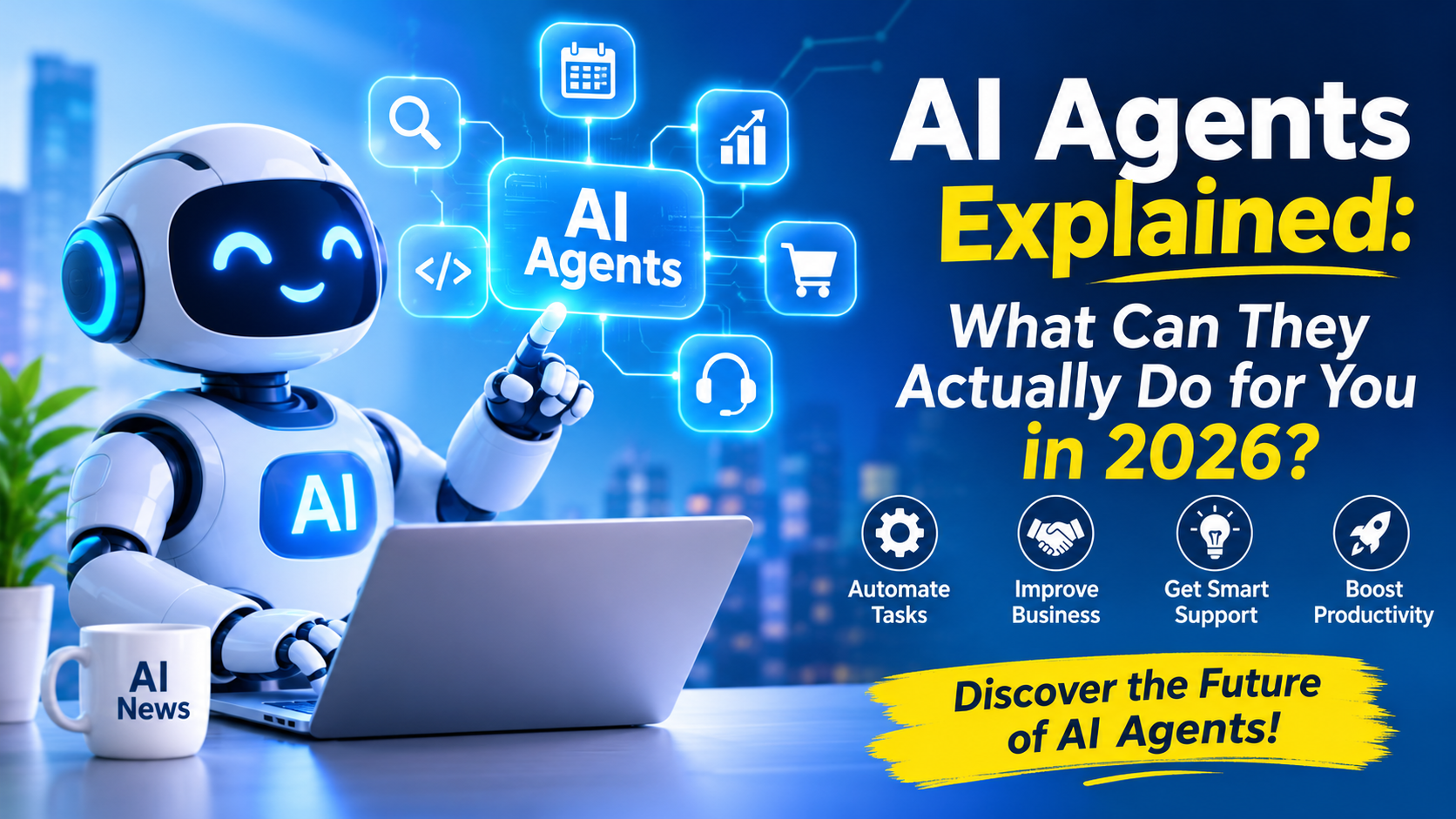

Artificial intelligence is evolving faster than ever. A few years ago, most people used AI tools to ask questions, generate content, or find information. Today, AI is moving beyond simple conversations. It can plan tasks, make decisions, use digital tools, and complete multiple activities with limited human involvement. This new development is bringing AI agents into the spotlight in 2026.
AI agents are becoming an important part of the modern digital world. From managing business operations to helping individuals organise their daily schedules, these intelligent systems are changing how people interact with technology. But what exactly are AI agents, and what can they actually do for you?
Let’s explore how they work, where they are useful, and why they are attracting so much attention.
What Are AI Agents?
AI agents are intelligent software systems designed to understand instructions, make decisions, and perform tasks to achieve specific goals. Unlike traditional AI chatbots that mainly respond to questions, AI agents can take action and complete tasks using connected applications, databases, websites, and other digital tools.
For example, if you ask a chatbot to help plan a business trip, it might suggest destinations, hotels, and travel options. An AI agent can potentially take this process further by comparing available flights, checking hotel options, preparing an itinerary, and organising the information for you.
The main difference is that AI agents do not simply provide answers. They can work through multiple steps to complete a requested task.
In simple terms, you provide the goal, and the AI agent figures out how to achieve it within the permissions and instructions you provide.
How Do AI Agents Work?
AI agents combine several technologies to understand instructions and perform activities. Their working process generally involves the following elements:
1. Understanding the Goal
First, the AI agent understands what the user wants to accomplish. It analyses the instruction and identifies the expected outcome.
2. Planning the Steps
After understanding the goal, the agent divides a complex task into smaller activities. It determines which actions are necessary and the order in which they should be completed.
3. Using Available Tools
AI agents can connect with different applications, APIs, websites, and databases. These connections allow them to collect information, analyse data, and perform authorised actions.
4. Taking Action
Once the plan is ready, the agent begins completing the required activities. It can adjust its approach if it encounters unexpected information or problems.
5. Checking the Results
Finally, the agent evaluates whether the task has been completed successfully. If something goes wrong, it may try another approach or request human assistance.
This combination of reasoning, planning, and tool usage makes AI agents more capable than conventional automated systems.
What Can AI Agents Actually Do for You in 2026?
AI agents are finding applications across different industries and everyday activities. Here are some practical ways they can make life and work easier.
1. Automate Everyday Tasks
One of the biggest advantages of AI agents is their ability to handle repetitive activities. They can help organise emails, manage schedules, prepare reports, sort information, and update records.
For example, an AI agent connected to an approved calendar and email account could identify meeting requests, check availability, and prepare calendar invitations for your approval.
This reduces manual work and allows people to spend more time on important responsibilities.
2. Improve Customer Support
Businesses are increasingly exploring AI agents to improve customer service. These systems can understand customer questions, retrieve relevant information, track support requests, and help resolve common issues.
For example, an online store could use an AI agent to check an order status, explain its return policy, and guide customers through a support process.
When a problem requires human judgement, the agent can transfer the conversation to a customer service representative.
3. Support Business Operations
AI agents can help businesses manage different operational activities. They can analyse information, prepare summaries, organise customer records, and assist with internal workflows.
Marketing teams can use them to research topics, analyse campaign performance, and organise content ideas. Sales teams can explore agents for lead research, customer follow-ups, and CRM updates.
However, businesses should establish clear permissions before allowing agents to make important changes or communicate externally.
4. Assist With Research and Information Gathering
Research often involves visiting multiple websites, collecting information, comparing sources, and preparing summaries.
AI agents can simplify this process by gathering information from approved sources, organising findings, and preparing structured reports.
For students, professionals, and researchers, this can save considerable time. However, important facts should always be checked against reliable sources because AI-generated information may contain mistakes.
5. Help Developers Write and Test Code
AI agents are also changing software development. They can analyse code, identify potential errors, suggest improvements, write new functions, and help run software tests.
Some advanced coding agents can work across multiple files and complete longer development tasks with limited supervision.
Developers can use these capabilities to reduce repetitive coding work and focus more on software design, problem-solving, and quality.
6. Personalise Online Shopping
AI agents could make online shopping more convenient by understanding customer requirements and comparing available products.
For example, someone looking for a laptop could explain their budget and requirements. An AI agent could research suitable models, compare specifications, and prepare recommendations.
With appropriate permissions and secure integrations, future shopping agents may also assist with purchasing activities. However, payments and other financial decisions should remain under clear user control.
AI Agents vs Traditional Chatbots: What’s the Difference?
Although AI agents and chatbots may appear similar, their capabilities are different.
FeatureTraditional ChatbotsAI AgentsMain purposeAnswer questionsComplete tasksDecision-makingUsually limitedCan make task-related decisionsTask executionMostly conversationalCan perform multiple actionsTool integrationOften limitedCan connect with external toolsWorkflow managementGenerally simpleCan manage multi-step workflowsHuman involvementUsually needed for actionsCan work with limited supervision
A traditional chatbot is useful when you need information or quick answers. An AI agent is more suitable when you want a system to work through a series of activities and achieve a specific result.
What Are the Benefits of Using AI Agents?
AI agents offer several potential advantages for individuals and organisations.
-
Save time: They can handle repetitive and time-consuming activities.
-
Improve productivity: People can focus on creative and strategic responsibilities.
-
Reduce manual work: Multiple activities can be managed through connected workflows.
-
Support faster decisions: Agents can collect and organise information for review.
-
Improve customer experiences: Businesses can offer more responsive customer support.
-
Scale operations: Organisations can automate suitable workflows as their requirements grow.
The actual benefits depend on the quality of the AI model, available tools, task complexity, and level of human supervision.
What Are the Risks and Limitations of AI Agents?
Despite their potential, AI agents are not perfect. Giving an AI system the ability to take action introduces additional risks that users and businesses should understand.
Incorrect Decisions: AI agents may misunderstand instructions or make incorrect decisions based on incomplete information.
Data Privacy: Agents connected to emails, business software, or personal accounts may access sensitive information. Proper access controls are essential.
Security Threats: Malicious instructions, prompt injection, and insecure integrations can influence an agent’s behaviour.
Limited Human Understanding: AI agents may struggle with situations requiring emotional intelligence, complex judgement, or an understanding of sensitive circumstances.
Unintended Actions: An agent may perform an action that the user did not expect, particularly when it has excessive permissions.
To reduce these risks, users should start with low-risk tasks, restrict access to necessary information, monitor activities, and require human approval before important actions such as payments, account changes, or external communications.
What Does the Future of AI Agents Look Like?
The future of AI agents is expected to involve more advanced automation, better tool integration, and improved coordination between multiple AI systems.
Instead of using separate applications for every activity, people may increasingly delegate complete workflows to intelligent agents. Businesses could use specialised agents for marketing, customer service, finance, research, and operations.
Multi-agent systems are another important development. In these systems, several specialised agents collaborate to complete a larger task. One agent might gather information, another could analyse it, and a third could prepare the final report.
However, greater autonomy will also require stronger security, accountability, transparency, and human oversight.
AI agents are unlikely to replace every human role. Their more practical purpose is to support people by handling suitable tasks while humans remain responsible for important decisions.
Final Thoughts
AI agents represent an important step in the evolution of artificial intelligence. They are changing how people approach everyday tasks, business operations, research, customer service, and software development.
In 2026, their biggest advantage is the ability to move beyond answering questions and start completing meaningful tasks. However, their success will depend on responsible implementation, reliable technology, and appropriate human supervision.
As AI continues to develop, staying informed about new technologies and industry developments becomes increasingly important. If you want to explore the latest artificial intelligence updates, emerging technologies, and industry trends, follow best AI news to stay informed about the changing world of AI.
The future of AI is not just about smarter conversations. It is about intelligent systems that can turn instructions into action.



Join the conversation