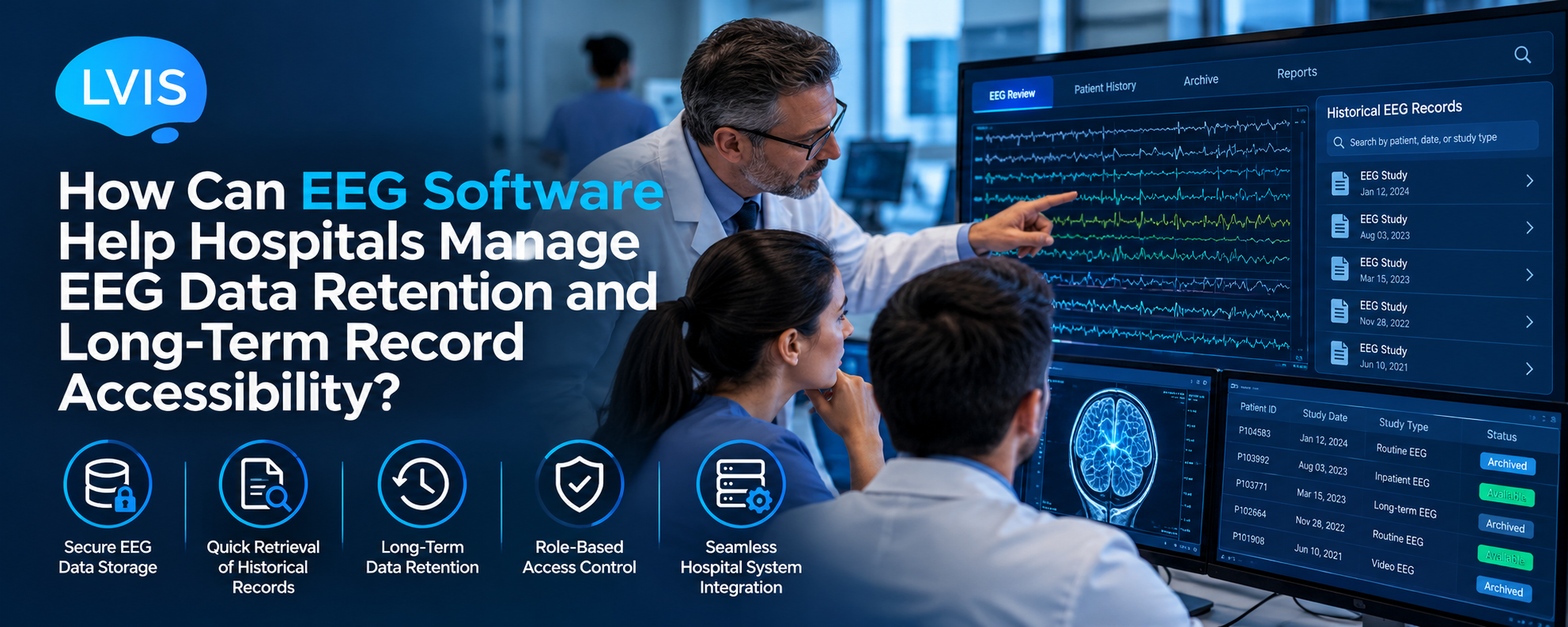
Hospitals generate substantial volumes of electroencephalography (EEG) data through routine neurological assessments, inpatient monitoring, and long-term epilepsy evaluations. As recording volumes increase, maintaining reliable access to historical EEG studies becomes an important clinical and operational responsibility. Neurologists may need previous recordings to compare findings, investigate changes in brain activity, or support ongoing patient care. EEG software can support these workflows by helping clinical teams organize recordings, locate relevant studies, and access EEG information within an established hospital data management environment. However, effective long-term record accessibility also depends on storage infrastructure, retention policies, cybersecurity controls, and integration with existing clinical systems.
Why Is Long-Term EEG Data Accessibility Important for Hospitals?
EEG recordings provide information about electrical activity in the brain that may remain clinically relevant beyond the original examination. A neurologist reviewing a patient’s current condition may benefit from comparing new findings with historical EEG recordings and associated clinical interpretations. For epilepsy monitoring units, historical data can also support longitudinal review when patients undergo repeated investigations. Hospitals therefore need processes that preserve the availability, integrity, and clinical context of EEG records throughout their required retention periods. Without a structured approach, older recordings may become difficult to retrieve, particularly when departments change software platforms or storage systems.
What Happens When Historical EEG Records Are Difficult to Retrieve?
Difficulty accessing historical EEG recordings can interrupt clinical workflows and create additional administrative work for neurology departments. Staff may need to search multiple storage locations, contact IT teams, or locate recordings maintained in legacy systems. These delays can complicate comparisons between current and previous studies, particularly when recordings are needed during time-sensitive clinical evaluations. Inconsistent file organization or missing patient identifiers can create further challenges when matching archived recordings to the correct medical record. A reliable retrieval process helps reduce unnecessary searching while supporting continuity of clinical information.
How Does EEG Software Support Data Organization and Retrieval?
EEG software can provide an interface through which authorized clinical users review recordings and access relevant study information. Depending on the platform and deployment configuration, software may support study organization, recording navigation, annotation management, and access to associated clinical data. These capabilities can make historical EEG review more manageable when recordings are maintained in compatible storage environments. Hospitals should distinguish between functions provided directly by the application and capabilities supplied by connected archives or hospital infrastructure. This distinction is important because a convenient clinical review interface does not automatically establish long-term storage or archival functionality.
Organizing Recordings With Consistent Study Information
Historical EEG retrieval becomes easier when recordings are associated with accurate and consistent identifying information. Relevant metadata may include patient identifiers, study dates, recording types, acquisition details, and other information required by the department’s workflow. Hospitals should establish procedures that reduce inconsistencies when recordings are imported, transferred, or archived. Standardized information also helps clinical teams distinguish between multiple EEG studies belonging to the same patient. During software evaluation, departments should verify which metadata fields are supported and how information is preserved when studies move between systems.
Retrieving Historical Recordings for Clinical Comparison
Neurologists may need to examine earlier EEG recordings alongside more recent studies to evaluate changes in observed patterns. Efficient retrieval depends on whether recordings remain accessible in a format supported by the department’s current review environment. The process should also preserve associated annotations and study context where clinically relevant. If older recordings require conversion or migration, hospitals should evaluate whether those processes affect data fidelity or interpretation. Testing representative historical studies before adopting a new system can help identify compatibility problems that might otherwise appear after implementation.
What Should Hospitals Consider When Planning EEG Data Retention?
Data retention policies determine how long EEG recordings and related clinical information must be maintained. Requirements may vary according to applicable laws, organizational policies, patient populations, record classifications, and institutional obligations. Hospitals should establish retention schedules through their health information management, legal, compliance, and clinical governance processes. Technology selection should then reflect those requirements rather than allowing storage limitations alone to determine how long records remain available. A documented retention strategy also helps departments understand when records should be archived, reviewed, or disposed of under authorized procedures.
Defining Storage and Archival Responsibilities
Hospitals should clarify which teams are responsible for active EEG storage, long-term archives, backups, and data recovery. Neurology departments typically understand the clinical importance of recordings, while IT teams manage the infrastructure supporting their availability. Health information management and compliance personnel may also contribute requirements related to record retention and authorized access. These responsibilities should be documented so that archived studies do not become inaccessible when personnel or technology systems change. Clear ownership is especially important when hospitals use multiple vendors or external hosting providers.
Distinguishing Active Storage From Long-Term Archives
Active storage generally supports recordings that clinicians access frequently during routine patient care and ongoing monitoring. Long-term archives may use different infrastructure designed for extended preservation and less frequent retrieval. Hospitals should evaluate how recordings move between these environments and whether clinical users can retrieve archived studies within acceptable timeframes. The process should account for file compatibility, associated metadata, access permissions, and potential retrieval costs. A system that performs well during active review may still require additional infrastructure to meet long-term archival needs.
How Can Hospitals Protect EEG Data Integrity Over Time?
Long-term accessibility is useful only when stored recordings remain complete, accurate, and suitable for their intended clinical use. Data integrity controls help organizations detect unauthorized changes, corruption, incomplete transfers, or other problems that could affect archived information. Hospitals may use measures such as file integrity verification, controlled migration procedures, backup validation, and documented recovery testing. These controls should be selected and managed through the organization’s established information security and data governance processes. Clinical teams should also verify that retrieved recordings retain the information needed for appropriate interpretation.
Why Should EEG Archives Include Recovery Testing?
A backup does not guarantee that an EEG recording can be restored successfully when needed. Recovery testing helps organizations determine whether stored files, metadata, and associated information can be retrieved after an infrastructure failure or other disruption. Hospitals should evaluate restoration procedures using representative EEG studies and the applications required to access them. Testing can also reveal dependencies on software licenses, proprietary formats, or discontinued systems. Documented recovery exercises provide stronger assurance than relying exclusively on confirmation that backup jobs completed.
How Do Access Permissions Affect EEG Record Management?
EEG recordings are part of sensitive clinical information and require appropriate safeguards against unauthorized access or disclosure. Hospitals should apply access controls based on legitimate clinical and operational responsibilities. A neurologist reviewing a patient study may require different permissions from an IT administrator maintaining storage infrastructure. Organizations should also consider authentication, audit logging, user provisioning, and timely removal of access when responsibilities change. These requirements should be evaluated across the complete EEG environment, including the review application, storage systems, connected services, and hospital identity infrastructure.
Supporting Clinical Collaboration Without Compromising Privacy
Neurology teams often include physicians, EEG technologists, epilepsy specialists, and other authorized professionals who contribute to patient evaluation. Collaboration may require several users to access the same recordings or review associated findings. Hospitals should determine how their technology environment supports appropriate information sharing while maintaining patient confidentiality. Access arrangements must reflect institutional policies and applicable privacy requirements rather than relying solely on the convenience of a software interface. During procurement, teams should verify available security features and identify which controls depend on external hospital systems.
How Can EEG Analysis Software Fit Into Existing Hospital Systems?
Hospitals rarely manage EEG recordings independently of their broader clinical information environment. Patient identifiers, examination orders, clinical reports, and relevant encounter information may be maintained in electronic health records or other hospital systems. EEG analysis software should therefore be evaluated in the context of the department’s existing data flows and operational requirements. Integration needs may include importing recordings, exchanging relevant information, or supporting established reporting workflows. The availability of specific interfaces and interoperability functions must be confirmed with the vendor rather than assumed from the software category.
Evaluating Compatibility With Existing Record Formats
Hospitals may maintain EEG recordings acquired through different devices, manufacturers, or generations of technology. These recordings can vary in format, metadata structure, and compatibility with review applications. Before selecting a platform, departments should identify the file types and acquisition systems used across their current and historical studies. Procurement teams can then request demonstrations using representative recordings from their own environment. This practical evaluation helps determine whether the proposed workflow supports the hospital’s actual clinical data rather than only vendor-provided examples.
Planning for Future System Changes
EEG systems may be replaced or upgraded during the lifetime of records that hospitals are required to retain. Organizations should consider how they would export, migrate, or retrieve information if they changed software providers. This includes understanding supported formats, data ownership arrangements, migration responsibilities, and potential dependencies on proprietary technology. Contracts and implementation plans should address relevant data access and transition requirements before deployment. Planning for future portability can reduce the risk of historical EEG information becoming difficult to access after technology changes.
Can AI EEG Tools Improve Historical Recording Review?
Artificial intelligence may support selected EEG review tasks, including identifying segments that warrant closer clinical attention. AI EEG capabilities should be evaluated according to their intended use, validation evidence, and compatibility with the organization’s clinical workflow. For historical studies, departments may be interested in whether supported analytical functions can be applied to previously recorded data. However, the ability to analyze archived recordings depends on file compatibility, available functionality, and the conditions under which the technology has been validated. AI-generated outputs should support qualified clinical review rather than replace professional interpretation.
Why Is Human Oversight Essential?
EEG interpretation requires clinical context, technical knowledge, and an understanding of potential recording artifacts. Automated findings may help reviewers prioritize selected information, but they can also require verification or additional investigation. Neurologists remain responsible for interpreting clinically relevant findings within the patient’s overall medical circumstances. Hospitals should establish procedures for reviewing AI-assisted outputs and documenting their use when appropriate. Any claims about analytical performance or workflow improvements should be supported by evidence relevant to the software version and intended clinical application.
What Should Hospitals Evaluate in EEG Review Software?
Clinical usability is an important consideration when selecting EEG review software for a hospital or neurology department. Reviewers should assess how easily they can navigate recordings, locate relevant segments, access study information, and perform their established interpretation tasks. They should also consider the training required for EEG technologists and physicians with different levels of software experience. A platform that fits existing workflows may reduce unnecessary administrative steps, although actual efficiency gains should be evaluated through testing. Procurement decisions should balance clinical functionality with security, compatibility, support, and infrastructure requirements.
Testing Historical Data Retrieval During a Demonstration
A vendor demonstration should include more than a review of recently acquired sample recordings. Hospitals can request testing with representative historical studies, including recordings from different acquisition systems where supported. Reviewers should examine whether essential information remains available and whether the recordings can be navigated appropriately. IT teams should separately evaluate the storage architecture and retrieval process required to make those studies accessible. This approach helps distinguish demonstrated application functionality from capabilities that may require additional configuration or third-party infrastructure.
How Can NeuroMatch Fit Into an EEG Software Evaluation?
Neuromatch, developed by LVIS Corporation, is a solution that hospitals can consider when evaluating EEG review and analysis workflows. Clinical and procurement teams should examine its documented capabilities against their own requirements for recording access, review functionality, and integration. They should specifically request confirmation of supported file formats, deployment options, data handling arrangements, and any relevant interfaces. Long-term archiving, retention enforcement, and historical record migration should not be assumed to be included without vendor confirmation. A structured evaluation can help determine whether the solution is appropriate for the hospital’s clinical and technical environment.
Questions to Ask Before Selecting a Platform
Hospitals should ask where EEG recordings are stored and which organization is responsible for maintaining the underlying infrastructure. They should also confirm how historical recordings are accessed, what permissions are supported, and whether relevant audit information is available. Questions about backup responsibilities, retention settings, supported file formats, and migration procedures are equally important. Procurement teams should request written clarification when a requirement depends on third-party systems or additional services. These answers help hospitals compare solutions using operational evidence rather than broad marketing descriptions.
How Can Hospitals Compare EEG Software Options?
Creating a structured list of eeg software options is a useful starting point, but the comparison should go beyond product names and feature summaries. Hospitals should identify mandatory clinical functions, data security requirements, integration needs, and long-term record management expectations. Each vendor can then be evaluated against consistent criteria using demonstrations, technical documentation, and responses to procurement questions. Departments should involve neurologists, EEG technologists, IT personnel, information security representatives, and procurement stakeholders in the process. A documented comparison helps ensure that important requirements are not overlooked during purchasing decisions.
Using an Evaluation Scorecard for Procurement
The EEG Software Evaluation Scorecard and Hospital Procurement Checklist – LVIS Corporation can serve as a starting resource for organizing vendor evaluation criteria. Hospitals can adapt the checklist to include historical data accessibility, file compatibility, user permissions, deployment architecture, and operational support. Each requirement should be assigned an appropriate priority based on the department’s clinical responsibilities and existing infrastructure. Procurement teams should record whether each capability has been demonstrated, documented, or remains subject to confirmation. This creates a more transparent basis for comparing potential solutions and identifying implementation risks.
What Should Hospitals Include in an EEG Data Management Plan?
An effective EEG data management plan should address the complete recording lifecycle, from acquisition and clinical review through retention and authorized disposal. It should identify who owns each process and how responsibilities are coordinated between clinical departments and hospital IT teams. The plan should also document applicable retention schedules, access controls, backup arrangements, recovery expectations, and system transition procedures. Regular reviews can help organizations identify changes in recording volumes, clinical requirements, or technology dependencies. These practices support sustainable data management regardless of which clinical review platform the hospital selects.
Establishing Clear Performance and Accessibility Requirements
Hospitals should define what acceptable record accessibility means for their clinical environment. For example, routine historical retrieval may have different operational requirements from access needed during an urgent inpatient evaluation. Departments should determine which studies must remain readily available and which can be maintained in longer-term archives. IT teams can then assess whether existing infrastructure and proposed software workflows can meet those expectations. Clear requirements help vendors provide relevant technical responses and allow hospitals to evaluate performance during implementation.
Conclusion: Evaluate EEG Data Accessibility With LVIS Corporation
Reliable EEG data retention requires coordination between clinical review workflows, hospital storage infrastructure, information security controls, and documented retention policies. EEG software can contribute to historical study accessibility when its capabilities align with the organization’s broader data management environment. LVIS Corporation provides EEG technology solutions for neurology teams evaluating clinical review and analysis workflows. EEG Laboratory Directors, Hospital IT Managers, neurologists, and procurement professionals should assess NeuroMatch against their specific requirements for recording compatibility, data access, and long-term operational support. Explore LVIS Corporation’s solutions and request information about how the platform may fit your department’s EEG review and data management needs.
Explore LVIS Corporation’s EEG Solutions: https://lviscorp.com/en/neuromatch
Visit LVIS Corporation: https://lviscorp.com/