


A token generation event (TGE) can draw thousands in one day. But how many will still care a month later? For founders, that matters more than trending hashtags. Marketing before TGE is not simply about attracting buyers. It is about giving the right people a reason to understand, test, and continue using what you are building.
Memento Research tracked 118 token launches in 2025 and found that 84.7% traded below their TGE valuations by December 20. Marketing cannot control market prices, but it can prevent an avoidable mistake: launching into attention without establishing genuine demand. Before you announce a date, test whether your audience understands the value beyond trading.
Start Marketing Before TGE With a Clear Token Purpose
Before hiring influencers, ask: would anyone want your product if the token were not tradable? If uncertain, fix the proposition before promotion. Start with the user problem, the product action that solves it, and the role the token plays in that action.
Put Usefulness Before Price Expectations
Consider a decentralized trading platform. “Our token will power the ecosystem” tells users almost nothing. Explain whether it pays for specific services, participates in governance, or supports a documented incentive mechanism. Separate live features from planned ones, and let a new visitor test the useful part without reading a fifty-page white paper. Avoid presenting proposed benefits as finished features.
Make Tokenomics Part of the Story
Token design and marketing must align. Audiences will ask about circulating supply, allocations, vesting, and upcoming unlocks. If your campaign promises community ownership while the distribution suggests otherwise, the contradiction becomes your headline. Publish a plain-English tokenomics explanation, with clear dates and risks, before asking anyone to trust the launch. Discuss who can sell when, not just who receives tokens.
Find Your Actual Users Before Buying Reach
Speculators are not necessarily product users. Map your first users by what they need: traders seeking better execution, developers needing infrastructure, or businesses seeking faster payments. Interview users where they discuss these problems. Their objections can matter more than ad impressions. Conduct five interviews in each priority segment. Ask what alternatives people use, what stops them from switching, and whether they would try a working demo. Use their answers to revise your landing page before buying traffic.
Chainalysis’s 2026 Global Crypto Adoption Index ranked Brazil first for grassroots adoption, with the United States second. Its methodology challenges the idea of one global crypto audience. Different markets have distinct behaviors and rules. Research language, payment habits, eligible jurisdictions, and local communities before choosing where to spend.
Give each audience a relevant path: an educational guide for newcomers, a demo for active users, or technical documentation for builders. The aim is qualified participation, not a bigger follower count.
Build Trust Before You Announce the Countdown
People have seen polished roadmaps before. What makes yours credible? Evidence. Publish demos, developer updates, independent security findings when available, and answers to difficult questions. If an audit is incomplete, say so. Audits cannot guarantee safety.
Founders looking for a coordinated approach to education, community outreach, and launch communications can review Web3 audience acquisition and launch marketing services as one option.
Give the Community Something Real to Evaluate
Host walkthroughs where users challenge assumptions. A testnet or beta offers more than giveaways. Track whether participants return and complete meaningful actions. Reward feedback without encouraging fake activity or promising an unapproved airdrop.
Trust also depends on what you refuse to claim. Avoid guaranteed returns, invented partnerships, and exchange-listing hints without confirmation. The UK Financial Conduct Authority requires clear risks in covered promotions. EU MiCA also sets requirements for applicable crypto-asset marketing communications, including consistency with required white papers. Review every market with qualified counsel before publishing offers.
Choose Marketing Channels for Their Jobs
Your launch needs coordinated channels, not every channel. Educational search content answers questions before people hear of your token. X can distribute product updates and founder commentary. Discord or Telegram can support discussion, but neither should become a room filled only with price predictions.
Creators are useful when their communities overlap with your likely users. Ask partners to demonstrate the product, disclose commercial relationships, and explain limitations. A smaller creator whose followers actually test your application may bring more value than a celebrity whose audience disappears after the sponsored post.
Connect each channel to one journey. A creator video should lead to a useful landing page, a demo, and a clear next step. Give each campaign its own tracked link or referral identifier. If viewers arrive but never try the product, change the message or audience before purchasing more exposure. Paid promotion must also pass platform and jurisdictional restrictions.
Run the Pre-TGE Campaign in Stages
A last-minute push creates noise when teams must resolve issues. Use a staged plan instead. The schedule below is an illustrative eight-week framework, not a universal timeline. Adjust it for product readiness, legal review, and the actual launch mechanism.
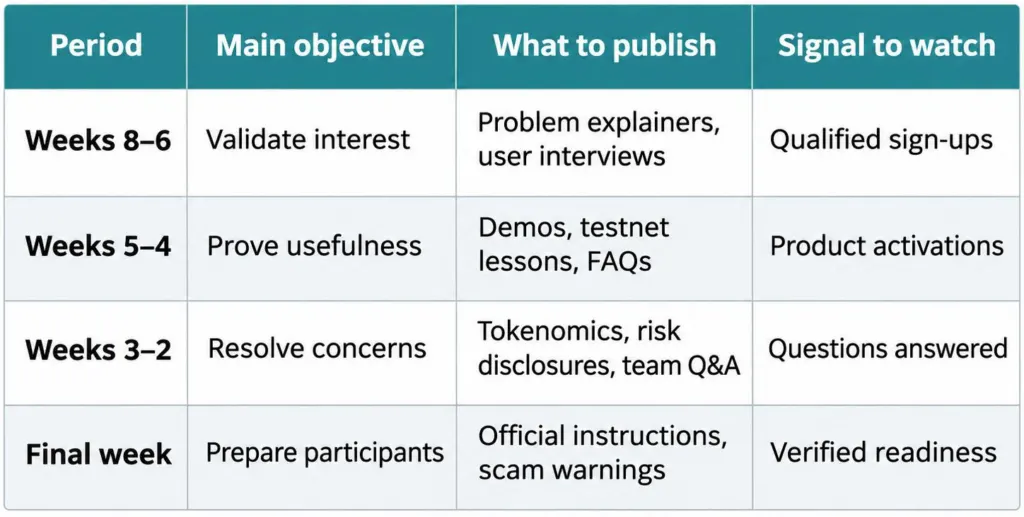
Avoid surprise allocations or wallet steps in the final week. Publish one official launch-information page and keep channels pointing to it. Test the mobile journey, wallet connection, geographic restrictions, and support process. Prepare messages for delays and phishing attempts. A calm correction is better than a rushed announcement that confuses thousands of users.
Measure What Happens After People Arrive
Follower growth is easy to report. Qualified activation is harder to fake and more useful to manage. Decide which action signals genuine interest: completing a testnet transaction, integrating an API, joining a product waitlist, or returning for a second session. Track the path from visitor to user, including where people abandon it. Fix confusing onboarding steps before increasing acquisition spending.
Build a simple weekly dashboard with acquisition source, cost per qualified participant, wallet-connection completion, first product action, and returning-user rate. Compare cohorts rather than celebrating one large traffic spike. A campaign bringing 500 testers may beat one attracting 50,000 unqualified visitors.
Plan the first 30 days after TGE: product updates, user support, community moderation, and honest explanations of changes. Token performance will remain exposed to wider market forces. Your marketing team’s job is to make product progress visible without pretending it can guarantee a price outcome.
Conclusion
The best time to explain a token’s purpose is before people are asked to buy or use it. Define your audience, demonstrate the product, explain tokenomics, and disclose risks. Then build a campaign that measures real participation rather than short-lived excitement. A successful TGE does not prove that a project has lasting users. The stronger achievement is launching with people who understand your product, trust your communication, and intend to return when the initial excitement passes.
Frequently Asked Questions
1. When should crypto marketing begin before TGE?
Begin as soon as you can clearly describe the user problem and show credible progress. Eight to twelve weeks may work, but readiness and regulatory checks matter more. Early research can start much sooner.
2. What matters more before TGE: community size or engagement?
Engagement tied to real product use is more informative. Look at returning participants, thoughtful questions, testnet activity, and referrals from relevant users. A large community driven mainly by giveaways may shrink quickly when rewards or launch speculation end.
3. Should founders use influencers before token launch?
Use creators selectively, especially those who can explain your product to a relevant audience. Check their past content, audience quality, and sponsorship disclosure practices. Avoid price promises and track what referred visitors actually do after arriving.
4. Is an airdrop necessary for a successful TGE?
No. Airdrops can distribute tokens and attract attention, but poorly designed rewards encourage farming and rapid exits. Decide whether distribution supports legitimate participation, and explain eligibility, limitations, and risks only after the rules have been approved.
5. Which pre-TGE marketing metrics should founders track?
Track qualified sign-ups, cost per qualified lead, product activation, returning users, and community response quality. Add wallet-connection and first-transaction rates when relevant. Compare these metrics by channel and audience to find which campaigns bring people likely to stay.



Join the conversation