
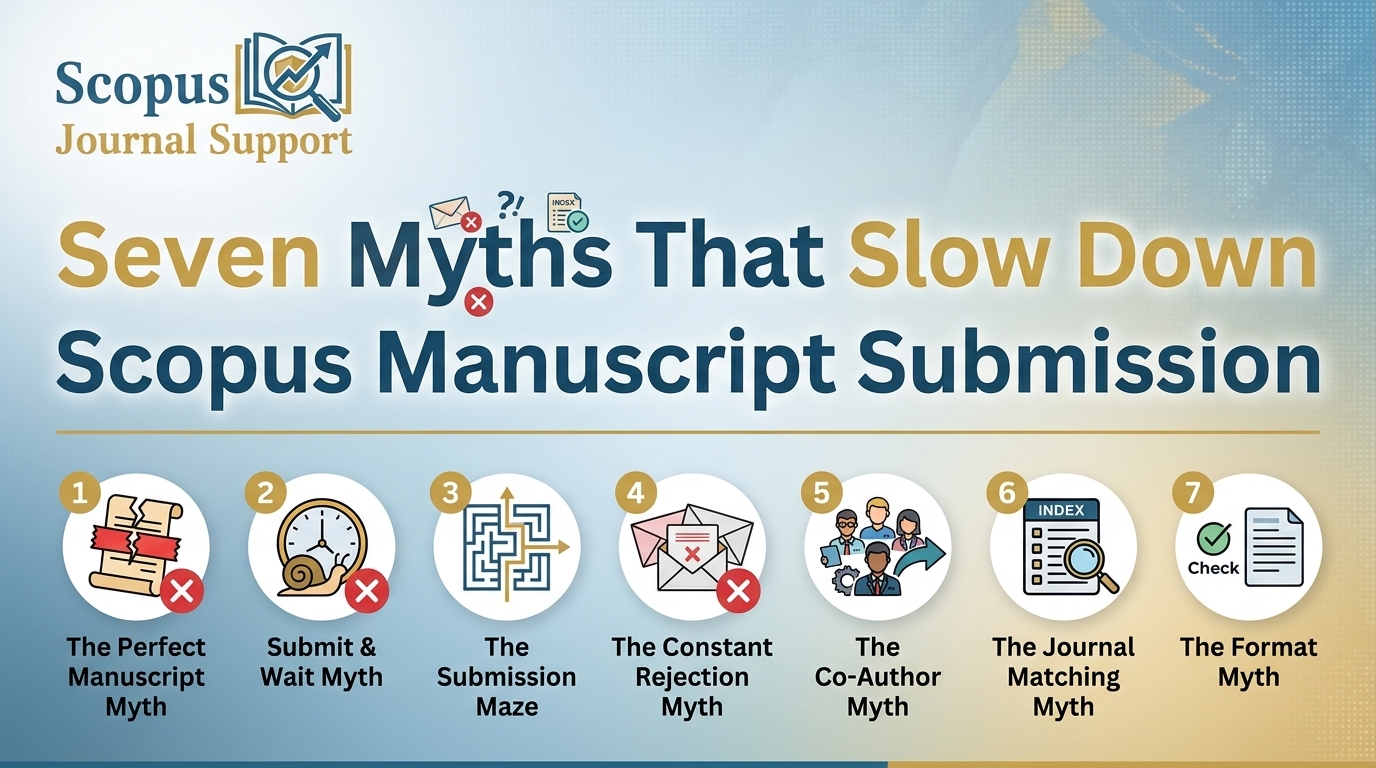

Some delays come from bad luck, but many come from beliefs that sound sensible and turn out to be wrong. A scholar who trusts the wrong assumption can lose months before anyone reads the paper. This article takes seven common myths apart one by one, and it explains what high quality Scopus manuscript submission process support Scopus Turkey should offer in their place.
Myth One: If a Journal Says It Is Indexed, It Is
Journal websites are written by the journal. A banner, a logo or a line in an invitation email is a claim, not proof. Check the official Scopus source list yourself, and compare the journal’s title and ISSN with what the publisher shows. Indexing status can change over time, so a journal that was listed when a colleague published there may not be listed today. This is why many authors ask for Scopus indexed journal publication help Turkey before drafting anything. They want one independent check before months of work go into a target.
Myth Two: Reviewers Only Judge the Results
Reviewers read the whole paper, and they form an opinion early. An unclear abstract, a vague research gap or a methods section that cannot be repeated all colour how the results are received. Before submitting, ask a colleague outside your subfield to read only the abstract and introduction. Then ask them to say, in one sentence, what your paper found and why it matters. If they hesitate, the paper is not ready, however strong the data.
Myth Three: A Low Similarity Score Means the Paper Is Safe
Similarity software compares text and produces a number. That number has no single safe value, because each journal and editor reads it differently. A low score can hide problems, such as paraphrased ideas that were never cited. A moderate score can be harmless, for example when it comes from reference lists, standard terms or a method description. What matters is whether every borrowed idea is credited and whether your own contribution is clearly yours. A Scopus plagiarism-free research paper editing service Turkey should help you reach that clarity by improving your wording and pointing out close overlap. It should never promise to push a score down by disguising copied sentences.
Myth Four: Formatting Can Wait Until After Acceptance
Some journals do accept a flexible format at first submission, and others do not. Treating all of them the same way is the myth.
Open the author guidelines before you write the final draft, not after. Look for these points:
- Whether the main file must be anonymised for blind review
- Which citation style and heading levels are required
- Word limits for the abstract and the full text
- Rules for figure format, table layout and supplementary files
- Mandatory declarations such as funding, ethics and conflicts of interest
Authors who look for Scopus journal formatting and submission help Turkey are usually not weak writers. They know that a returned file often loses more time than a rejected one, because it goes to the back of the queue after correction.
What Real Support Looks Like
A common belief is that support means handing over your paper and receiving a finished one. That is not how responsible help works. The ideas, data and conclusions belong to the author, and acceptance rests only with editors and reviewers. Scopus Journal Support focuses on the stages around the submit button: choosing a suitable journal, preparing the manuscript to that journal’s instructions and keeping communication with the editorial office organised. This is the practical meaning of high quality Scopus manuscript submission process support Scopus Turkey, which is guidance that makes your paper easier to evaluate without changing what it says. When you speak to any provider, ask what they will do with your file, what stays your responsibility and how unpublished data is handled. Specific, modest answers are a good sign.
Myth Five: A Revision Request Means the Paper Failed
A request for revision is the editor saying the paper has potential and needs work. Most published articles went through at least one round. Handle it in an orderly way. Read the letter once, then wait a day. Quote each comment in a response document, describe what you changed and give the page or line where the change appears. If you disagree with a point, explain why with evidence and keep the tone polite. Doctoral students meet this stage for the first time with an article taken from a thesis chapter. PhD research paper publication help Turkey can make that first round less alarming, since an outside reader can explain what a comment really asks for.
Myth Six: Sending to Several Journals Saves Time
It feels efficient to submit one paper to three journals and take the first yes. In practice, journals require that a manuscript be under consideration with one journal at a time, and breaking that rule can damage your standing with editors. A better use of time is a ranked list prepared in advance. Choose a first and second journal while you draft, and note the changes the second would need. If the first one declines, you can move within days instead of weeks.
Myth Seven: Affordable Help Must Mean Less Careful Help
Researchers working to a tight timetable sometimes assume that accessible support is thin support. The two are not opposites. What matters is whether the service is clearly described and whether its limits are stated honestly. When you look for affordable manuscript submission support Scopus Turkey, judge it by the clarity of the explanation. You should know exactly what is covered, what is not and what you still have to do yourself. A vague promise is a bad sign at any level.
Support Beyond a Single Article
Some projects are bigger than one paper, and a good partner will say plainly when a need is different. Anyone planning a book publication faces a very different path from article writing. A proposal, a chapter outline, the publisher’s own review and permission for borrowed figures all need attention, and the timeline is normally longer. For most researchers, journal publication is still the main route to being read and cited. It rewards a good match between paper and journal, and a careful reply to reviewers, more than it rewards speed.
Early-stage projects have their own needs. Research and consultancy services are useful when a question is vague, a data plan needs a second opinion or a literature review lacks shape. Scopus Journal Support can discuss where a project stands and which kind of help would be realistic. At the end of a degree, dissertation writing asks for something else again: one argument held steady across many chapters. It works best when the student leads the thinking and uses guidance for structure and clarity. In every case, Scopus journal publication support should be honest about what is possible and respectful of the author’s ownership of the work.
Questions Scholars Ask Before Submitting
What happens after my paper is accepted?
You will normally receive a copyright or licence agreement and later a set of proofs. Proofs are your last chance to correct typing errors, author names and affiliations, so read them slowly and return them by the stated date. New content is generally not allowed at this stage.
Can I withdraw a manuscript after submitting it?
Yes, but do it through the submission system or by written request to the editorial office. Withdrawing during peer review wastes reviewers’ time, so some editors may ask for a reason. Do it only for a sound reason, such as finding an error in the data.
Should I name opposed reviewers?
Many journals allow it. If you do, give a short and professional reason, such as a direct competing project or a past dispute. Editors take such requests seriously when they are specific and are cautious when they look like a way to avoid criticism.
How is a review article different from an original research article?
An original research article reports new data or a new analysis. A review article gathers and assesses published work to show what is known, what is disputed and what remains open. Each type has its own structure and expectations, so confirm the journal accepts the type you plan to write.
Do I need to declare funding even if it was small?
Yes, in most cases. Journals ask for every source of financial support, and funders often require it to be acknowledged. If the work had no funding, a short statement saying so is usually expected.
Before You Believe the Next Myth
Most of these myths survive because they save effort in the short term and cause trouble later. A manuscript moves more smoothly when each decision is checked against the journal’s own rules and your own evidence. If you would like a second opinion on your paper, the team at Scopus Journal Support is glad to talk it through and explain how high quality Scopus manuscript submission process support Scopus Turkey could fit your plans.



Join the conversation