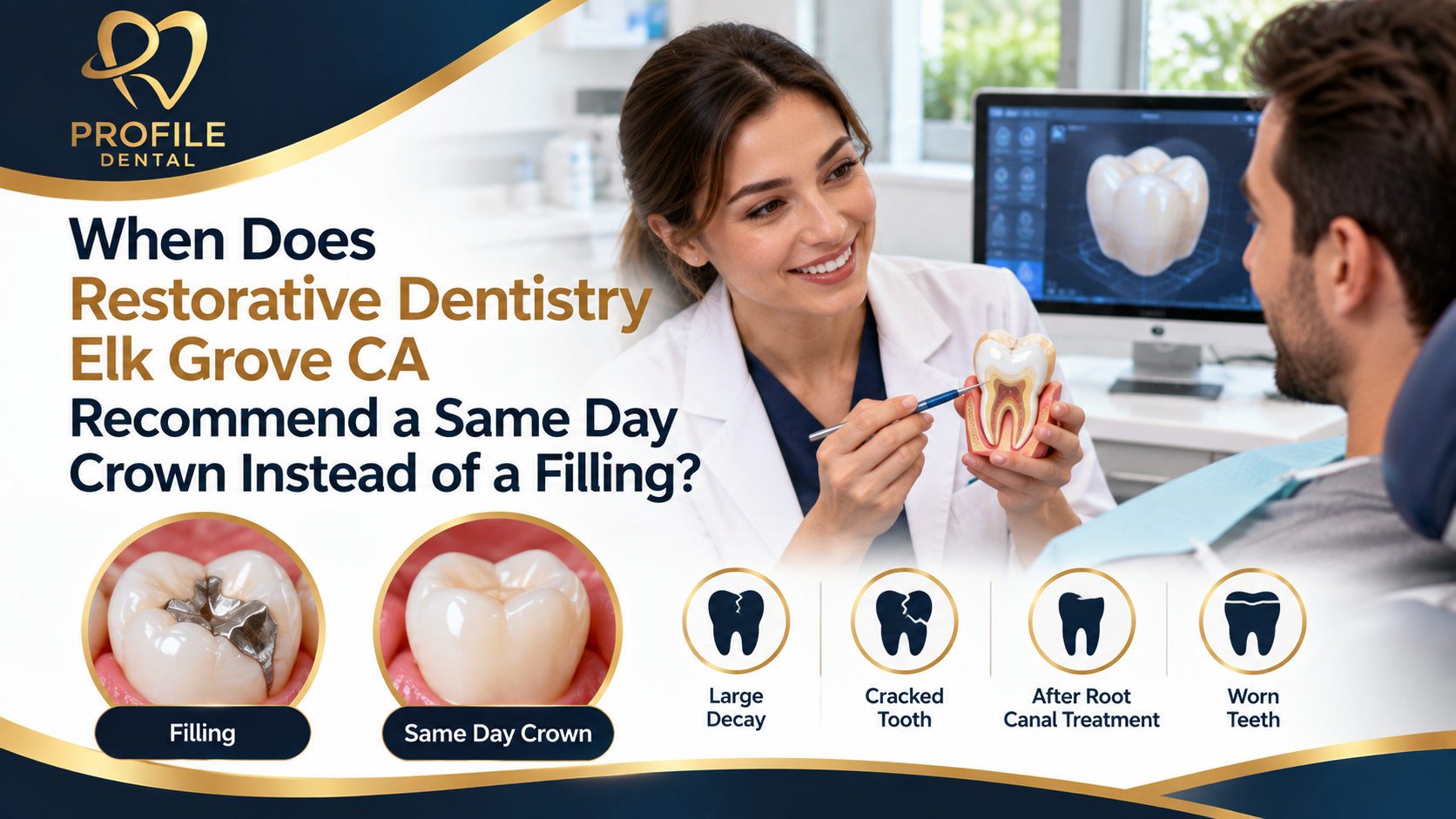
A filling and a crown can both repair damaged teeth, but they solve different structural problems. Restorative Dentistry Elk Grove, CA treatment may recommend a filling when the damaged area is limited and the tooth still has enough strong structure to support normal chewing. A crown may be considered when decay, fracture, a large existing filling, wear, or previous treatment has weakened a larger portion of the tooth.
For suitable cases, Profile Dental offers same-day crowns that can be designed from digital impressions and placed without the traditional wait for a laboratory crown. The convenience can be valuable, but the main decision is still whether the tooth needs a filling, an inlay or onlay, a crown, root canal treatment, or another restoration.
What is the main difference between a filling and a crown?
A filling replaces a localized area of tooth structure that has been lost to decay or damage. The dentist removes the affected material and fills the space with a restorative material. The remaining tooth continues to provide most of the strength and shape.
A crown takes a different approach. It covers the visible portion of the tooth and is used when the tooth needs more extensive protection or rebuilding. Profile Dental’s crown service lists cracked or broken teeth, severe decay, large fillings, worn teeth, and root canal-treated teeth among situations where a crown may be appropriate.
The Cleveland Clinic explains that smaller cavities are commonly treated with fillings, while crowns are used for larger cavities or broken teeth. It also notes that inlays and onlays can be an option when a cavity is too large for a filling but the tooth does not require full crown coverage.
That means the choice is not simply based on preference. It depends on how much healthy tooth remains, where the damage is located, and what the tooth must withstand during chewing.
When can a filling be the better choice?
A filling can be an excellent conservative treatment when decay or damage is relatively small. Because a filling repairs only the affected area, more of the natural tooth can often be preserved.
The dentist considers the width and depth of the cavity, the strength of the surrounding walls, and the location of the tooth. A small cavity on a tooth with otherwise healthy structure is different from a large restoration that occupies much of a molar.
A filling may also be appropriate for a modest chip or an old filling that can be replaced without removing a large amount of additional tooth structure. The goal is to use the least extensive restoration that can reliably solve the problem.
However, repeatedly enlarging fillings in a heavily restored tooth can leave thinner walls of natural tooth around the restoration. At some point, full coverage may offer better support. That threshold is individualized.
When might a crown provide better support?
A crown may be recommended when a tooth is structurally compromised. Examples include a large fracture, extensive decay, a failing large filling, a cracked cusp, severe wear, or a tooth that needs protection after root canal treatment.
For tooth broken treatment in elk grove ca, the dentist examines whether the remaining tooth can support a direct filling. If a large portion has fractured away, a filling may not provide enough coverage or resistance to chewing forces.
Dental Crowns in Elk Grove, CA can also be used when a tooth has substantial existing dental work and the remaining walls are thin. A crown surrounds those weakened areas and restores the overall shape of the tooth.
A crown does require preparation of the tooth, so it should not be used simply because it is “stronger.” The treatment should match the structural need.
How do same-day crowns change the treatment process?
Traditional crowns frequently involve at least two appointments. At the first visit, the tooth is prepared and an impression is taken. A temporary crown protects the tooth while a dental laboratory makes the permanent restoration. The patient then returns for placement.
Same-day crowns can combine those steps when the clinical situation is suitable. Profile Dental states that it uses digital impressions and CEREC technology to design and fabricate crowns in the office. That can remove the need for a temporary crown and reduce the number of visits.
Patients looking for same day crowns near me elk grove ca may find this particularly helpful when work, school, caregiving, or travel makes multiple appointments difficult. The same-day process can also restore function sooner.
The technology does not change the basic treatment principles. The dentist still needs to remove decay, prepare the tooth correctly, capture an accurate scan, design appropriate contacts and bite, and verify the restoration before final placement.
What if the tooth has deep decay or nerve pain?
A crown may not be enough if decay or a crack has reached the pulp inside the tooth. Symptoms such as severe spontaneous pain, lingering sensitivity, swelling, or an abscess can indicate the need for additional treatment.
Root canal treatment elk grove ca may be recommended when the pulp is inflamed or infected but the tooth can still be saved. After the root canal, the tooth may then receive a crown or another restoration depending on its location and remaining structure.
This sequence is important because covering an infected or severely inflamed tooth with a crown does not treat the problem inside the root canal system. Diagnosis must come first.
If symptoms are acute, a same-day dentist Elk Grove CA visit can help identify whether the immediate need is pain relief, root canal therapy, a filling, a crown, or another form of care.
Are inlays and onlays an alternative to a crown?
Sometimes. Inlays and onlays are indirect restorations that can replace a larger portion of damaged tooth structure while preserving more natural enamel than a full crown in certain cases.
An inlay fits within the cusps of the tooth, while an onlay can cover one or more cusps. They can be useful when a filling would be too large or weak but the tooth does not require complete coverage.
Not every practice or clinical situation uses the same restorative approach. The dentist should explain the reasonable options, how much tooth structure each requires, and why one approach is preferred for your specific tooth.
This is a useful question to ask during Restorative Dentistry Elk Grove, CA treatment because the best restoration should balance preservation, strength, function, appearance, and long-term maintenance.
Profile Dental’s same-day dentist guide is a useful related article for patients comparing urgent fillings, chipped tooth repair, and same-day restorative care.
How do dentists evaluate whether a tooth is strong enough for a filling?
The dentist looks at more than the size of the visible cavity. The location of the decay, thickness of the remaining tooth walls, cracks, previous restorations, bite forces, and the tooth’s position in the mouth all matter.
Molars absorb strong chewing forces. A large filling that removes or replaces multiple cusps can leave the remaining tooth more susceptible to fracture. A smaller restoration surrounded by thick healthy enamel may have a very different prognosis.
The dentist may also use X-rays to assess decay between teeth, the depth of a cavity, and the surrounding bone. Visual inspection and bite testing can help identify cracks or weakened areas.
The final recommendation should be based on the whole tooth rather than on a simple rule about cavity size.
Common mistakes when choosing between a filling and a crown
One mistake is choosing solely based on price or speed without understanding the condition of the tooth. A less extensive treatment can be appropriate when the tooth is strong enough, but an undersized restoration can fail if the remaining structure cannot support it.
The opposite mistake is assuming every large filling needs a crown. Some teeth may be treated with an inlay, onlay, or another conservative approach.
Patients should also avoid delaying treatment until the tooth breaks. A heavily restored tooth that has developed cracks or recurrent decay may have more treatment options when the problem is identified early.
Key takeaways
A filling is generally used for a localized defect when enough healthy tooth remains. A crown is more likely to be recommended when a larger portion of the tooth is weakened, cracked, decayed, worn, or previously treated.
Restorative Dentistry Elk Grove, CA at Profile Dental includes same-day crown options for appropriate cases. Digital crown technology can reduce appointment time, but treatment selection should always be based on diagnosis and the amount of healthy tooth that can be preserved.
Frequently asked questions
Is a crown stronger than a filling?
A crown provides more extensive coverage, but that does not make it the correct choice for every tooth. Smaller defects may be better treated with a filling because it preserves more natural tooth structure.
Can a large filling be replaced with a crown?
Yes, when a large filling has failed or the remaining tooth has become weak, a crown may be recommended. The dentist needs to assess the remaining structure and any cracks or decay.
Can I get a permanent crown in one appointment?
In suitable cases, same-day crown technology can allow the crown to be designed, fabricated, and placed in one appointment.
Does a tooth need a root canal before every crown?
No. Many crowns are placed on teeth with healthy pulp. Root canal treatment is needed only when the pulp is inflamed, infected, or otherwise requires endodontic care.
Ask Profile Dental which restoration fits your tooth
If you have a large filling, a cracked tooth, decay, or a restoration that keeps failing, contact Profile Dental to find out whether a filling, same-day crown, or another restorative option makes the most sense. Call (916) 691-5330 or use the contact page to request an appointment at 7805 Laguna Blvd Suite 310, Elk Grove, CA 95758.
Dental information disclaimer: This article is general educational information and does not replace a dental examination or individualized treatment recommendation from a licensed dentist.