


Case study
Your Melbourne home has been listed for five weeks. Buyers are looking, but serious offers are not coming in. Should you reduce the asking price or improve how the home is presented?
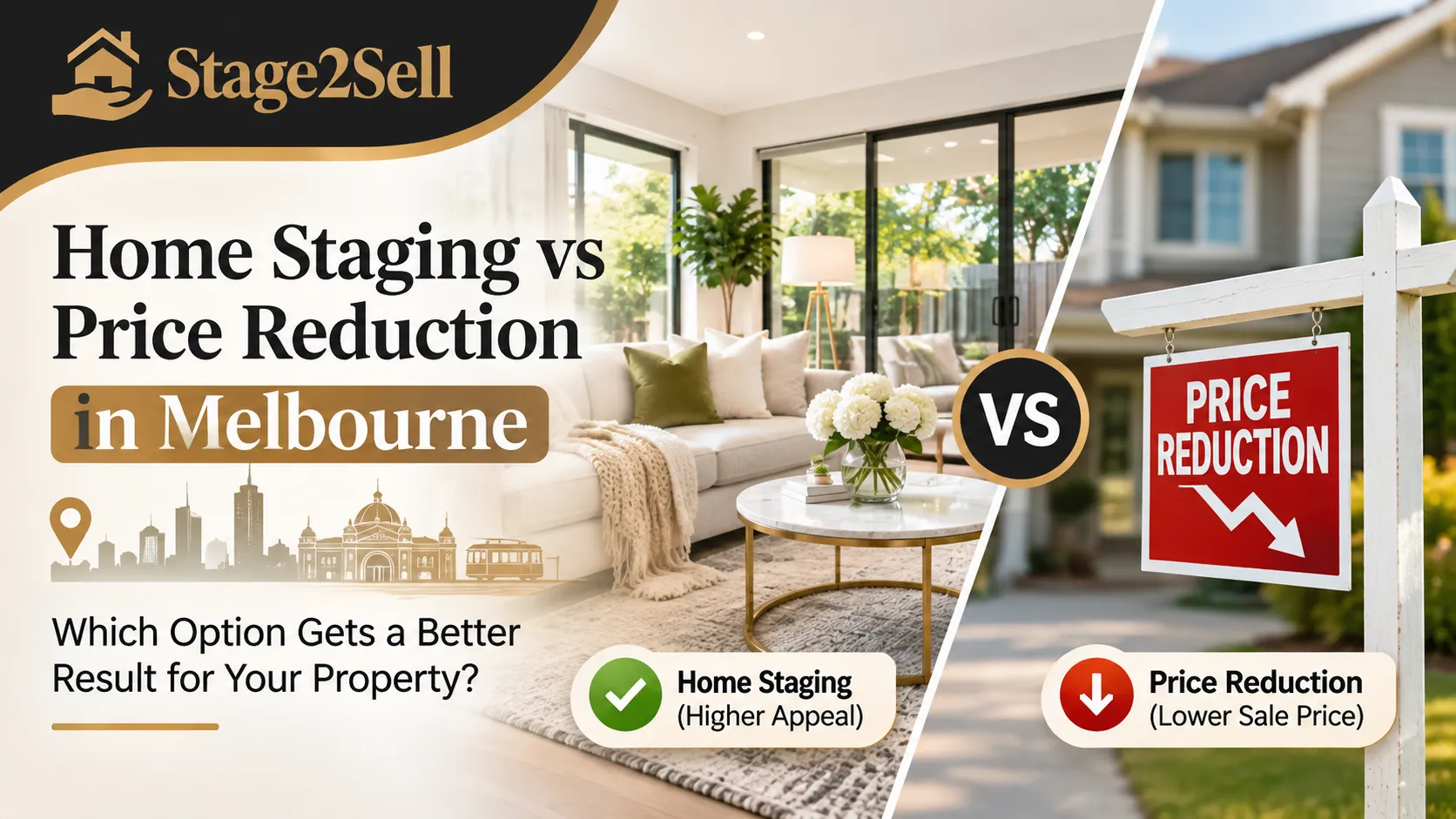
The answer depends on what is stopping buyers. Home staging can help people understand a property’s space and potential. A price reduction can correct a genuine gap between expectations and market value. Neither is a guaranteed fix.
Home Staging vs Price Reduction at a Glance
Consider an illustrative Melbourne property advertised for $915,000. The figures below show the scale of each decision; they are not a property valuation or a promise that staging will prevent a reduction.
What the numbers look like
2% asking-price reduction: $18,300.
3% asking-price reduction: $27,450.
Illustrative staging budget: $2,500–$4,000.
A $3,000 staging bill equals approximately 0.33% of a $915,000 asking price.
That difference is worth examining. But it does not mean a $3,000 staging investment saves $18,300 or increases the eventual selling price.
Published staging estimates differ by property size, furniture requirements and hire duration. Confirm an itemised price with a provider rather than treating this example as a Stage2Sell package quote. Explore Stage2Sell’s property staging services for the available approach.
First, Find Out Why Your Home Is Not Selling
A five-week campaign with no serious offer can indicate different problems. Before making changes, ask your agent for evidence across the sales funnel.
Check these five signals
1. Listing views — Are buyers finding the property online?
2. Enquiries — Do those views turn into questions or inspection bookings?
3. Inspection attendance — Are serious buyers actually visiting?
4. Buyer feedback — Are people concerned about price, layout, condition or location?
5. Comparable sales — Are similar nearby homes selling around your current price range?
Low engagement with weak photographs can point towards presentation. Regular inspections without offers, especially alongside repeated comments about poor value, can point towards price.
When Home Staging May Be the Better First Move
Staging is most useful when the property is competitively priced but buyers cannot easily picture living there.
Signs presentation is holding you back
Vacant rooms feel smaller or their purpose is unclear.
Bulky furniture makes the floor plan look cramped.
Listing photographs appear dark, dated or inconsistent.
The main bedroom, living area or entry lacks a clear focal point.
Outdoor areas or a study nook are difficult to imagine using.
In these cases, a targeted refresh may be more appropriate than furnishing the entire home. Prioritise the rooms that matter most in photography and inspections.
What if the listing is under three weeks old?
The spreadsheet’s working decision rule is to assess staging before immediately cutting the price when a listing is under three weeks old. Treat this as a review checkpoint, not a market-wide rule.
If comparable sales already show the asking price is unrealistic, waiting or paying for styling first may make matters worse.
Do not forget the photographs
Complete styling and decluttering before the new shoot.
Show room proportions and useful furniture layouts clearly.
Agree with the agent on revised images, copy and distribution.
Check the listing platform’s rules before promising a fresh listing launch.
To determine whether a light-touch approach is enough, compare Stage2Sell’s full versus partial staging guide.
When a Price Reduction Makes More Sense
A price adjustment may be more effective when the home already presents well but qualified buyers still do not see sufficient value.
Warning signs that pricing is the obstacle
Comparable homes have recently sold for noticeably less.
The listing receives inspections but no meaningful offers.
Multiple buyers independently say the home is overpriced.
Location, layout or major defects are the main objections.
A fixed settlement deadline makes continued holding costs significant.
Staging cannot change the land size, neighbourhood or underlying property condition. And a lower advertised price is not the same as a guaranteed selling price.
Ask the agent to show the recommended revised range against actual comparable sales, buyer search brackets and likely sale method.
Three Common Seller Scenarios
Scenario 1 — Weak photos, few inspections
The home is vacant, the images are unconvincing and similar local properties appear to be selling close to the asking price.
Likely next step: Consider targeted staging and a professional photo refresh.
Track: Qualified enquiries, inspection attendance and genuine offers.
Scenario 2 — Plenty of inspections, no offers
The home already looks polished, but buyers consistently compare it unfavourably with cheaper alternatives.
Likely next step: Reassess the asking price using comparable sales.
Track: Feedback after the adjustment and the quality of new enquiries.
Scenario 3 — Presentation and price are both weak
Oversized furniture makes the home feel small, and the asking range sits above close competitors.
Likely next step: Coordinate focused styling with an evidence-based pricing review.
Track: Whether the combined changes address buyer objections.
Does Staging Pay for Itself?
For a simplified break-even example, assume staging costs $3,000. All else being equal, a $3,000 improvement in sale proceeds would offset that staging expense before other variables.
Costs worth including
Installation, furniture and accessory hire.
Collection and possible hire extensions.
Photography and additional marketing expenses.
Mortgage interest, insurance and other costs if the property stays unsold.
A quicker sale could reduce holding costs; a delayed sale could add them. There is no reliable basis for guaranteeing that a staged home will command a particular uplift.
For additional context, see the house staging cost guide and the full versus partial staging comparison.
A Seven-Step Decision Checklist
1. Compare the asking price with recent, genuinely comparable sales.
2. Review listing views, enquiries, inspections and offers.
3. Ask buyers and your agent for specific objections.
4. Audit the photography, room layout, lighting and condition.
5. Request a written staging scope and all-in costs.
6. Ask for a justified alternative pricing strategy.
7. Agree on a review date and measures of success before changing the campaign.
You may discover the best next move is smaller than either option: decluttering, rearranging existing furniture, painting a tired room, improving lighting or refreshing the images.
Should You Stage or Reduce the Price?
Choose a presentation-first review when
The asking price is supported by comparable sales.
The photographs or room presentation are clearly limiting appeal.
The staging scope and campaign relaunch costs are affordable.
Choose a pricing-first review when
The home already looks competitive in person and online.
Buyer feedback repeatedly identifies poor value.
Recent comparable transactions do not support the advertised range.
If both problems exist, address both. The purpose of the comparison is not to defend a price at all costs; it is to remove the real obstacles to a sale.
Request a Melbourne Home Staging Quote
If poor presentation may be reducing enquiry quality, Stage2Sell can discuss styling options for the rooms and selling campaign. Review the property staging options or request a staging quote, then compare the written proposal with your agent’s pricing evidence.
Frequently Asked Questions
Is home staging worth it if my home is not selling?
Possibly, when presentation is the problem and the asking price is realistic. It is unlikely to fix an underlying pricing or property-condition issue by itself.
Should I cut my price after three weeks?
Not automatically. Review buyer response and comparable sales first. Three weeks is a useful checkpoint, not a universal deadline.
Is partial staging enough?
It can be when a small number of rooms need attention. Ask a stylist to identify the spaces that most affect the photography and inspection experience.
Will staging guarantee a higher selling price?
No. Buyer demand, pricing, market conditions and the property itself still determine the outcome.




Join the conversation