

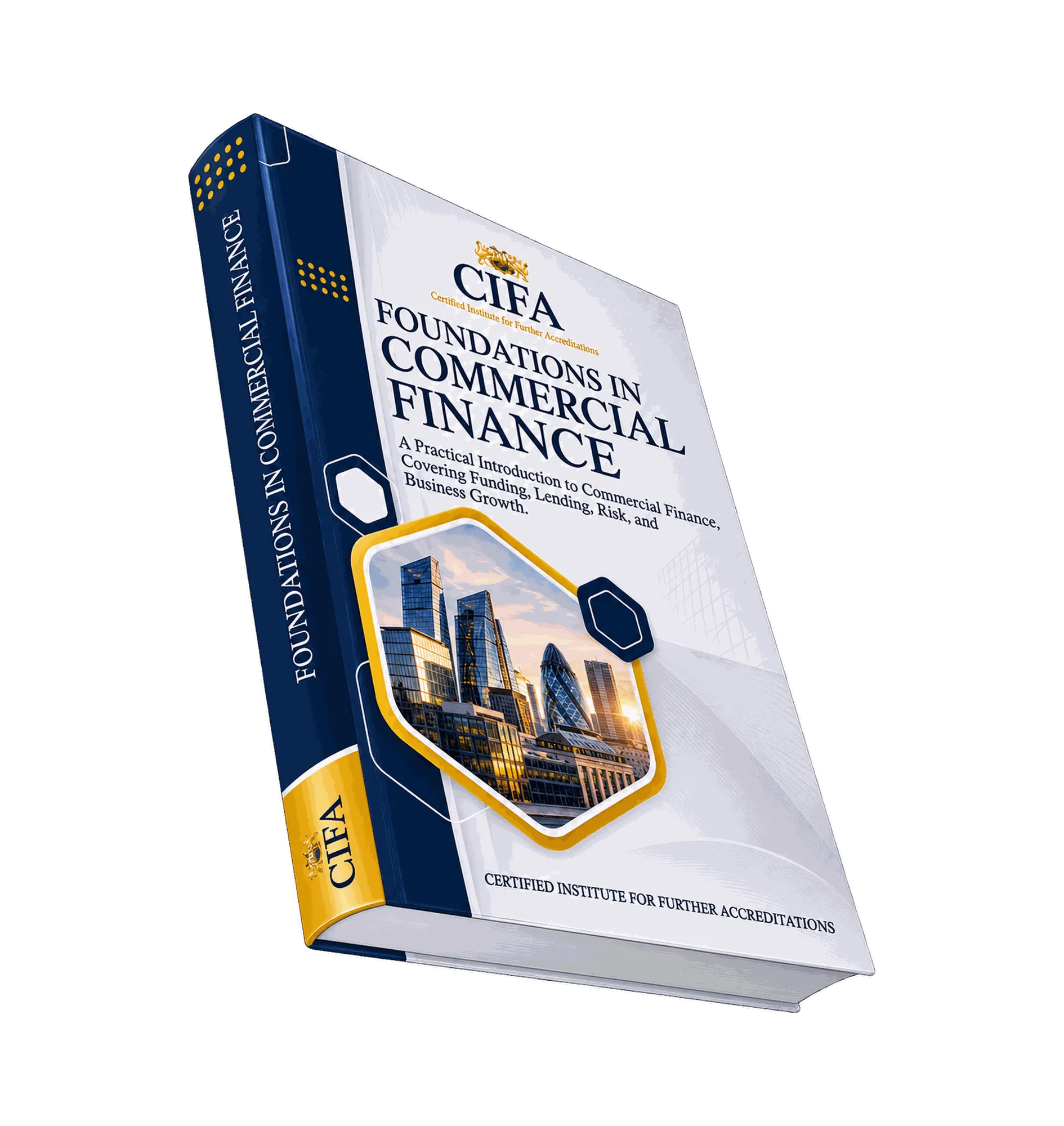

Commercial finance plays an important role in helping businesses manage their financial responsibilities, secure funding and achieve long-term growth. From purchasing equipment and expanding operations to managing cash flow and investing in new opportunities, businesses often depend on appropriate financial solutions to achieve their objectives. Understanding how these funding arrangements work is therefore valuable for professionals working in banking, lending, financial advisory and business consultancy.
The Foundation to Commercial Finance course offered by CIFA provides structured learning for individuals who want to develop their knowledge of business funding and commercial lending. The programme explores financial statement analysis, cash flow forecasting, affordability assessments, credit evaluation and different business funding solutions.
As businesses face changing financial requirements, professionals who understand commercial finance can develop valuable knowledge for supporting funding applications and understanding lending decisions. Building these skills can also provide a foundation for further professional development within the financial services sector.
Understanding the Fundamentals of Commercial Finance
Commercial finance refers to financial products and funding arrangements designed to support business activities. Companies may require external funding for various reasons, including purchasing assets, maintaining working capital, acquiring property or supporting expansion.
Unlike personal finance, commercial lending involves evaluating the financial position, performance and future prospects of a business. Lenders consider several factors before deciding whether an application meets their requirements.
These factors may include:
Business revenue and profitability.
Existing financial commitments.
Cash flow performance.
Repayment affordability.
Credit history and financial risks.
Available security or collateral.
The purpose of the requested funding.
Understanding these factors is important for professionals involved in commercial lending and business finance.
The Foundation to Commercial Finance programme introduces learners to these fundamentals and explains how different elements contribute to commercial funding decisions.
Why Commercial Finance Knowledge Is Important for Finance Professionals
Businesses operate in competitive environments where access to appropriate funding can influence their ability to maintain operations and pursue growth opportunities.
Finance professionals need to understand how businesses use funding and what lenders consider when assessing applications. This knowledge can support better communication between businesses, financial advisers, brokers and lending institutions.
Commercial finance knowledge is particularly relevant to individuals involved in financial analysis, business consultancy, banking and credit assessment.
Developing an understanding of commercial finance can help professionals:
Recognise different business funding requirements.
Understand financial information and business performance.
Evaluate cash flow and repayment affordability.
Identify appropriate commercial lending solutions.
Understand credit assessment procedures.
Prepare clear and structured funding proposals.
Recognise professional and regulatory responsibilities.
These areas provide a useful foundation for individuals seeking to understand the commercial lending process.
Financial Statement Analysis and Business Performance
Financial statements provide important information about the financial position and performance of a business. They help business owners, financial professionals and lenders understand how an organisation manages its resources and whether it can meet its financial responsibilities.
Financial statement analysis involves examining financial information to identify strengths, weaknesses and potential concerns.
Three important areas of financial analysis include profitability, liquidity and financial stability.
Profitability helps explain whether a business generates sufficient income compared with its expenses. Liquidity indicates whether an organisation can meet its short-term financial obligations. Financial stability provides a broader understanding of its financial commitments and overall position.
Professionals involved in commercial finance should understand how to interpret these indicators and recognise their importance when evaluating funding applications.
The course introduces financial statement analysis as a core subject, helping learners develop an understanding of the financial information that lenders use when reviewing business applications.
Cash Flow Forecasting and Financial Affordability
Cash flow is one of the most important considerations in commercial lending. A business may report strong profits but still experience difficulties meeting payments if money does not enter the business at the right time.
Cash flow forecasting helps organisations estimate future income and expenditure. It allows businesses and finance professionals to examine whether sufficient funds are likely to be available to meet financial commitments.
Affordability assessment focuses on whether a business can reasonably manage proposed repayments alongside its existing obligations.
Important considerations include:
Expected business income.
Operating expenses.
Existing borrowing commitments.
Future cash requirements.
Seasonal changes in business activity.
Potential financial uncertainties.
Understanding these elements can help professionals evaluate the financial risks associated with borrowing.
The Foundation to Commercial Finance course covers cash flow forecasting and affordability, providing learners with an understanding of how these factors contribute to commercial lending decisions.
Exploring Different Business Funding Solutions
Businesses have different financial requirements, which means a single funding solution may not be suitable for every organisation.
Some businesses require short-term finance to manage working capital, while others need longer-term funding to purchase equipment, acquire property or support expansion.
Commercial finance professionals should understand the available funding options and consider how they relate to individual business circumstances.
Selecting an appropriate funding solution requires an understanding of the purpose of borrowing, the financial position of the business and its ability to meet repayment obligations.
A well-informed approach helps ensure that funding discussions are based on realistic requirements rather than assumptions.
CIFA introduces business funding solutions as an important part of its commercial finance curriculum, helping learners understand how different funding arrangements relate to business needs.
Credit Assessment and Understanding Lender Criteria
Credit assessment is a central part of the commercial lending process. Before providing finance, lenders need to understand the financial risks associated with a potential borrower.
They examine relevant financial information, repayment capacity and other factors to determine whether an application meets their lending criteria.
Creditworthiness is influenced by several considerations, including financial performance, existing liabilities, business stability and the availability of appropriate security.
Understanding lender criteria can help commercial finance professionals prepare more complete applications and explain the lending process to clients.
An effective credit assessment process involves:
Reviewing relevant business information.
Understanding financial performance.
Examining existing financial commitments.
Assessing repayment capacity.
Identifying potential credit risks.
Considering lender requirements.
Maintaining accurate supporting documentation.
Learning about these processes can help individuals develop a clearer understanding of how commercial finance applications are evaluated.
Client Fact Finding and Preparing Funding Proposals
Successful commercial finance arrangements begin with understanding the client’s actual requirements.
Before identifying potential funding solutions, professionals need to gather relevant information about the business, its financial circumstances and the purpose of borrowing.
Client fact finding helps establish a clearer picture of the organisation’s needs. It also allows finance professionals to identify relevant information that lenders may require when assessing an application.
Preparing a funding proposal requires clear communication and accurate documentation. A well-organised proposal should explain the funding requirement and provide relevant information to support the application.
Important elements include:
Understanding the client’s business objectives.
Identifying the purpose of the requested finance.
Gathering relevant financial information.
Reviewing repayment affordability.
Understanding potential lending requirements.
Presenting information clearly and accurately.
The course explores client fact finding and funding proposals to help learners understand the importance of preparation throughout the commercial finance process.
Regulation and Professional Integrity in Commercial Finance
Commercial finance involves financial decisions that can have significant consequences for businesses. Professionals must therefore understand the importance of ethical behaviour, transparency and appropriate regulatory awareness.
Professional integrity means acting honestly, communicating information accurately and treating clients fairly.
Finance professionals should avoid making misleading statements, understand the limits of their responsibilities and recognise when additional guidance may be necessary.
Professional conduct also involves maintaining appropriate records, protecting confidential information and following relevant requirements.
The Foundation to Commercial Finance course includes regulation and professional integrity as a dedicated learning area.
Understanding these principles can help learners recognise the importance of responsible conduct when working with clients, lenders and other financial professionals.
Managing Commercial Finance Transactions and Client Relationships
Arranging commercial finance involves more than identifying a suitable funding solution. Professionals also need to understand how transactions progress from the initial client discussion to completion.
Transaction management involves organising documentation, communicating with relevant parties, monitoring progress and responding to requests for additional information.
Maintaining effective client relationships is equally important. Clients need clear updates and realistic expectations throughout the funding process.
Strong professional relationships can be supported by:
Maintaining regular communication.
Providing accurate information.
Organising relevant documentation.
Responding to client enquiries.
Managing expectations appropriately.
Demonstrating professional integrity.
Understanding transaction management can help learners appreciate how commercial finance professionals contribute to an organised lending process.
What Will You Learn in the Foundation to Commercial Finance Course?
The CIFA Foundation to Commercial Finance course is organised into eight chapters that develop knowledge progressively, covering the main stages of commercial funding.
Chapter 1: Commercial Finance Fundamentals
Explore the basic principles of commercial finance, business funding requirements and the participants involved in the commercial lending market.
Chapter 2: Financial Statement Analysis
Understand how to interpret business financial statements and examine profitability, liquidity and financial stability.
Chapter 3: Cash Flow Forecasting and Affordability
Develop an understanding of cash flow forecasting, borrowing capacity, repayment obligations and financial affordability.
Chapter 4: Business Funding Solutions
Explore different commercial funding options and understand how funding solutions relate to individual business requirements.
Chapter 5: Credit Assessment and Lender Criteria
Learn about creditworthiness, lending requirements, financial risks and the factors lenders consider when evaluating applications.
Chapter 6: Client Fact Finding and Funding Proposals
Understand how to gather client information, identify funding requirements and prepare structured finance proposals.
Chapter 7: Regulation and Professional Integrity
Explore regulatory awareness, professional responsibilities, ethical conduct and due diligence within commercial finance.
Chapter 8: Transaction Management and Client Relationships
Understand the stages involved in managing commercial finance transactions and maintaining effective professional relationships.
Together, these eight chapters provide a structured introduction to commercial finance and the responsibilities involved in supporting business funding applications.
Who Should Study Commercial Finance?
Commercial finance education can be useful for individuals at different stages of their professional development.
The programme may be suitable for:
Aspiring Finance Professionals: Individuals interested in beginning a career in commercial finance, banking or lending.
Banking and Lending Professionals: People seeking to strengthen their knowledge of business funding and credit assessment.
Business Owners and Entrepreneurs: Individuals interested in understanding commercial borrowing and business financing options.
Financial Advisers and Consultants: Professionals looking to broaden their knowledge of commercial funding solutions.
Accounting and Finance Graduates: Graduates interested in developing practical knowledge of financial analysis and business lending.
Business and Finance Managers: Professionals involved in budgeting, financial planning and business funding decisions.
Career Changers: Individuals considering a transition into commercial finance or business lending.
The programme is classified as intermediate level, making it relevant to learners who want to develop structured knowledge of commercial finance.
How CIFA Supports Commercial Finance Professional Development
Choosing an appropriate educational programme can help individuals build knowledge in a specific area of financial services.
CIFA provides the Foundation to Commercial Finance course as a Level 4, CPD-accredited learning programme. Its curriculum combines financial analysis, lending principles, funding proposals and professional responsibilities.
The programme includes several learning features:
40 CPD hours.
Level 4 course classification.
Intermediate-level content.
Fully digital learning materials.
Chapter-based mock examinations.
Practical case studies and worked examples.
Downloadable study resources.
Lifetime access to the learning portal.
A digital profile to showcase learning achievements.
A certificate of achievement after successfully completing and passing the examination.
Learners also receive a Study Resources and Practical Toolkit containing practical templates, a capstone assessment, a glossary, knowledge check answers, extended workshop guidance and optional further reading.
These resources support independent learning and help learners connect course concepts with commercial finance scenarios.
Career Development Opportunities in Commercial Finance
The commercial finance sector includes different professional responsibilities related to lending, business funding, financial assessment and client relationships.
Developing knowledge of these areas may support individuals interested in exploring career pathways such as:
Commercial finance broker or adviser.
Business finance case handler.
Credit analyst support professional.
Lending and underwriting support.
Financial relationship management support.
Finance consultancy support.
Accountancy practice roles involving funding advice.
Career progression depends on relevant experience, additional qualifications, employer requirements and the responsibilities associated with each position.
The Foundation to Commercial Finance programme can provide structured knowledge for individuals exploring these professional areas and seeking to strengthen their understanding of business funding.
Why Continuous Learning Matters in the Financial Services Sector
Financial services professionals operate in an environment where business requirements, lending practices and regulatory expectations can change.
Continuous learning helps individuals maintain relevant knowledge and identify areas where further development may be valuable.
Commercial finance education can strengthen understanding of business financial performance, funding requirements and credit assessment.
CPD learning also provides a structured way to record professional development activity and demonstrate a commitment to maintaining knowledge.
By investing in ongoing education, individuals can develop a stronger understanding of their professional responsibilities and prepare for further opportunities within financial services.
Conclusion
Commercial finance is an important part of business development, supporting organisations that need funding to manage operations, purchase assets and pursue growth opportunities. Understanding financial statements, cash flow forecasting, credit assessment and business funding solutions can help individuals develop valuable knowledge of the commercial lending process.
The Foundation to Commercial Finance course from CIFA offers structured Level 4, CPD-accredited learning across eight essential chapters. From commercial finance fundamentals to transaction management, the programme introduces the subjects that contribute to effective business funding assessments.
For aspiring finance professionals, existing lending specialists, business managers and career changers, this course provides an opportunity to strengthen commercial finance knowledge and support continued professional development.
Frequently Asked Questions
1. What is the Foundation to Commercial Finance course?
The Foundation to Commercial Finance course is a Level 4, CPD-accredited CIFA programme covering business funding, financial statement analysis, cash flow forecasting, affordability, credit assessment and commercial lending.
2. How many CPD hours does the Foundation to Commercial Finance course provide?
The course provides 40 CPD hours. Study time is recorded through the CIFA learning platform, allowing learners to track their learning activity.
3. What certificate will I receive after completing the course?
Learners who successfully complete the course and pass the final CIFA examination receive a digital Certificate of Achievement. A printed certificate can also be requested through CIFA customer service at an additional cost.



Join the conversation