


Picture a Tuesday. Someone needs a packed lunch, someone needs a quick
reply, and someone needs you to “just sort it out.” By night, you
have helped everyone and checked in with nobody, including yourself. You are
not lazy. You are not ungrateful. You are running on empty in a way that sleep
cannot fix.
Years of family expectations, professional demands, and
social duties can blur out who you are. Your calendar fills with other people’s
needs, and your own wishes shrink to a whisper. Ignore that whisper long enough
and it turns into burnout, resentment or a quiet “is this it?”
This guide explains the identity shift that begins when you stop
living for everyone else. You will see how self-concept, external
validation and people pleasing shape your daily choices. You will
learn how values mapping and reflective self-assessment show
where your life and your goals part ways. You will also see how women
self-development coaching gives your rebuilding a clear path.
How a Woman Slowly Loses Her Sense of Self
Nobody wakes up and decides to disappear. The loss happens slowly, and the
roles and hours behind it are easy to measure. This section shows how identity
gets built, and how it gets buried.
How
Roles Pile Up and Shape Identity
Identity formation never ends at adulthood. You keep shaping your sense of self through
the roles you carry, and for many women those roles arrive in a heap. Daughter,
employee, partner, mother, the reliable one. Each role adds a duty, but few add
a choice. The weight of this mental load grows quietly.
India’s Time Use Survey 2024 shows the scale. Females aged six and above
spent 289 minutes a day on unpaid domestic services, while males spent 88
minutes, and 81.5% of females took part against 27.1% of males. That is nearly
five hours of daily unpaid domestic work with no salary and little
applause.
Why
Time Decides Who You Become
Time builds identity. Hours spent serving others leave fewer hours for your own
interests, friendships and dreams. Deloitte’s 2025 study of 7,500 women across
15 countries found that only four in ten women feel able to switch off from
work. Many women ask, why do I feel like I am losing myself? The answer
is simple. Your authentic self needs attention to grow. Starve it long
enough and you forget what you like, what you want and what you refuse. Nothing
dramatic happens. You simply stop asking yourself questions.
Why External Validation Keeps You Pleasing Everyone?
Approval feels good, and that is exactly the problem. This section explains how
the hunt for praise turns into a daily habit, and what that habit costs.
The
Pull of External Validation
External validation feels like fuel. A thank you or a “what would we do without
you” gives a quick glow, and soon you chase it. You say yes before you
check your energy. You smile through plans you dislike. Your self worth
starts to depend on other people’s reactions, which makes every missed
compliment feel like a small failure.
People
Pleasing and Its Hidden Cost
This habit, called people pleasing, often begins as a survival skill. A
girl learns that being helpful earns approval, and a grown woman keeps that
script long after she needs it. What is people pleasing and why do women do
it? It means putting other people’s comfort above your own needs to avoid
conflict or disapproval, and social expectations about being agreeable and
selfless push many women toward it. The load shows in the data. Deloitte’s 2025
survey found that 51% of women rate their mental health as good, and 36% report
higher stress than last year. These figures do not prove that people pleasing
causes stress. They do show that women carry heavy loads, and every unwanted
yes adds weight. Name the pattern first, because you cannot change a habit you
cannot see.
Values Incongruence and the Line Between Duty and Self Abandonment
Doing your duty is not a problem. Losing yourself inside it is. This section
helps you spot the mismatch and tell the two situations apart.
How
Values Incongruence Shows Up
Daily life gives small clues. You may value health, yet skip every walk. You
may value creativity, yet shelve every idea. What is values incongruence?
It is the gap between what you believe matters and how you spend your time and
energy, and research on self-concept suggests such gaps can weigh on
wellbeing and life satisfaction. The signs are small. You feel irritated
by requests you once accepted. You feel guilty for resting. Sunday evenings
feel heavy. Treat these signals as information, not as proof that you are
ungrateful.
Meeting
Responsibilities or Abandoning Yourself
Responsibility is real, and you may love the people you care for. How
do I know if I am meeting responsibilities or abandoning myself? Check
whether you still have a say.
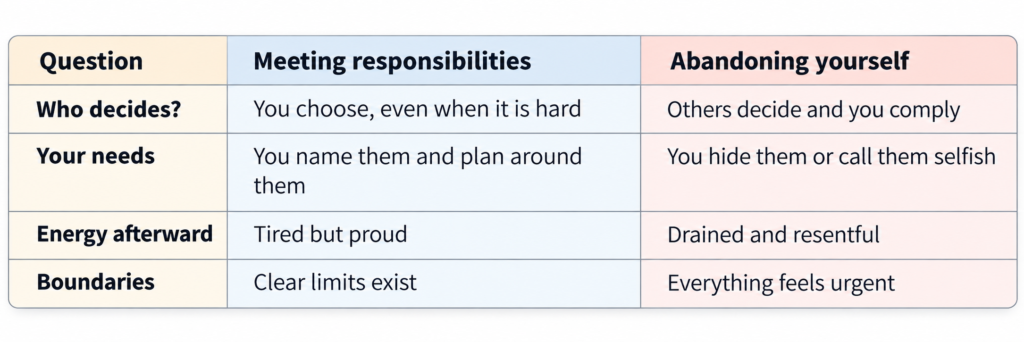
You do not have to drop your roles. You only need to put yourself back
in the picture, because healthy boundaries protect both your energy and
your relationships.
Values Mapping and Reflective Self-Assessment in Practice
Insight needs a method. This section gives you two simple tools that turn vague
unease into a clear picture of what needs to change.
Mapping
What Matters Most
Many women have never written their values down. What is values mapping?
It is a simple exercise that turns vague feelings into a visible list, where
you name your core values and then compare them with how you spend your week.
Many women discover that two or three values have been missing for years. That
finding is not a failure. It is a map that shows exactly where to begin your personal
growth.
Reflecting
Honestly on Your Week
Reflective self-assessment adds honest questions about each area of your life. Follow these steps
in one quiet hour.
·
Write ten values that matter to you, such as health, learning, family,
freedom or creativity.
·
Circle your top five.
·
List last week’s main activities and match each to a value.
·
Mark any value that got no time at all.
·
Note which commitments you accepted from guilt, not choice.
·
Pick one small change that brings a neglected value back.
Stay kind while you work. The goal is clarity, not blame.
How Women Self-Development Coaching Rebuilds Identity
Knowing the problem is one step. Changing your habits is another. This section
shows how coaching turns your insights into steady, practical action.
What
Coaching Looks Like in Practice?
A coach works as a thinking partner who asks thoughtful questions and listens
without judgment. How does women self-development coaching work? It
gives shape to the fog, helping you rebuild self-awareness, set personal
priorities, and make decision making easier. Coaching looks forward
and focuses on clarity and action, so please also seek a licensed mental health
professional if you face deep distress.
Signs
the Identity Shift Has Begun
The shift looks quiet from the outside. You pause before saying yes. You set a
limit without a long apology. You protect one hour a week that belongs only to
you. Guilt appears, then fades faster each time. Slowly, your sense of
purpose returns, and your choices reflect your own aspirations. You
stay the same caring woman. You simply stop disappearing inside that care.
Conclusion
Losing yourself rarely happens in one day. It happens through thousands of
small yeses that feel kind in the moment. India’s Time Use Survey 2024 records
the gap in unpaid domestic work, and Deloitte’s 2025 study records
rising stress and little time to switch off. None of this means you must walk
away from the people you love.
The shift begins when you see the difference between fulfilling duties
and abandoning yourself. You learn how external validation and people
pleasing steer your days. You spot values incongruence through small
signals. Then you use values mapping and reflective self-assessment
to see where life and values separate.
A clear boundary, a protected hour or one decision made for you can
start the change. Women self-development coaching can guide each step
and keep you accountable. You deserve a life you recognize as your own. Start
with one honest question today. What do I actually want?
Reconnect With Yourself. Contact Soul Sakhi Today!
Soul Sakhi is built for women who feel successful yet unfulfilled, or who stand
at a crossroads and wonder who they are now. Sangita, the founder of Soul
Sakhi, is a Communication Enhancer and Life Coach with over 17 years of
experience in multinational environments and works from Bangalore. Through
personalized, one to one coaching, she guides women back to their identity, power
and purpose. Her work includes Identity Alignment and Purposeful Living,
Confidence and Self Worth Elevation, and Mindset Realigning.
At Soul Sakhi, you will not receive a list of orders. You will receive
the right questions, a safe space and practical tools for real life. Visit https://soulsakhi.co.in to book a discovery call, or message Soul
Sakhi on WhatsApp at 9972467890.
Frequently
Asked Questions (FAQs)
1. What is the identity shift when a woman stops living for everyone else?
It is the move from defining yourself only by roles and duties toward knowing
your own values, needs and goals. You still care for others, but you include
yourself in the picture.
2. Is putting myself first selfish?
No. Selfishness ignores others. Self care keeps you healthy enough to show up
well. Clear limits protect your energy, and rested people usually offer more
thoughtful and lasting support.
3. How do I stop people pleasing?
Start small. Pause before answering a request, check your capacity and practise
a short, kind no. Repeat daily. Each boundary you hold weakens the old habit
and builds self-trust.
4. What is values mapping?
Values mapping lists what matters most to you and compares that list with how
you spend your time. The gaps show where your choices and priorities no longer
match.
5. When should I try women self-development coaching?
Try it when you feel stuck, unfulfilled or unsure of your next step. Coaching
suits women who want clarity and practical tools. Choose a licensed counsellor
for deeper emotional or clinical concerns.


Join the conversation