When families explore marriage through Vedic astrology, one term often comes up: Ashtakoot. You may have also heard people talk about the “36 guna score” while discussing kundali matching. But what exactly is being measured, and why does the score matter?
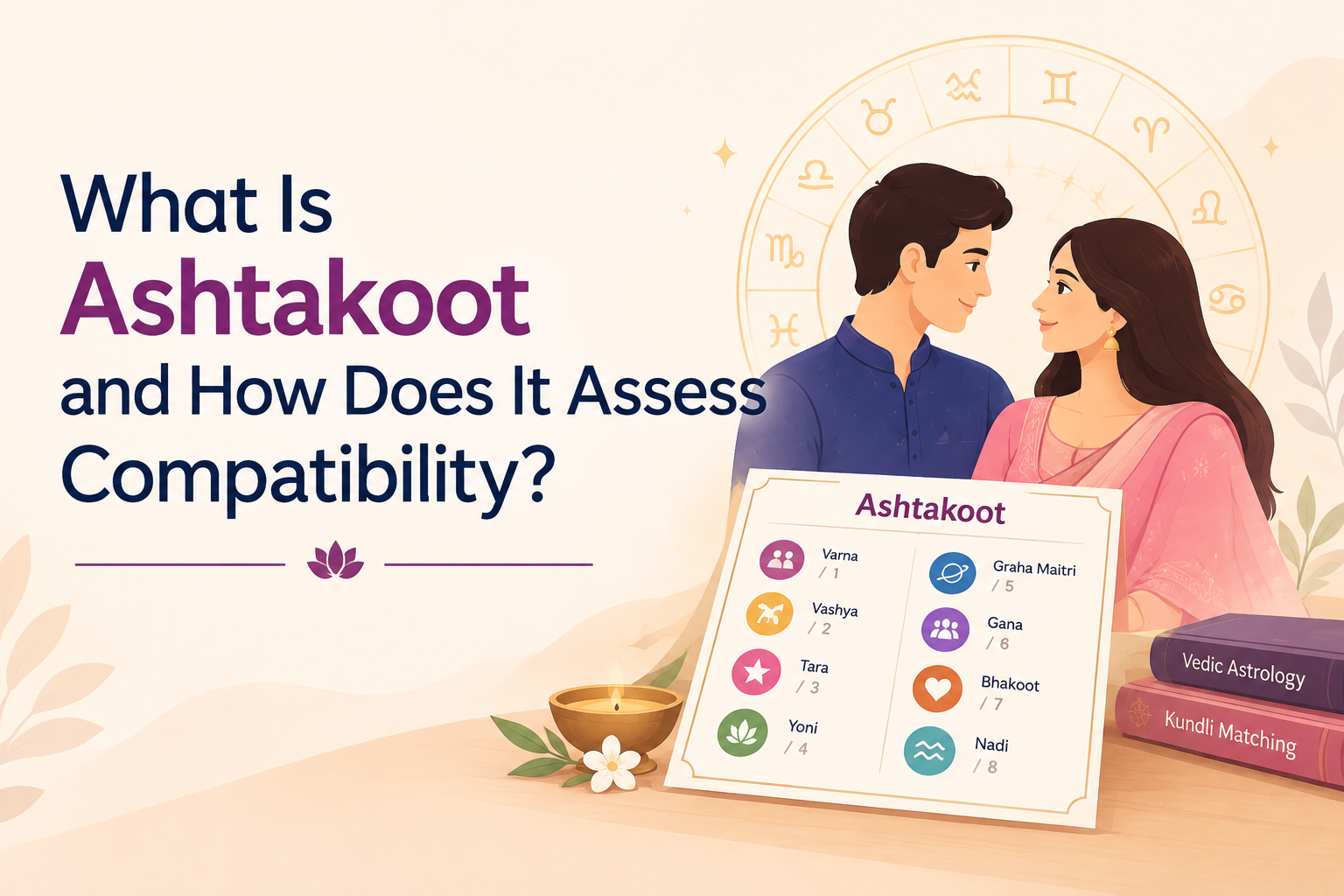
Ashtakoot, also known as Ashtakoota Milan, is a traditional system used to compare the birth details of two prospective partners. It examines eight different areas of compatibility, with points assigned to each. Together, these categories create a maximum score of 36.
However, the number is only one part of the picture. Understanding what each koota represents is far more useful than simply asking whether the score is high or low.
What Does Ashtakoot Mean?
The word “Ashtakoot” can be understood through its two parts: “Ashta,” meaning eight, and “Koota,” referring to categories or factors.
In traditional Vedic astrology, Ashtakoot evaluates compatibility primarily through the Moon signs and nakshatras of the two individuals. Each of the eight kootas looks at a different aspect of the prospective relationship.
The points assigned to these factors add up to 36. This makes Ashtakoot a structured part of kundali matching, giving astrologers a framework for comparing two charts.
What Are the Eight Kootas?
The eight categories do not carry equal weight. Some receive fewer points, while others contribute significantly to the final score.
1. Varna – 1 Point
Varna carries one point and traditionally relates to spiritual or personal compatibility. It has the smallest contribution to the overall Ashtakoot score.
2. Vashya – 2 Points
Vashya carries two points and is traditionally associated with mutual influence, attraction, and interpersonal dynamics. It considers how naturally the two individuals may respond to one another.
3. Tara – 3 Points
Tara receives three points. It compares the nakshatras of the prospective partners and is traditionally associated with well-being, fortune, and general harmony.
4. Yoni – 4 Points
Yoni carries four points and focuses on physical and instinctive compatibility. Nakshatras are assigned symbolic animal categories, which are then compared as part of the assessment.
5. Graha Maitri – 5 Points
Graha Maitri contributes five points. It examines the relationship between the ruling planets of the Moon signs and is traditionally connected with mental compatibility, communication, and mutual understanding.
6. Gana – 6 Points
Gana is worth six points and relates to temperament and behavioural tendencies. Nakshatras are traditionally grouped into three classifications—Deva, Manushya, and Rakshasa—and their combinations are considered during the matching process.
7. Bhakoot – 7 Points
Bhakoot carries seven points, making it one of the more heavily weighted categories. It examines the relationship between the Moon signs and is traditionally associated with emotional connection, family life, and material circumstances.
8. Nadi – 8 Points
Nadi has the highest weight, with eight points. In traditional kundali matching, it is considered in relation to health, hereditary factors, and family or progeny-related matters.
Together, these eight categories make up the complete 36-point framework.
How Is the Score Calculated?
Once the eight kootas have been assessed, the points are added together to produce an overall score out of 36.
Traditionally, a score of 18 or above is often considered an acceptable baseline for compatibility. Higher scores may be viewed as stronger within the Ashtakoot framework.
However, a score should not be treated like an exam result where 35 means “excellent” and 17 means “absolutely not.”
The individual factors matter. Two couples can receive the same total score while having very different strengths and areas that require attention.
Why Is Ashtakoot Only One Part of Kundali Matching?
A complete kundali matching assessment can go beyond Ashtakoot. An astrologer may examine the individual birth charts, planetary positions, the seventh house, relevant planetary aspects, doshas, and planetary periods.
Mangal Dosha, for example, may be evaluated separately according to the astrological approach being followed. Other chart combinations can also provide additional context.
This broader analysis is important because Ashtakoot focuses on specific compatibility factors rather than every possible feature of two birth charts.
Think of it as one chapter of a book. It can tell you plenty, but reading only that chapter will not give you the complete story.
What If the Score Is Low?
A lower Ashtakoot score can raise concerns, but it does not automatically provide a final answer about a marriage.
Traditional astrologers may examine the complete charts to determine whether other supportive factors are present. Depending on the specific combination, certain mitigating or cancellation principles may also be considered.
This is why it is better to understand why points were lost instead of focusing only on the final number.
Can a High Score Guarantee a Successful Marriage?
No.
Ashtakoot is a traditional astrological framework, not a guarantee of relationship success. A strong score cannot replace communication, trust, shared values, emotional maturity, or practical compatibility.
Likewise, a lower score does not tell you everything about two people’s ability to build a healthy relationship.
Real marriage involves everyday decisions that no scoring system can make for you—like discussing finances, setting boundaries, or deciding who forgot to buy groceries again.
Final Thoughts
Ashtakoot is an eight-factor system used in traditional Vedic kundali matching to assess compatibility between two prospective partners. The eight kootas examine different areas, from temperament and communication to emotional, physical, and family-related considerations.
Their individual scores add up to a maximum of 36 points, with 18 traditionally used as a general baseline in many practices.
Still, the final number should be interpreted alongside the broader birth charts rather than treated as a standalone verdict. Used thoughtfully, Ashtakoot can provide one structured perspective on compatibility while leaving room for the real-world qualities that make a marriage work: understanding, respect, honesty, and a willingness to grow together.