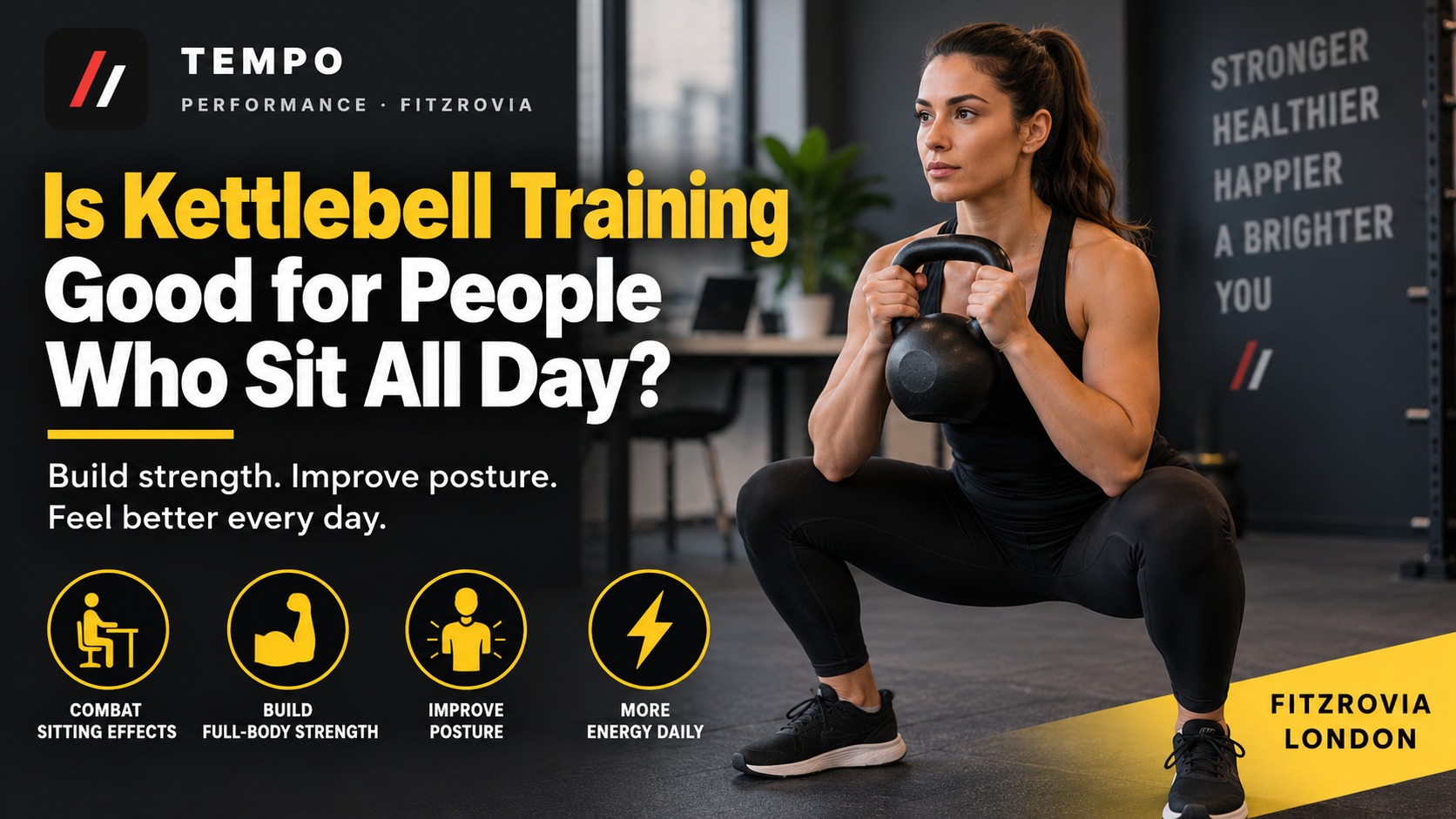
Kettlebell training for beginners can be a practical training option for people who spend much of the working day sitting, provided the exercises, loads and progression are appropriate for the individual. A kettlebell can be used for several movement patterns in a relatively compact training session, but sitting all day does not automatically mean that any particular kettlebell exercise is suitable. Technique, current capacity and sensible progression matter more than simply adding more movement after work.
For office-based people in Fitzrovia, the appeal is straightforward. Training needs to fit around work while addressing the fact that much of the day may involve very little movement. The useful question is therefore not whether kettlebells are a magic answer to sitting. It is whether they can form part of a well-planned programme that gets you moving, develops strength and remains realistic enough to follow consistently.
Why kettlebell training can suit a desk-based routine
Kettlebells are versatile because one piece of equipment can be used in different types of strength-focused movement. For someone whose day is dominated by a desk, that can make a training session easier to organise without requiring an unnecessarily complicated exercise list.
The important distinction is between being inactive during work and being ready for demanding training. Long periods at a desk do not tell a coach how strong, mobile or technically experienced someone is. A beginner still needs an appropriate starting point. That may mean learning basic movement patterns carefully before attempting faster or more technically demanding kettlebell exercises.
This is where kettlebell training for beginners should remain genuinely beginner-focused. The objective is not to copy an advanced workout. It is to establish movements that can be performed with control, then build from there.
Movement quality comes before workout intensity
A hard session is not automatically a useful session. If someone has spent most of the day sitting, jumping immediately into unfamiliar, high-volume work can make it harder to maintain good technique.
A more measured approach gives the person time to understand how each exercise should feel and how to control the kettlebell. It also allows the programme to respond to the individual rather than assuming that every desk worker has the same needs.
What should beginners focus on first?
The first priority is learning movements that match current ability. That means choosing an appropriate load, understanding the exercise and being able to repeat the movement without technique deteriorating simply to finish a set.
A beginner programme does not need a huge exercise library. In practice, a smaller selection can make it easier to learn what you are doing and notice whether you are improving. The exact exercise choice should depend on the person rather than a generic internet routine.
Working with a Personal Trainer Fitzrovia can be useful when you want the programme to reflect your starting point, work schedule and training experience. Coaching can also help distinguish between a movement that is simply unfamiliar and one that needs to be adjusted.
Progress should be earned rather than rushed
Progression can involve more than using a heavier kettlebell. Better control, cleaner repetitions, an appropriate increase in training volume or moving to a more challenging exercise can all change the training demand.
This matters for desk-based beginners because consistency is more useful than repeatedly choosing sessions that are too difficult to sustain. A personal training programme that progresses with you provides a clearer framework for changing the programme as your ability changes.
Can kettlebells undo the effects of sitting all day?
A workout should not be treated as permission to ignore movement for the rest of the day. Kettlebell training can add purposeful activity and strength work to a desk-based lifestyle, but it does not make the other hours of the day irrelevant.
A practical approach is to view training and everyday movement as related but separate parts of the routine. Your kettlebell session can provide structured exercise. Outside that session, breaking up long periods of sitting and finding realistic opportunities to move can help prevent the entire day from becoming sedentary.
The goal is not to create an exhausting routine around an already busy job. It is to make movement more regular and training more purposeful.
How can kettlebell training fit around office work in Fitzrovia?
A programme is easier to follow when it acknowledges the working day rather than competing with it. Some people can train before work, others during a lunch break, and others after leaving the office. There is no need to force one schedule on everyone.
If travel or working patterns make regular in-person sessions difficult, Online & Virtual Training can provide another way to receive structured coaching. The important factor is that the programme still has a clear purpose and progression rather than becoming a random collection of workouts.
For a beginner, schedule decisions should also consider concentration and energy. Learning a new movement when you are rushing can be less productive than choosing a training window in which you can pay attention to technique.
Kettlebell training for beginners should remain simple enough to repeat
The strongest beginner plan is not necessarily the one with the most exercises. It is the one that gives you enough practice to improve while remaining manageable alongside work and normal life.
That often means avoiding constant exercise changes. Repeating key movements gives you an opportunity to become more confident and allows progress to be judged against something consistent. Variety can be useful, but variety without a reason can make it difficult to know whether the programme is actually moving forward.
For someone who sits all day, this simplicity can be especially valuable. The programme has a defined place in the week, the exercises have a purpose, and the progression does not depend on chasing exhaustion.
A realistic desk-worker example
Consider an illustrative example of someone working around Fitzrovia who spends most weekdays at a computer and has little kettlebell experience. Rather than selecting a demanding online circuit, the person begins with a small number of coached movements and a manageable training schedule.
As technique becomes more reliable, the programme can be adjusted. The load, repetitions, exercise variation or overall training demand may change according to what the coach observes. The important point is that the training evolves from the person’s actual starting point rather than from assumptions about what a beginner should be able to do.
Common mistakes to avoid
- Starting with exercises that are too technically demanding for your current experience.
- Choosing a kettlebell because it looks like the weight you “should” use rather than because you can control it.
- Treating every session as a test of how tired you can become.
- Changing exercises so frequently that you never get enough practice to improve them.
- Assuming one workout completely compensates for an otherwise inactive day.
- Following a generic routine despite pain, limitations or uncertainty about technique.
Key takeaways
- Kettlebells can be a useful component of training for desk-based beginners.
- The programme should match your current ability rather than an advanced template.
- Technique and sensible progression matter more than making every session harder.
- Structured training and everyday movement both deserve attention.
- A programme that fits around your working life is more practical than one built around an unrealistic schedule.
FAQ
Is kettlebell training suitable if I have never trained before?
Kettlebell training can be adapted for beginners, but the exercises and loads should suit your current ability. Learning technique and progressing gradually are more appropriate than immediately copying advanced kettlebell workouts.
Should I use kettlebells every day if I sit at a desk?
Sitting at a desk does not automatically mean you need daily kettlebell sessions. Training frequency should be based on your programme, experience, recovery and wider activity rather than on a fixed rule applied to every office worker.
Are kettlebell swings the first exercise every beginner should learn?
There is no single exercise that must be first for every beginner. Exercise selection should reflect your experience, movement quality and the purpose of the programme.
Can I do kettlebell training at home?
Kettlebell exercises can be performed in different settings when there is appropriate space, equipment and a suitable programme. Beginners who are unsure about technique can benefit from professional instruction before progressing independently.
Build training around your actual working week
Kettlebell training for beginners can work well for people who sit all day when it is treated as structured training rather than a quick fix for desk work. Start at an appropriate level, give yourself time to learn the movements and let progression reflect what you can actually do.
If you want the programme to be shaped around your experience and working routine in Fitzrovia, professional coaching can provide a clearer route from beginner exercises towards more demanding training.
Fitness disclaimer: Consult an appropriately qualified professional before starting a new exercise programme, particularly if you have an injury, medical concern or uncertainty about whether an exercise is suitable for you.