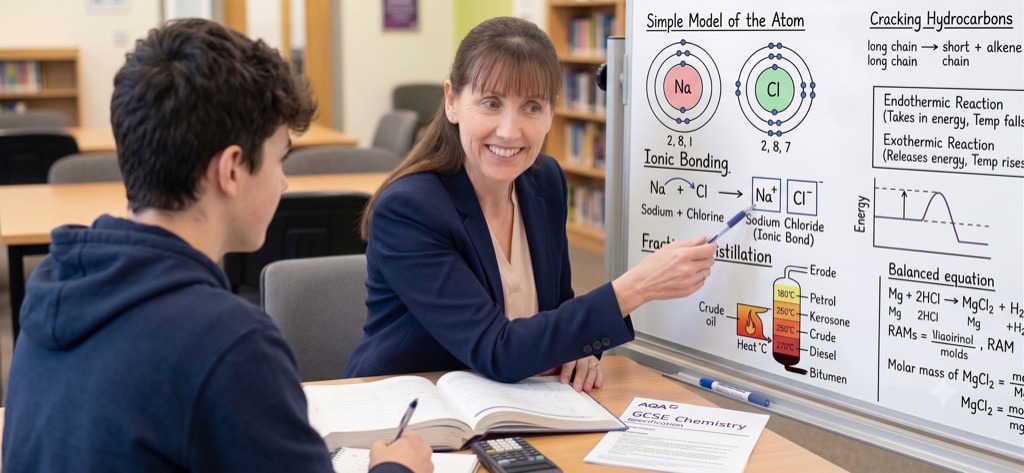
GCSE Chemistry can be challenging for students because it combines scientific concepts, mathematical calculations, chemical equations, practical experiments, and detailed exam questions. While some students quickly understand atomic structure and chemical bonding, others need additional explanations, visual examples, or more time to practise unfamiliar topics. A teaching approach that works well for one student may not be equally effective for another.
Personalised GCSE Chemistry tuition helps address these differences by adapting lessons to each student’s abilities, learning preferences, and academic goals. Rather than following the same pace for everyone, individual tuition focuses on identifying knowledge gaps, strengthening scientific understanding, and developing the skills required to answer exam questions confidently. With the right support, students can make steady progress, improve their problem-solving abilities, and approach their GCSE Chemistry exams with greater confidence.
What Is Personalised GCSE Chemistry Tuition?
Personalised tuition is an individualised teaching approach that focuses on a student’s specific learning requirements. Instead of concentrating only on completing the syllabus, a tutor assesses what the student already understands, identifies areas that require improvement, and develops lessons around those priorities.
A GCSE Chemistry Tutor can adapt explanations, teaching methods, practice activities, and revision plans according to a student’s progress. For example, a student who struggles with chemical equations may need step-by-step demonstrations and repeated practice, while someone who understands the calculations but loses marks in written answers may benefit more from exam technique and scientific terminology.
This flexibility allows students to receive targeted support without spending unnecessary time revisiting topics they have already mastered. It also creates opportunities to ask questions, clarify misunderstandings, and practise difficult concepts in a supportive learning environment.
1. Supporting Students Who Struggle with Fundamental Chemistry Concepts
Chemistry involves several interconnected concepts. Students need to understand atomic structure before progressing confidently to topics such as the periodic table, chemical bonding, and chemical reactions. When these foundations are weak, more advanced material can become increasingly difficult.
Personalised tuition helps students strengthen their understanding by breaking complex ideas into smaller, manageable steps.
Simplifying Abstract Scientific Concepts
Topics such as ionic bonding, covalent bonding, electrolysis, and particle theory can be difficult because students cannot always observe the underlying processes directly. Tutors can use diagrams, labelled illustrations, models, and everyday examples to make these ideas easier to understand.
For instance, when teaching ionic bonding, a tutor can explain how electrons are transferred between atoms, how oppositely charged ions form, and why these ions attract each other. Students can then practise drawing dot-and-cross diagrams and explaining the formation of ionic compounds.
This gradual approach encourages genuine understanding rather than memorising definitions without knowing what they mean.
Addressing Knowledge Gaps Before Moving Forward
Some students struggle with advanced topics because they have misunderstood earlier lessons. Personalised tuition provides time to revisit these gaps before introducing more challenging material.
A tutor may begin with atomic structure, check the student’s understanding of protons, neutrons, and electrons, and then connect these concepts to electronic configuration and the periodic table.
By building knowledge in the correct sequence, students can develop a stronger foundation for the rest of the GCSE Chemistry syllabus.
2. Adapting Lessons to Different Learning Preferences
Students do not all process information in the same way. Some understand concepts more easily through visual demonstrations, while others benefit from listening to explanations, discussing ideas, or completing practical questions.
Personalised lessons can combine different teaching methods to help students engage with the material more effectively.
Visual Learning Methods
Visual resources can make complicated Chemistry topics easier to understand. Diagrams, flowcharts, labelled models, and comparison tables help students recognise relationships between scientific ideas.
For example, a visual explanation of the reactivity series can help students compare metals and understand displacement reactions. Similarly, particle diagrams can demonstrate the differences between solids, liquids, and gases.
Visual revision materials can also help students organise information and recall important details during examinations.
Step-by-Step Explanations and Discussion
Some students need to hear a concept explained in different ways before it becomes clear. Tutors can use questions, discussions, and practical examples to identify misunderstandings and provide further clarification.
A student learning about exothermic and endothermic reactions, for instance, may initially confuse energy released with energy absorbed. A tutor can explain the direction of energy transfer, relate it to temperature changes, and ask the student to describe the process in their own words.
This interactive approach helps students develop a clearer understanding and gives tutors opportunities to check whether learning has taken place.
Learning Through Practice
Other students make the greatest progress when they actively apply what they have learned. Regular practice with chemical equations, calculations, and exam-style questions helps turn theoretical knowledge into practical skills.
A flexible lesson can combine explanations with worked examples and independent exercises. The tutor can then review mistakes immediately and demonstrate how to correct them.
3. Helping Students Who Find Chemistry Calculations Difficult
Mathematical calculations are an important part of GCSE Chemistry. Depending on the exam board and specification, students may need to calculate relative formula mass, determine concentrations, interpret quantitative data, or solve problems involving moles and reacting masses.
Students who understand the scientific concepts may still lose marks because they struggle to select the correct formula, rearrange equations, or show their working clearly.
Breaking Calculations into Manageable Steps
A GCSE Chemistry Tutor can teach calculation methods through a consistent process:
- Identify the information provided in the question.
- Determine what needs to be calculated.
- Select the appropriate formula.
- Substitute the known values carefully.
- Complete the calculation and check the answer.
- Include the correct units and appropriate working.
This structure helps students approach unfamiliar questions systematically instead of guessing which method to use.
For example, when calculating relative formula mass, students can practise identifying each element in a chemical formula, finding its relative atomic mass, multiplying by the number of atoms, and adding the results.
Once the method is understood, students can progress to more challenging questions that require several stages of reasoning.
Developing Confidence with Quantitative Questions
Repeated practice is particularly useful for topics involving moles, concentration, gas volumes, and percentage yield where these are included in the student’s specification.
Tutors can gradually increase question difficulty, beginning with straightforward examples and progressing to multi-step problems. Reviewing incorrect answers helps students recognise patterns in their mistakes, such as confusing mass with relative formula mass or forgetting to convert units.
This targeted approach helps students improve accuracy while developing the confidence to tackle calculation questions independently.
4. Supporting Students Who Struggle with Exam Technique
Understanding Chemistry is only part of achieving a strong GCSE result. Students must also communicate scientific knowledge clearly and respond to questions according to the command words and mark schemes used by their exam board.
Some students know the correct scientific concept but lose marks because their answers are incomplete, vague, or insufficiently detailed.
Understanding Command Words
GCSE Chemistry questions often use command words such as describe, explain, compare, calculate, and evaluate. Each requires a different type of response.
For example, a question asking students to describe an observation may require them to state what happens during an experiment. An explain question generally requires them to connect the observation to a scientific principle.
Personalised tuition helps students recognise these differences and practise responding appropriately.
Improving Extended-Response Answers
Longer questions may require students to explain a chemical process, evaluate an experimental method, or discuss the advantages and disadvantages of a particular approach.
Tutors can help students structure their answers logically, use accurate scientific vocabulary, and include relevant evidence or explanations. They can also identify common weaknesses, such as making unsupported statements or repeating information without developing the argument.
Practising these skills helps students turn their subject knowledge into clear, relevant examination answers.
Learning from Past Papers
Past papers are useful for identifying recurring weaknesses and becoming familiar with examination formats. However, simply completing questions is not enough if students do not understand why their answers lose marks.
A personalised approach involves reviewing incorrect responses, comparing them with mark schemes, and practising similar questions until the underlying problem is resolved.
Students can then focus revision time on the topics and skills most likely to improve their performance.
5. Providing Support for Students with Different Learning Challenges
Students may experience different barriers to learning. Some find it difficult to concentrate for extended periods, while others need additional processing time, repeated explanations, or a more structured learning environment.
Personalised tuition can accommodate many of these requirements by adjusting the pace, organisation, and delivery of lessons.
Students Who Need More Time to Understand Topics
A student who needs additional time can revisit difficult concepts without feeling pressured to keep up with a large group. Tutors can divide complex topics into shorter sections, check understanding regularly, and introduce new material when the student is ready.
This can be particularly helpful when learning challenging areas such as electrolysis, equilibrium, organic chemistry, or quantitative chemistry.
Students Who Benefit from Structured Learning
Some students work more effectively when lessons follow a predictable routine. A tutor can begin by reviewing previous learning, introduce one or two key concepts, demonstrate examples, and finish with practice questions.
Clear learning objectives and regular progress checks can make lessons easier to follow. Short revision tasks between sessions can also help students retain information and identify areas that need further attention.
Students Who Need Additional Learning Support
Students with dyslexia, ADHD, or other learning differences may benefit from suitable adjustments, depending on their individual needs. These might include shorter tasks, clear written instructions, uncluttered learning materials, frequent checks for understanding, or additional opportunities to practise.
Effective support should be based on the student’s circumstances rather than assumptions about a diagnosis. Where appropriate, tutors can work with parents and the school’s existing support arrangements to help maintain consistency.
Any formal examination access arrangements must be assessed and approved through the relevant examination procedures; ordinary tuition does not automatically provide eligibility for extra time or other adjustments.
6. Building Confidence and Reducing Chemistry Exam Anxiety
Students who repeatedly struggle with Chemistry may begin to believe that they are not capable of succeeding in the subject. This lack of confidence can make revision more stressful and prevent them from asking questions or attempting unfamiliar problems.
Personalised tuition can create a supportive environment where students can discuss difficulties openly and work through mistakes without the pressure of comparing themselves with classmates.
Setting Achievable Learning Goals
Breaking a large syllabus into smaller goals can make revision feel more manageable. Instead of attempting to master several difficult topics in one session, a student might focus on balancing equations, understanding ionic bonding, or improving calculations involving concentration.
Achieving these smaller objectives helps students recognise their progress and understand which skills still require attention.
Encouraging Independent Problem-Solving
Effective tutoring should gradually help students become less dependent on assistance. Tutors can initially demonstrate a method, complete an example with the student, and then ask the student to solve a similar problem independently.
As their understanding improves, students can attempt unfamiliar questions and explain the reasoning behind their answers.
This progression supports confidence, independence, and a more positive attitude towards examination preparation.
7. Creating a Revision Plan Around Individual Academic Goals
Every student begins GCSE Chemistry revision from a different position. Some need to strengthen their understanding of the entire syllabus, while others are aiming to improve a particular grade or prepare for a specific examination paper.
A personalised revision plan helps students use their available time more effectively.
Identifying Strengths and Weaknesses
An initial assessment can help establish which topics the student understands and where additional support is needed. This may involve short diagnostic questions, discussions about classroom learning, and a review of previous assessments.
The findings can be used to prioritise topics rather than allocating equal time to every area.
For example, a student who understands atomic structure but struggles with quantitative chemistry may need more calculation practice and less time reviewing familiar concepts.
Matching Revision to the Exam Board
GCSE Chemistry specifications differ between examination boards, including AQA, Pearson Edexcel, and OCR. Students should follow the specification and assessment requirements relevant to their course.
A tutor can use the appropriate specification, practical requirements, and past papers to guide revision. This helps ensure that students practise relevant content and become familiar with the types of questions they may encounter.
Monitoring Progress Over Time
Progress should be assessed through more than a student’s confidence during lessons. Regular quizzes, topic assessments, marked exam questions, and comparisons of performance can reveal whether knowledge and examination skills are improving.
Tutors can use these results to adjust future sessions, revisit persistent weaknesses, and introduce more challenging questions when appropriate.
8. How Online GCSE Chemistry Tuition Makes Personalised Learning More Flexible
Online tuition can make individual support easier to access by allowing students to learn from home and arrange lessons around their schoolwork and other commitments.
Virtual whiteboards, digital worksheets, shared diagrams, and online practice questions can support explanations and provide immediate opportunities to apply new knowledge.
For example, a tutor can use a digital whiteboard to balance a chemical equation, annotate a diagram of an electrolysis cell, or demonstrate a calculation one step at a time. Students can then complete similar questions while the tutor checks their reasoning.
Online lessons also make it easier to revisit digital resources between sessions. Students can organise notes, review worked examples, and practise questions at their own pace.
However, the quality of learning depends on the teaching approach, the student’s engagement, and the suitability of the resources. Practical Chemistry knowledge must still be developed in accordance with the school’s teaching programme and the required practical work for the relevant specification.
9. What Should Parents Look for in a GCSE Chemistry Tutor?
Choosing a suitable tutor involves more than finding someone who knows the subject. Parents should consider whether the tutor can explain difficult concepts clearly, adapt lessons to individual requirements, and help students develop independent examination skills.
Useful factors to consider include:
- Subject knowledge: The tutor should understand the relevant GCSE Chemistry specification and the topics students are expected to study.
- Personalised teaching: Lessons should respond to the student’s strengths, weaknesses, learning pace, and academic objectives.
- Exam preparation: Students should receive opportunities to practise past-paper questions, understand mark schemes, and improve their written answers.
- Progress monitoring: Regular feedback should identify improvements and explain which areas need further work.
- Clear communication: Parents and students should understand learning objectives, progress, and recommended next steps.
- Flexible support: Lesson scheduling and learning resources should suit the student’s circumstances.
A good tutor should also encourage students to ask questions, explain their reasoning, and gradually develop the confidence to work independently.
Conclusion
Personalised GCSE Chemistry tuition can support students with different learning needs by adapting explanations, lesson pace, practice activities, and revision strategies to their individual requirements. Whether a student struggles with fundamental concepts, mathematical calculations, exam technique, or confidence, targeted support can help address these challenges systematically.
A GCSE Chemistry Tutor can identify knowledge gaps, break difficult topics into manageable steps, and provide regular opportunities to practise applying scientific knowledge. With clear learning goals, specification-focused revision, and constructive feedback, students can strengthen their understanding and become better prepared for their examinations.
The most effective approach recognises that progress looks different for every student. By focusing on individual needs and developing independent learning skills, personalised tuition can help students approach GCSE Chemistry with greater understanding, confidence, and readiness for their exams.