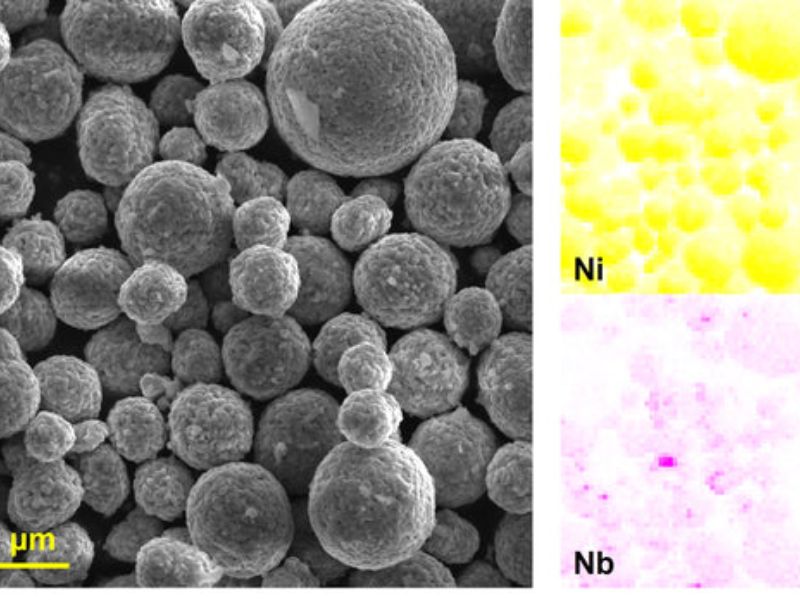
Modern batteries need materials that can balance energy density, stability, and practical manufacturing requirements. Ampcera supports research into advanced battery materials by offering solutions for solid state battery development, electrode processing, and cathode engineering. One important material for this work is NMC811 cathode powder, a nickel rich cathode chemistry that is widely studied for high energy battery applications.
What Is NMC811 Cathode Powder?
NMC811 refers to a nickel manganese cobalt oxide cathode with a nominal composition of approximately 80% nickel, 10% manganese, and 10% cobalt. The high nickel content can provide high specific capacity, while manganese and cobalt contribute to structural and electrochemical characteristics.
For researchers, NMC811 cathode powder can serve as a useful platform for studying cathode behavior, surface modification, electrolyte compatibility, and cell performance. Its properties make it relevant to both conventional lithium ion battery research and emerging solid state battery systems.
Why Is Nickel Rich Cathode Chemistry Important?
Nickel rich cathodes attract attention because increasing nickel content can help improve energy density. At the same time, higher nickel levels can introduce challenges related to surface reactions, structural changes, thermal behavior, and long term cycling.
This creates a need for careful material engineering. Researchers may study particle morphology, composition, surface coatings, electrode formulation, and operating conditions to understand how a cathode behaves in a complete cell.
Key Areas Researchers Examine
- Particle size and distribution
- Surface chemistry and coating quality
- Electrode composition
- Cathode electrolyte interface behavior
- Charge and discharge performance
- Cycling stability
- Compatibility with solid electrolytes
The Role of Surface Coatings
Cathode surface coatings can create an additional interface between active material and electrolyte. Depending on the coating chemistry and processing method, a coating may help reduce unwanted reactions and support a more stable cathode electrolyte interface.
Ampcera offers coated cathode materials using approaches such as lithium niobium oxide and lithium zirconium oxide. These materials are relevant for research involving high nickel cathodes and solid state battery architectures.
When researchers evaluate NMC811 cathode powder, surface treatment can therefore become an important part of the material selection process. The goal is not simply to choose a high energy material, but to understand how its surface interacts with the rest of the cell.
NMC811 Cathode Powder for Solid State Batteries
Solid state batteries replace the conventional liquid electrolyte with a solid electrolyte. This change creates new opportunities, but it also introduces different interface and processing requirements.
A cathode must work effectively with the selected solid electrolyte and electrode formulation. Researchers often investigate how cathode particles, electrolyte particles, conductive additives, and binders interact within the composite cathode.
Ampcera provides sulfide solid electrolytes alongside coated cathode materials and processing services. This broader portfolio can help research teams study material combinations rather than evaluating each component in isolation.
What Should Researchers Consider When Selecting Cathode Material?
Selecting a cathode involves more than looking at nominal capacity. Researchers should consider how the material fits their testing method, electrolyte, electrode formulation, and development goals.
Material Characteristics
Important characteristics may include particle size, composition, morphology, coating chemistry, and surface condition. Consistent material properties can make it easier to compare experimental results across different batches or cell designs.
Electrochemical Requirements
Researchers should also define the voltage range, target loading, current rate, cycle life expectations, and cell configuration before selecting a material. These factors can influence which cathode formulation is appropriate for a particular experiment.
Processing Compatibility
The cathode must also be compatible with the intended electrode manufacturing method. Dry processing, wet processing, pressure assisted fabrication, and other approaches can place different requirements on the material.
How Ampcera Supports Cathode Research?
Ampcera works across several areas of advanced battery materials. Its portfolio includes sulfide solid electrolytes, coated cathodes, dry electrode processing, electrolyte film services, and battery research equipment.
This combination can be useful for teams investigating NMC811 cathode powder because cathode development is closely connected to electrolyte selection and electrode processing. A research program may require material screening first, followed by composite electrode fabrication and cell testing.
Ampcera’s coated cathode portfolio includes lithium niobium oxide coated NMC811 as well as other coated NMC and single crystal cathode materials. Such options allow researchers to compare different surface treatments and cathode structures during development.
Benefits of Using a Research Focused Cathode Material
A well characterized cathode material can help researchers build a more consistent experimental workflow. It can also make comparisons between different formulations easier.
Potential research benefits include:
- More controlled material comparisons
- Better evaluation of interface behavior
- Easier study of coating effects
- Flexible testing with different electrolytes
- Support for prototype cell development
- Improved understanding of electrode formulation
These benefits depend on the complete cell design and testing conditions. A cathode material alone cannot determine final battery performance.
NMC811 Cathode Powder and Electrode Development
Electrode development involves combining active material with other components to create a functional composite. NMC811 cathode powder can be evaluated alongside solid electrolyte, conductive additives, and other components to study electrode behavior.
The balance between active material, solid electrolyte, conductive additives, and processing conditions can influence electrode performance.
For solid state research, uniform mixing is especially important because ionic and electronic pathways need to work throughout the composite. Processing conditions can affect particle contact, density, and interface quality.
Ampcera’s dry process services can support cathode composite powder mixing, kneading, and electrode film fabrication. This can provide researchers with an additional route for studying advanced electrode designs.
Common Challenges in Nickel Rich Cathodes
Nickel rich cathodes can present several research challenges. Surface reactions, structural changes, particle cracking, and interface instability may affect long term performance.
Researchers therefore often combine material characterization with electrochemical testing. Comparing fresh and cycled materials can help identify changes that occur during battery operation.
The choice of electrolyte also matters. Sulfide solid electrolytes, for example, have different chemical and processing considerations from conventional liquid electrolytes. Understanding the complete material system is essential when developing a solid state cell.
How Can Researchers Build a Better Testing Strategy?
A practical testing strategy can begin with clear research objectives. Teams should define what they want to measure before selecting materials and cell configurations.
A simple workflow can include:
- Define the target battery application.
- Select the cathode chemistry.
- Evaluate particle and surface characteristics.
- Choose a compatible electrolyte.
- Develop the composite electrode.
- Build and test cells under controlled conditions.
- Analyze cycling and interface performance.
- Refine the material or processing method.
This approach helps separate material effects from processing and cell design effects.
Frequently Asked Questions
What is NMC811 used for?
NMC811 is mainly studied as a nickel rich cathode material for high energy lithium based battery applications. It is also relevant to research into solid state battery systems.
Why are coatings studied on nickel rich cathodes?
Coatings are studied because they can modify the cathode surface and may help control reactions between the cathode and electrolyte. Their effectiveness depends on coating chemistry, thickness, processing, and cell conditions.
Can NMC811 be used with solid electrolytes?
Yes. Researchers can investigate NMC811 in solid state battery configurations, but the cathode, electrolyte, conductive additives, and processing conditions need to be evaluated together.
What does Ampcera provide for cathode research?
Ampcera provides advanced battery materials and services, including coated cathodes, sulfide solid electrolytes, dry electrode processing, electrolyte film processing, and battery research equipment.
Is NMC811 suitable for every battery design?
No. Material selection depends on the application, cell architecture, voltage range, loading, electrolyte, manufacturing process, and performance requirements.
Conclusion
NMC811 cathode powder remains an important research material for teams exploring high energy battery technologies. Its nickel rich composition offers an attractive foundation for studying energy density, while its surface and interface behavior creates opportunities for further material engineering.
Ampcera supports this research through coated cathode materials, sulfide solid electrolytes, electrode processing, and other battery development solutions. By evaluating cathode chemistry together with surface treatment, electrolyte compatibility, and processing conditions, researchers can develop a clearer understanding of advanced cell performance.
For teams working on next generation energy storage, careful material selection and controlled experimentation remain essential. A research focused approach can help turn promising cathode chemistry into useful knowledge for future battery development.