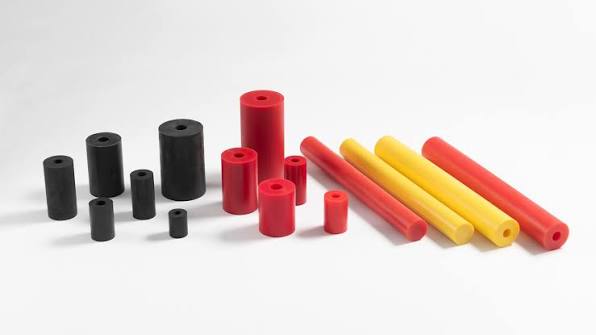
Elastomer springs are flexible mechanical components that absorb and release energy through the deformation of rubber-like materials rather than relying on metal coils or leaves. They are particularly useful when equipment needs vibration isolation, shock absorption, controlled movement, or compact spring action. Unlike conventional springs made from metal, elastomer designs can combine springing, damping, and isolation in a single component.
This makes elastomer springs valuable in applications where reducing vibration is just as important as supporting a load. Industrial machinery, rail systems, vehicles, construction equipment, and mounting systems can all benefit from their ability to handle repeated compression and dynamic forces. However, selecting the right elastomer is more complicated than simply choosing a component based on its physical size.
What Are Elastomer Springs?
An elastomer spring is a spring element made from an elastic polymer, most commonly a rubber-based compound. When a load is applied, the material deforms. Once the load is removed, the elastomer attempts to return toward its original shape, creating a restoring force.
The behavior is different from a steel spring. Metal springs generally store energy efficiently and return much of it during unloading. Elastomers, by contrast, exhibit hysteresis, meaning some mechanical energy is dissipated as heat during each loading cycle. That characteristic gives elastomer springs an important advantage: they can provide both spring force and damping.
Elastomer springs can be manufactured in several configurations, including cylindrical blocks, bonded rubber elements, conical designs, pads, bushings, and specialized composite assemblies. Their geometry is just as important as the material because changing the shape can significantly alter stiffness, allowable deformation, and load capacity.
For example, a rubber block compressed vertically behaves differently from the same material loaded in shear. Engineers therefore consider the direction and type of loading before specifying an elastomer spring.
How Elastomer Springs Work
The basic principle is straightforward: mechanical energy causes the elastomer to deform, and the material generates a restoring force.
However, elastomers are viscoelastic, so their response depends on several variables rather than only the applied load. Temperature, loading frequency, strain level, material formulation, and operating environment can all influence performance.
A useful distinction is between static stiffness and dynamic stiffness. Static stiffness describes the response under relatively slow loading, while dynamic stiffness considers faster or repeated loading. A component that performs well under a slowly applied load may behave differently when subjected to continuous vibration.
Compression
Compression designs are loaded by pushing the elastomer between surfaces. They are often used for heavy-duty isolation and shock absorption.
Shear
Shear designs allow movement across the elastomer. They can provide controlled flexibility while restricting unwanted movement in other directions.
Combined Loading
Many industrial components experience compression, shear, and lateral forces simultaneously. In these cases, the geometry and mounting arrangement must be evaluated as a complete system rather than treating the elastomer as a simple vertical spring.
A Practical Guide to Selecting an Elastomer Spring
Choosing an elastomer spring starts with the operating conditions rather than the component itself.
1. Determine the Required Load
Identify the normal operating load as well as the maximum expected load. Include equipment weight, impact forces, acceleration, and other dynamic loads where applicable.
For example, a support carrying a stationary machine may experience relatively predictable compression. A spring used beneath mobile equipment may see substantially higher transient forces.
Avoid selecting a component solely because its rated load appears higher than the equipment weight. The actual load distribution and safety requirements also matter.
2. Identify the Required Deflection
Determine how much movement is acceptable under the expected load.
If an application requires 5 mm of controlled movement, a component designed for only 1 mm may become excessively stressed. Conversely, using an extremely soft element where limited movement is required can cause instability or excessive vibration.
The goal is controlled deflection, not simply maximum flexibility.
3. Consider the Operating Environment
Temperature is one of the most important environmental factors.
Elastomer properties can change significantly at very low or high temperatures. Exposure to oils, fuels, solvents, water, ozone, ultraviolet radiation, or chemicals can also affect service life depending on the material.
Common elastomer families have different strengths. Natural rubber, nitrile, EPDM, silicone, polyurethane, and other compounds can behave very differently under identical conditions.
For instance, an application involving petroleum-based fluids requires different material considerations than an outdoor installation exposed primarily to weather and ozone.
4. Evaluate Dynamic Conditions
Determine whether the spring will experience vibration, impacts, oscillation, or continuous cycling.
Frequency matters because elastomers can exhibit different stiffness and damping characteristics at different operating frequencies. A component used in a machine running continuously at a particular rotational speed should therefore be evaluated under representative dynamic conditions.
Common Applications
Elastomer springs are used across many industries because they combine flexibility and damping in relatively compact packages.
Industrial machinery: They can isolate equipment from vibration and reduce the transmission of mechanical forces into supporting structures.
Rail transportation: Elastomeric suspension components can help absorb vibration and accommodate controlled movement between structural parts.
Automotive systems: Rubber-based spring elements and isolators are commonly used where vibration reduction and controlled movement are required.
Construction equipment: Heavy machinery produces substantial shocks and vibration, making elastomeric components useful for mounts and suspension-related applications.
Material-handling equipment: Conveyors, processing equipment, and other systems may use elastomer elements to reduce impact and noise.
Common Mistakes and Challenges
One of the biggest mistakes is treating an elastomer spring like a conventional steel spring. Its performance is strongly influenced by temperature, frequency, deformation, and material characteristics.
Another common problem is over-compression. Elastomers need sufficient space to deform without contacting surrounding hardware or being forced beyond their recommended strain limits.
Poor mounting can also reduce performance. An elastomer that is intended to work primarily in compression may perform poorly if the installation introduces unexpected tensile or shear loads.
Ignoring aging is another concern. Even when an elastomer looks intact, prolonged exposure to heat, ozone, chemicals, and repeated cycling can change its mechanical properties.
Finally, designing around a single laboratory specification can be misleading. Real equipment experiences variable loads and environmental conditions, so application-specific testing is often valuable for critical systems.
Practical Tips for Better Performance
Start with the load-deflection requirement, then select the material and geometry. Reversing this process often leads to compromises later.
Keep operating temperatures within the material’s intended range. If the component will experience substantial temperature fluctuations, evaluate performance across the entire expected range rather than using room-temperature specifications alone.
Allow adequate clearance around the spring so it can deform as intended. Check the mounting surfaces for alignment and make sure installation does not introduce unintended loads.
For applications involving continuous vibration, examine both static and dynamic behavior. If possible, test the component under conditions that reproduce the actual operating frequency, temperature, and load.
Maintenance should also focus on changes rather than appearance alone. Cracking, permanent deformation, surface deterioration, unusual movement, increased vibration, or changes in equipment alignment can indicate that an elastomeric component needs inspection.
Conclusion
Elastomer springs provide a useful combination of load support, flexibility, vibration isolation, and energy dissipation. Their performance depends not only on material hardness but also on geometry, loading direction, temperature, frequency, deformation, and environmental exposure.
The most reliable approach is to define the real operating conditions first, calculate the required load and deflection, select an appropriate elastomer compound, and then verify the design under representative conditions. When these factors are considered together, elastomer springs can provide predictable and durable performance in demanding mechanical systems.