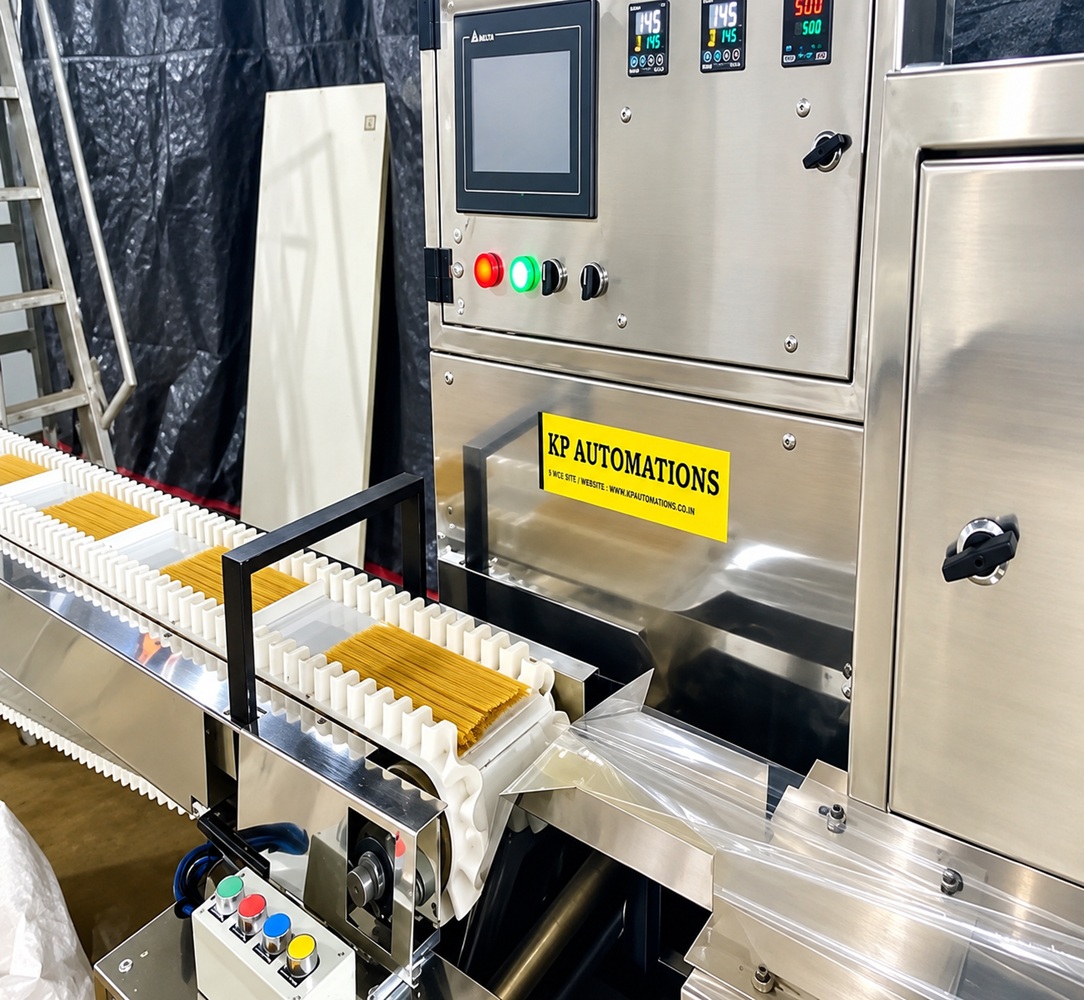
For a pasta manufacturing business, packaging is more than the final step in production. It influences product presentation, pack-weight consistency, storage, transportation, and the overall experience of distributors and customers. Selecting the right automatic pasta packing machine helps manufacturers establish a packaging process that supports their product range and commercial goals.
KP AUTOMATIONS provides pasta processing and packaging machinery for commercial and industrial applications. With solutions covering pasta production, drying, and packing, the company supports businesses looking to develop new manufacturing facilities or improve existing operations.
Before investing in packaging equipment, manufacturers should understand their product requirements, target markets, packaging formats, and expected production volumes. These factors help determine which machine configuration is appropriate for the business.
Understanding Your Packaging Requirements Before Buying
Every pasta business has its own packaging priorities. A manufacturer supplying supermarkets may need consumer-friendly retail pouches, while a supplier serving restaurants and institutional kitchens may focus on larger packs.
An automatic pasta packing machine should therefore be selected according to the products being packed and the customers they serve.
Start by identifying the following requirements:
- Pasta varieties to be packaged
- Required pack weights and dimensions
- Expected packaging output
- Packaging film or other materials
- Product identification and batch coding needs
- Storage and distribution conditions
- Future plans for new products or pack sizes
Defining these details before purchasing machinery makes it easier to compare equipment on practical suitability rather than price or maximum advertised speed alone.
How a Pasta Making Machine Connects With Packaging
The packaging section depends on the quality and quantity of pasta supplied by the production line. A pasta making machine forms the product through processes such as mixing, extrusion, shaping, and cutting, depending on the equipment configuration.
After production, pasta intended for dry storage must pass through an appropriate drying process and reach the required condition before packaging. Product transfer and handling must then deliver pasta to the packing section without creating unnecessary delays or damage.
A typical process may include:
Pasta Production → Drying → Cooling → Product Handling → Weighing → Filling → Sealing → Finished-Pack Inspection
Each stage has a separate role. Packaging equipment should be selected with the expected output and product characteristics of the upstream machinery in mind.
When manufacturers plan a new facility, reviewing the entire process can help identify potential bottlenecks before equipment is installed.
Selecting the Right Packaging Technology
Different packaging technologies are available for food products. The suitable option depends on the pasta variety, packaging material, required pack format, and production target.
Vertical Form-Fill-Seal Systems
Vertical form-fill-seal, or VFFS, equipment forms pouches from packaging film, fills them with a measured quantity of product, and seals the package. Depending on the configuration, the system can be combined with weighing equipment and product-feeding components.
VFFS systems may suit manufacturers packing short-cut pasta into retail or wholesale pouches. Buyers should confirm the supported film types, pouch dimensions, weight range, sealing arrangements, and achievable production speed for their intended application.
Weighing and Filling Systems
Weighing equipment measures product portions before they enter the package. The appropriate system depends on the target weight, pasta shape, product flow, and required accuracy.
Some configurations use multi-head weighing systems, while other applications may require different dosing arrangements. Manufacturers should discuss these requirements with the machinery supplier before choosing a complete packing line.
Specialized Packaging Arrangements
Long pasta products, specialty shapes, and unusual pack sizes may require specific feeding or handling arrangements. Equipment suitability should be confirmed for each intended product rather than assumed from the machine’s general description.
KP AUTOMATIONS offers packaging-related solutions alongside its broader pasta machinery portfolio. Buyers can review its types of packing machines to understand the available equipment categories.
Packaging Short-Cut and Long-Cut Pasta
Pasta shape is an important consideration when selecting packing equipment.
Short-cut products such as macaroni, penne, fusilli, and similar varieties can be handled using suitable feeding and weighing arrangements. Their dimensions and flow characteristics affect how consistently they move through the machine.
Long-cut pasta, including spaghetti and linguine, may need specialized handling to accommodate strand length and reduce unnecessary breakage. Manufacturers should confirm the product range supported by the proposed packaging configuration.
For businesses producing several varieties, the equipment selection process should include a product list and the dimensions of each product. Where practical, testing the intended pasta with the proposed machine can help confirm feeding performance and package appearance.
This approach reduces the risk of purchasing equipment that performs well with one product but struggles with another.
Why Pack-Weight Consistency Matters
Customers expect each package to contain the stated quantity. Inconsistent filling can affect customer confidence, inventory management, and compliance with applicable packaging regulations.
A suitable automatic pasta packing machine can help standardize filling operations when it is configured and maintained correctly. However, automation alone does not eliminate the need for routine checks.
Manufacturers should establish procedures for:
- Setting the target pack weight
- Checking weighing-system calibration
- Verifying sample packs during production
- Investigating underweight or overweight packs
- Recording inspection results
- Correcting recurring filling problems
The weighing range and accuracy requirements should be discussed during equipment selection. Buyers should also confirm how the machine handles different pack weights and whether changeover requires additional components or adjustments.
Choosing Packaging Formats for Retail and Wholesale Markets
Packaging format affects the way a product is stored, transported, displayed, and sold. A manufacturer serving multiple customer groups may need more than one pack size.
Retail packages often prioritize presentation, clear product identification, convenient handling, and consistent dimensions. Wholesale and food-service packages may emphasize larger quantities, practical storage, and transport durability.
Before finalizing a machine, define the intended packaging formats and verify that the equipment supports them.
Consider:
Pack size: Establish the standard weights required by customers and distributors.
Packaging material: Confirm compatibility with the machine’s film-feeding and sealing system.
Product protection: Select packaging appropriate for the product and its expected storage conditions.
Branding and information: Determine the space required for product names, ingredient information, dates, batch details, and other applicable label information.
Distribution: Consider carton dimensions, stacking, warehouse handling, and transport requirements.
A clear packaging specification can help the business avoid unnecessary changes after the equipment has been installed.
The Role of a Fully Automatic Pasta Making Machine
A fully automatic pasta making machine can help coordinate production operations and reduce the need for repetitive manual intervention, depending on the selected system.
However, the degree of automation across a factory depends on the complete equipment configuration. Automated extrusion does not necessarily mean that drying, cooling, product transfer, or packaging is also automated.
Manufacturers should examine how the production line connects to the packing section. The aim is to establish a suitable material flow in which each stage can handle the required output.
For example, the packaging system should be able to process the expected quantity of finished pasta without creating persistent accumulation between drying and packing. At the same time, the production line should not be designed around an unrealistic assumption that every machine will always operate at its maximum rated speed.
Planning around practical operating conditions provides a more useful basis for choosing equipment.
Integrating an Automatic Pasta Making Machine With a Dryer
Drying is essential when manufacturing shelf-stable dried pasta. The dryer must be suitable for the pasta type, production rate, and required final product condition.
An automatic pasta making machine and the drying system should be evaluated together so that the quantity of pasta produced can be processed appropriately. The handling arrangement after drying also matters because the product must reach packaging in a suitable condition.
A pasta dryer may be designed for batch or continuous operation, depending on the plant’s production requirements. Continuous systems can be relevant to production lines that move pasta through controlled drying zones, while static or room-based arrangements may suit other operating models.
KP AUTOMATIONS provides information about its pasta continuous dryer, which manufacturers can review when planning a production line.
The appropriate dryer should be selected based on verified technical specifications and the intended production process, rather than the equipment category alone.
Evaluating Packaging Speed and Actual Output
Maximum advertised speed is only one factor when comparing packaging machinery. Actual output can vary with pack size, film properties, pasta shape, weighing requirements, sealing conditions, and product changeovers.
Before purchasing, request performance information for the exact application.
Useful questions include:
- What output can the machine achieve at the required pack weight?
- Which packaging materials are supported?
- What pouch dimensions are available?
- How long does a product or pack-size changeover take?
- What maintenance and cleaning procedures are required?
- Which components are included in the quotation?
- What installation and training support is available?
Where possible, ask the supplier to demonstrate the equipment using a representative product and packaging material. Practical testing can reveal issues that may not be obvious from a general specification sheet.
Planning for Hygiene, Inspection, and Maintenance
Food packaging equipment should be operated under suitable hygiene procedures. The design and maintenance approach should support routine cleaning and inspection of relevant product-contact areas.
Manufacturers should establish procedures for removing product residue, inspecting equipment, and keeping packaging materials protected from contamination. Cleaning requirements must follow the machinery manufacturer’s instructions and the facility’s food-safety procedures.
Maintenance planning is also important. Sealing components, product-feeding mechanisms, weighing systems, and other moving parts require appropriate inspection according to the equipment design.
A practical maintenance program should define inspection intervals, replacement parts, operator responsibilities, and the process for reporting faults. Keeping maintenance records can help teams identify recurring issues and plan servicing before problems cause major production interruptions.
Comparing the Total Cost of Ownership
The purchase price of a packing machine does not represent the full cost of operating it. Buyers should consider installation, utilities, packaging materials, spare parts, maintenance, labour, and any equipment needed to integrate the machine with the production line.
When comparing suppliers, assess the expected cost per acceptable finished pack rather than purchase price alone.
A useful evaluation should include:
- Machine and accessory costs
- Installation and commissioning
- Packaging-material consumption
- Routine maintenance
- Changeover and cleaning time
- Operator training
- Spare-parts availability
- Technical support
- Practical production output
A lower-cost machine may not be the most economical choice if it cannot support the required packaging formats or creates operational bottlenecks. Equally, purchasing unnecessary capacity can increase the initial investment without delivering a meaningful benefit.
The best option is the configuration that matches the business’s present needs while allowing reasonable room for future growth.
Why Consider KP AUTOMATIONS?
KP AUTOMATIONS is an Indian manufacturer of pasta machinery with a portfolio covering production equipment, drying systems, and packaging solutions. The company traces its beginnings to 1998 and serves businesses looking for machinery for commercial and industrial pasta manufacturing.
For buyers, the most important step is to communicate the intended application clearly. Share details about the pasta varieties, target output, pack weights, packaging materials, available factory infrastructure, and future product plans.
This information allows the supplier to assess the appropriate configuration and clarify the scope of the proposed equipment. Buyers should also confirm the technical specifications, installation responsibilities, operator training, warranty terms, and after-sales support before finalizing an order.
Conclusion
Choosing an automatic pasta packing machine requires a clear understanding of the product, target market, package format, and production requirements. The right system should deliver suitable weighing, filling, and sealing performance while fitting the wider manufacturing process.
A pasta making machine, a fully automatic pasta making machine, a suitable pasta dryer, and a compatible pasta packing machine each contribute to the overall production workflow. Evaluating these requirements together helps manufacturers avoid mismatched capacities and build a packaging operation that can support commercial growth.
KP AUTOMATIONS offers pasta production, drying, and packaging machinery for businesses developing or upgrading their manufacturing facilities. By defining requirements carefully and checking actual equipment performance before purchase, manufacturers can make a more informed investment in their pasta packaging operations.