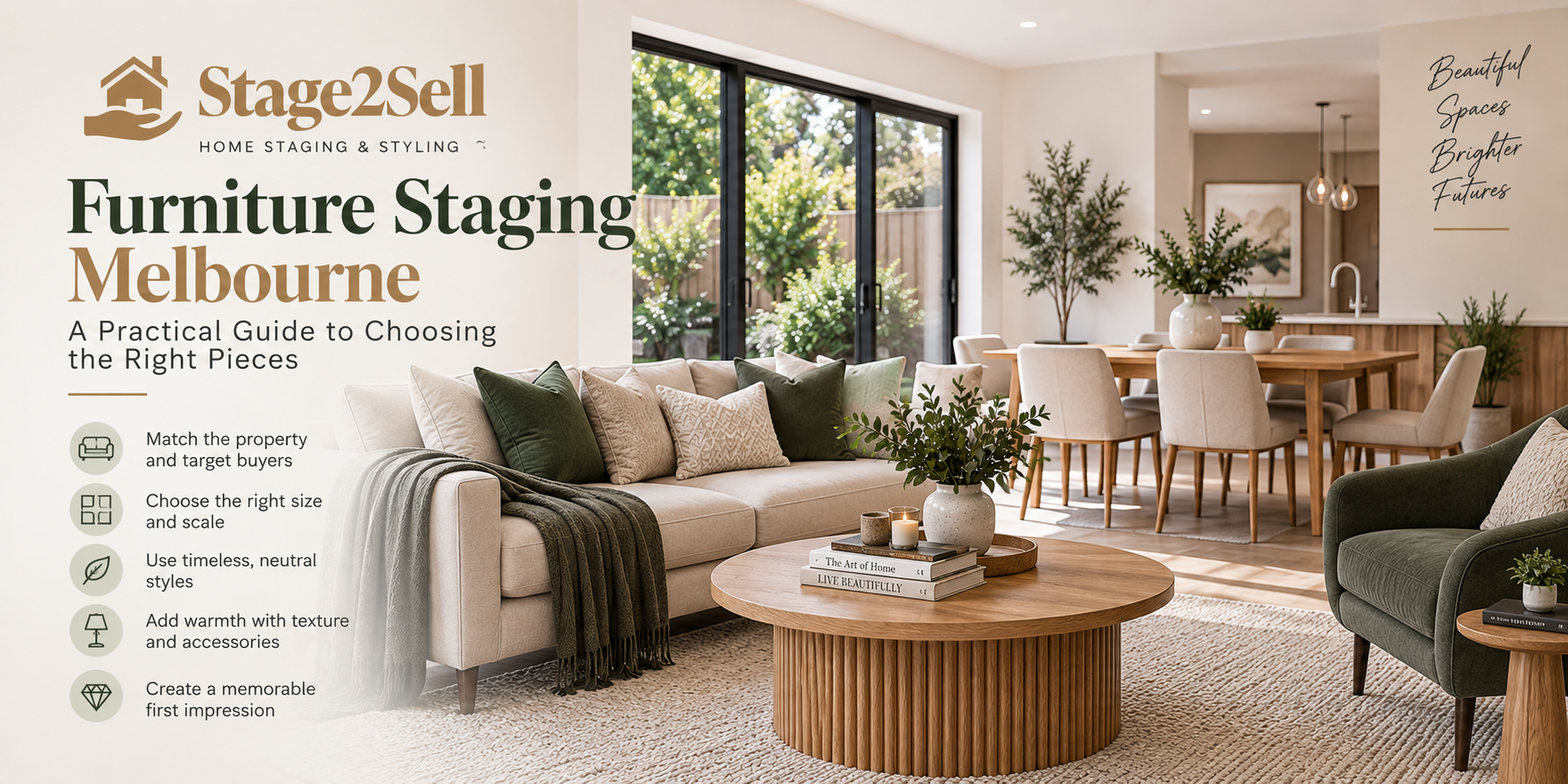
Furniture staging melbourne is best approached as a practical sales-preparation decision. Furniture staging works best when each piece explains the room rather than simply filling it. For Melbourne sellers, that means choosing furniture that fits the scale of the property, keeps walkways open, supports listing photography and gives buyers a clear sense of how the space can be used.
Stage2Sell describes furniture staging as using sofas, chairs, tables, beds and smaller decorative items to make rooms feel complete and understandable. The strongest schemes are selective. They use enough furniture to establish function and comfort without making the property feel crowded.
Related Stage2Sell resource what furniture staging is
Why furniture scale matters in Melbourne properties
Scale is one of the first things buyers read visually. An oversized sectional can make a reasonable living room appear tight, while furniture that is too small can make a large room feel disconnected. The objective is to create believable proportions.
Measure the major rooms before making decisions. Note door swings, windows, heating or cooling outlets and the main walking paths. In open-plan homes, furniture can also define zones without adding walls, for example by using the back of a sofa to separate living and dining areas.
This is particularly relevant for apartments, townhouses and compact inner-suburban homes where floor area needs to work hard. In larger family homes, scale still matters because empty zones can make rooms feel unfinished.
Choose the living room pieces first
The living room often anchors the visual identity of the listing. Start with seating, a coffee table, a rug and one or two supporting pieces such as an occasional chair or side table. The arrangement should create conversation and still leave a clear route through the room.
Useful next read home staging Melbourne
A common mistake is placing all furniture against the walls. Pulling pieces slightly inward can create a more intentional zone, provided the room has enough space. Another common problem is using too many small items, which can make the room appear busy in wide-angle photography.
Stage2Sell’s own furniture-staging advice warns against oversized pieces, poor layouts and inconsistent styling. Those problems are more important to fix than chasing decorative trends.
Use dining furniture to show capacity without crowding
A dining setting gives buyers an immediate sense of capacity. The table should fit the room while allowing chairs to move comfortably and preserving a route to nearby doors, kitchens or outdoor areas. If the dining zone is compact, a smaller table with fewer chairs can be more convincing than a large setting squeezed into the space.
For open-plan layouts, keep the dining furniture visually related to the living room through compatible timber tones, upholstery and accessory choices. Matching every item exactly is unnecessary; the scheme simply needs to feel coherent.
In homes where the dining area is ambiguous, a well-placed table can clarify the floor plan more effectively than decorative objects alone.
Bedrooms need proportion before decoration
The bed is the dominant piece in most bedrooms, so its scale shapes how the entire room reads. Choose a bed size that demonstrates usability without blocking wardrobe access or reducing the walking path to a narrow strip. Bedside tables, lamps and simple linen can then complete the room.
Useful next read property styling packages
Do not overfill secondary bedrooms. Buyers usually need to understand that a room can function as a bedroom, not see every possible furniture item. A bed and one or two supporting pieces may be enough.
In premium properties, texture and layering can be more detailed, but the same rule applies. Proportion comes first, decoration second.
Know what to keep in an occupied home
Partial staging depends on making honest decisions about existing furniture. Keep pieces that are in good condition, correctly scaled and compatible with the intended scheme. Remove items that are visibly worn, highly personal, oversized or difficult to integrate.
This does not mean an occupied home must lose its character. A quality timber dining table or neutral sofa can provide a useful foundation. The stylist can then add rugs, artwork, cushions, occasional furniture and lighting to bring the rooms together.
Stage2Sell’s partial staging option is designed for this type of situation. It allows sellers to improve the presentation without replacing everything already in the property.
Plan furniture for photography as well as inspections
Furniture needs to work from the camera’s point of view and from a buyer’s walking path. A room may feel comfortable in person but photograph poorly if tall pieces block windows or if the main furniture arrangement creates visual clutter in the widest angle.
Useful next read home staging in Altona
Before photography, check the likely camera positions and look for objects that overlap awkwardly. Simplify tabletops, keep major surfaces tidy and ensure focal points such as fireplaces, windows or architectural details remain visible.
Professional house staging Melbourne services usually make these decisions as part of the layout plan rather than treating photography as an afterthought.
Use local context without forcing a theme
Local buyer context can influence furniture choices, but the styling should not become a costume. Coastal Altona or Williamstown homes may suit lighter, relaxed materials, while newer family homes in Tarneit or Caroline Springs may need practical, clean-lined furniture that demonstrates family living.
Stage2Sell has local service pages for these suburbs, which helps sellers understand how full, partial and premium options are applied in different property types. The useful lesson is to match the home and likely buyer, not to copy a generic showroom.
How to brief a professional stylist
A useful stylist brief is specific but not controlling. Provide a floor plan, recent photographs, the planned photography date and details about any furniture that must remain. Mention access restrictions, pets, children or building rules before the installation is scheduled.
Then allow the stylist to solve the room rather than prescribing individual decorative items. The professional value lies in scale, proportion and coordination, which are difficult to achieve by selecting pieces independently from photographs online.
Check furniture condition as carefully as furniture size
Condition influences the way staged furniture reads in person and in high-resolution photography. Upholstery should look clean, tables should be free from obvious damage, and decorative pieces should support the same level of finish across the room. A correctly scaled item can still weaken the presentation if it looks tired beside fresher pieces. This is one reason professional inventory selection can be more effective than borrowing unrelated furniture from several sources.
Consistency also matters between connected spaces. The living and dining areas do not need identical furniture, but timber tones, shapes and visual weight should feel related. When the major pieces share a coherent direction, buyers can focus on the property rather than noticing abrupt style changes from room to room.
Common furniture staging mistakes
Common mistakes include using too much furniture, mixing unrelated styles, ignoring walkways, blocking natural light and choosing pieces based on personal preference rather than room scale. Another mistake is spending heavily on accessories while the core furniture layout is still wrong.
Fix the largest spatial problems first. Once the sofa, dining table, beds and major pathways make sense, smaller styling decisions become easier.
Key takeaways
Furniture staging is a spatial decision before it is a decorative one. Choose pieces that explain the room, preserve movement and photograph well. Keep suitable existing furniture in occupied homes, remove pieces that work against the presentation, and use accessories to support the layout rather than distract from it.
Frequently Asked Questions
What is furniture staging?
Furniture staging is the planned use of furniture and décor to show how a property can function and to improve its presentation before sale.
Does every room need furniture staging?
No. Priority rooms usually include the living area, dining area and main bedroom. Other rooms can be added when they improve the campaign or clarify the floor plan.
Can I use my own furniture for staging?
Yes. Partial staging can retain suitable existing pieces and add hired furniture or accessories where needed.
How do I know if furniture is too large for a room?
If it blocks windows, door swings, wardrobe access or comfortable walking paths, it is likely too large or poorly positioned for staging.
Is furniture staging useful for apartments?
Yes. Correctly scaled furniture can make compact rooms easier to understand and can show how living, dining and working zones fit within limited floor area.
Final recommendation
Use the article guidance to define the presentation problem first, then choose the staging scope that solves it. For a property-specific recommendation, request a free Stage2Sell quote.