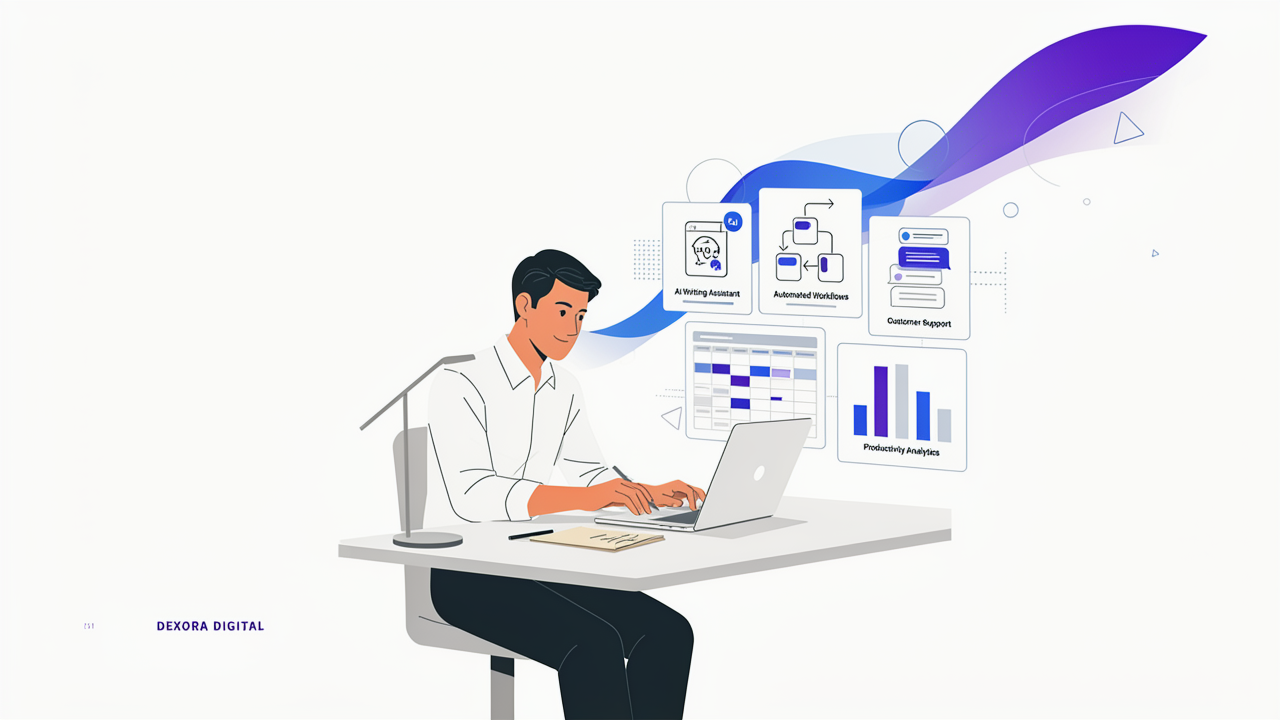
Artificial intelligence is becoming an important part of how small businesses manage daily operations, communicate with customers, and make decisions. However, getting value from AI involves more than subscribing to several tools. Businesses need a practical workflow that connects technology with real tasks, clear responsibilities, and measurable goals.
In 2026, small businesses can use AI to streamline repetitive work, organize information, support marketing activities, and improve customer experiences without building complicated systems. The key is to start with everyday business challenges and introduce automation where it delivers genuine value.
With a thoughtful approach, AI automation for small businesses can reduce manual work, improve consistency, and give owners more time to focus on growth. Here is how to build a useful AI workflow step by step.
1. Identify Repetitive Tasks Before Choosing AI Tools
The first step is understanding where your business spends time unnecessarily. Many small businesses handle repetitive activities manually, including answering common customer questions, scheduling appointments, preparing reports, organizing leads, and following up on inquiries.
Before investing in software, document the tasks your team performs every day and week. Identify which activities follow predictable rules, which require human judgment, and which frequently cause delays.
For example, a digital marketing agency might spend hours collecting campaign data, preparing weekly summaries, drafting social media posts, and responding to routine client questions. A local service company might struggle with appointment requests, lead tracking, and sending reminders.
These tasks offer different opportunities for AI assistance and automation. AI can help summarize campaign results or draft content, while automation can transfer lead information into a customer relationship management system and trigger follow-up reminders.
Start with one or two tasks that consume significant time but involve relatively low risk. Estimate how long they currently take and how often they occur. This gives you a baseline for measuring improvements later.
The goal is not to automate every activity. It is to identify work where a well-designed process can reduce unnecessary effort without sacrificing quality or customer relationships.
2. Choose AI-Driven Productivity Solutions That Fit Your Needs
Once you understand your operational challenges, select tools that address those specific problems. AI-driven productivity solutions can support writing, research, meeting summaries, document analysis, customer support, and task management.
For instance, a small business owner could use an AI assistant to turn rough notes into a professional email, summarize a long document, or create a first draft of a marketing plan. A team could use meeting transcription and summarization features to turn discussions into action items.
Choose tools based on practical requirements rather than popularity. Consider ease of use, integration options, data privacy, pricing, reliability, and the time required to train employees. A simple tool that fits your existing process may be more useful than an advanced platform with features your team rarely needs.
You should also distinguish between AI assistance and rule-based automation. AI is useful when work involves language, classification, summarization, or interpreting information. Traditional automation is often better for predictable actions, such as copying approved data between systems or sending a notification when a form is submitted.
Combining the two can produce a more dependable workflow. AI can classify an incoming inquiry, for example, while an automation platform routes it to the appropriate team member.
3. Map the Workflow From Start to Finish
A collection of AI tools does not automatically create an effective workflow. The real value comes from connecting individual steps so information moves smoothly from one stage to the next.
Begin by defining the trigger, the information required, the action to perform, and the expected result. Then determine where AI should contribute and where human approval is necessary.
Consider a simple lead-management workflow for a small service business. A potential customer completes a website form. The form information enters the CRM, an AI tool categorizes the inquiry based on the service requested, and the system assigns it to the appropriate salesperson. The salesperson receives a notification and reviews an AI-generated response draft before contacting the customer.
This workflow reduces manual data entry while keeping a person involved in the customer conversation.
When selecting business automation tools, look for integrations with the applications your company already uses. Depending on your needs, these might include email, calendars, spreadsheets, CRM software, accounting systems, or project management platforms.
Document each step clearly, including what happens when information is missing or a system fails. A workflow should have a reliable fallback instead of silently losing important requests.
Keep the initial design simple. Once it works consistently, you can add further steps or connect additional systems.
4. Apply AI Automation to Everyday Business Operations
The most useful applications of AI automation for small businesses often involve activities that repeat frequently across departments.
In marketing, AI can help generate content outlines, organize keyword research, suggest email subject lines, and adapt approved messaging for different platforms. Employees should review factual claims, brand voice, and search intent before publishing anything.
In sales, automation can capture leads, update records, assign follow-up tasks, and notify team members when a prospect needs attention. AI can summarize previous interactions to help sales representatives prepare for conversations.
Customer service teams can use AI to draft responses to common questions, summarize support tickets, and direct inquiries to the right department. More sensitive issues, complaints, refund decisions, and unusual requests should be escalated to a human.
Administrative workflows offer additional opportunities. AI can extract information from suitable business documents, summarize reports, and help organize internal knowledge. Automated reminders can then ensure that employees review outstanding tasks or missing information.
For example, a small ecommerce business might connect order notifications, inventory alerts, customer service requests, and weekly sales summaries into a coordinated workflow.
However, not every process needs AI. If a basic rule or template can solve the problem accurately, adding a language model may increase complexity without providing meaningful benefits.
5. Protect Business Data and Keep Human Oversight
Automation should make business operations more reliable, not introduce unnecessary risks. Before connecting AI systems to company information, establish clear rules about what employees can share and which actions require approval.
Avoid entering passwords, confidential customer records, payment details, or sensitive business information into tools that have not been approved for that use. Review each provider’s data-handling policies, retention settings, access controls, and available privacy protections.
Give employees access only to the information and systems they need. For workflows that can send emails, change customer records, publish content, or initiate transactions, apply permissions and approval steps appropriate to the potential impact.
Human oversight is particularly important when AI generates customer-facing content, interprets financial information, or makes recommendations that could affect customers or business decisions.
Test new workflows using sample data before deploying them. Check whether the system handles unusual inputs, duplicate records, missing fields, and integration failures correctly. Keep logs where appropriate so problems can be investigated.
Assign an employee to monitor each important workflow and define when it should stop, request approval, or escalate an issue. Responsible implementation helps businesses gain efficiency without giving up control.
6. Measure Results and Improve the Workflow Over Time
A successful AI workflow should deliver measurable improvements. Track a small set of indicators that reflect the problem you originally wanted to solve.
Useful measurements include time spent per task, response time, error frequency, lead follow-up rates, customer satisfaction, and cost per completed activity. Choose metrics that reflect business outcomes rather than the number of AI-generated documents or automated actions.
For example, if an automated lead workflow reduces initial response time from several hours to a few minutes, investigate whether that improvement also leads to more booked consultations. If AI-assisted content production saves writing time but increases editing requirements, calculate the actual net benefit.
Review performance regularly and collect feedback from employees who use the workflow. They may identify confusing steps, inaccurate AI outputs, or unnecessary notifications that are not obvious during initial testing.
Start with a short pilot, compare results against your baseline, and adjust the workflow before expanding it. As your business grows, review costs, usage limits, integration reliability, and whether the chosen tools still fit your needs.
The best AI-driven productivity solutions are not necessarily the most sophisticated. They are the ones that consistently solve real problems and remain manageable as business requirements change.
Conclusion
Building a practical AI workflow in 2026 begins with identifying repetitive tasks, selecting suitable tools, connecting processes, and establishing clear safeguards. Small businesses can use AI to support marketing, sales, customer service, and administration without attempting to automate everything at once.
Focus on one meaningful business problem, measure the results, and improve the process before expanding it. Combine AI capabilities with dependable business automation tools, and keep people involved wherever judgment, accountability, or customer trust matters.
For small businesses ready to modernize their operations, a carefully planned approach to AI automation can create more efficient workflows, better customer experiences, and additional capacity for sustainable growth.