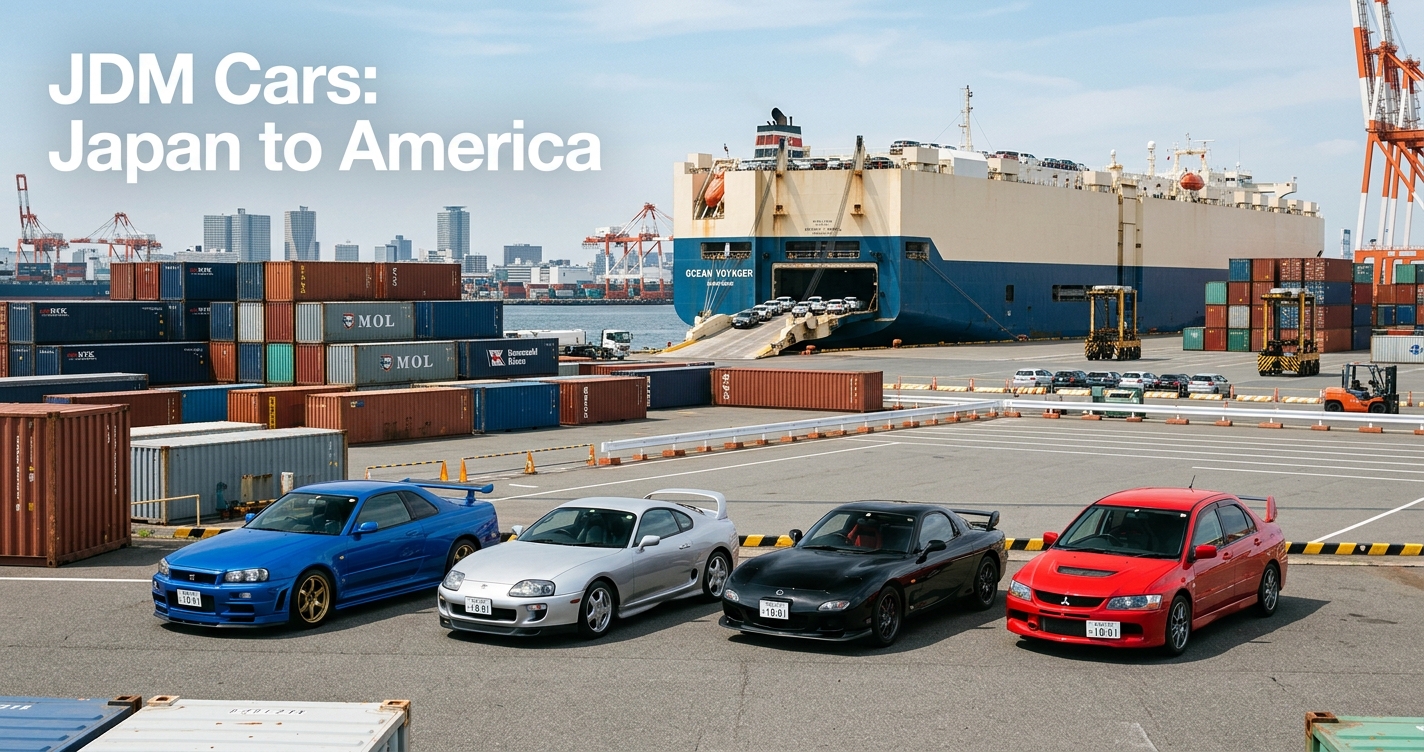
When American enthusiasts see a Japanese-market Nissan Skyline, Toyota Chaser, Mazda RX-7, or Mitsubishi Lancer Evolution advertised for sale, one question often comes to mind: where did the car actually come from? The answer is more interesting than simply saying “Japan.” Most JDM vehicles sold in America begin their lives in Japan, pass through domestic dealerships or auctions, and are then exported through specialized Japanese exporters before reaching the United States.
The growing interest in JDM cars for sale in America has created a market that connects Japanese auctions, exporters, importers, compliance specialists, and American dealers. Understanding this supply chain is important because the vehicle’s history, condition, mileage, export documentation, and eligibility can all affect what happens after it arrives in the United States.
What Does JDM Actually Mean?
JDM stands for Japanese Domestic Market. The term generally refers to vehicles and specifications originally produced for sale in Japan rather than vehicles manufactured specifically for export.
Some Japanese-market models were never officially sold in the United States. Others were offered in America but had different engines, trims, equipment, or specifications in Japan.
Examples of vehicles commonly associated with the JDM market include:
- Nissan Skyline GT-R and other Skyline variants
- Toyota Supra and Chaser
- Mazda RX-7
- Mitsubishi Lancer Evolution
- Subaru Impreza WRX STI
- Toyota Aristo
- Honda Integra Type R
- Nissan Silvia
However, not every Japanese vehicle exported to America is technically JDM. A Toyota Corolla manufactured in Japan for the U.S. market is a Japanese-built vehicle, but it is not necessarily a JDM vehicle.
Where Do These Cars Come From in Japan?
Most Japanese car imports destined for American buyers originate from one of several sources.
Japanese Car Auctions
Large vehicle auctions are one of the most important sources. Japanese auction houses process thousands of used vehicles, including ordinary commuter cars, performance models, luxury vehicles, vans, and rare enthusiast cars.
An exporter or purchasing agent can inspect available vehicles, review their auction information, and bid according to the buyer’s requirements.
Auction vehicles may have detailed records covering:
- Mileage
- Vehicle grade
- Exterior and interior condition
- Previous repairs
- Accident-related damage
- Optional equipment
- Engine and transmission specifications
This makes the auction system an important part of the sourcing process for buyers looking for specific Japanese-market models.
Private Sellers and Dealers
Not every JDM vehicle comes from an auction. Some cars are purchased directly from Japanese dealers or private owners.
This can be particularly useful for unusual or highly sought-after vehicles that may not appear frequently at major auctions. Specialty dealers may also have access to enthusiast-owned cars with extensive maintenance records.
Japanese Exporters
After a vehicle is purchased, it normally moves through an exporter or vehicle trading company. The exporter handles much of the preparation required before the car leaves Japan.
Depending on the arrangement, this can include:
- Purchasing the vehicle.
- Confirming ownership and documentation.
- Arranging inland transportation.
- Preparing export paperwork.
- Organizing shipping.
- Coordinating with the receiving importer.
This stage is an important part of the JDM import process because paperwork errors or incomplete documentation can create complications later.
How Does a JDM Car Reach America?
The journey from a Japanese auction or dealership to an American driveway involves several stages.
| Stage | What Happens |
|---|---|
| Sourcing | The vehicle is located in Japan |
| Inspection | Condition and vehicle history are reviewed |
| Purchase | The buyer, agent, or exporter completes the transaction |
| Export preparation | Documentation and transportation are arranged |
| Ocean shipping | The vehicle travels to the United States |
| Customs | Import documentation and applicable requirements are handled |
| Compliance | The vehicle must satisfy relevant federal and state requirements |
| Registration | The owner completes local registration procedures |
The exact process varies according to the vehicle’s age, specifications, destination state, and import method.
Why the 25-Year Rule Matters
One of the most important considerations for American buyers is the federal 25-year import rule.
Generally, vehicles that are at least 25 years old can be imported into the United States without having to meet the same Federal Motor Vehicle Safety Standards that apply to newer vehicles. The vehicle’s age is calculated according to its date of manufacture.
This rule is a major reason why interest in older JDM models continues to grow.
For example, a vehicle manufactured in 2001 reaches the 25-year threshold in 2026. However, buyers should verify the exact manufacturing date and current federal requirements before purchasing.
Age alone should not be treated as the only consideration. Customs documentation, emissions requirements, state rules, and other regulations may still apply.
JDM Imports vs. Japanese-Built Cars
It is useful to distinguish between these categories before shopping.
| Vehicle Type | Originally Sold in Japan? | JDM? | Potential Import Interest |
|---|---|---|---|
| Japanese-market Skyline | Yes | Yes | High |
| Japanese-market Supra | Yes | Yes | High |
| U.S.-spec Toyota built in Japan | No | No | Varies |
| Japanese domestic kei car | Yes | Yes | Niche |
| Japanese-market sports coupe | Yes | Yes | High |
The distinction becomes particularly important when researching specifications and import eligibility.
What Should American Buyers Check?
Finding a desirable vehicle is only the first step. A careful buyer should investigate the entire vehicle history and import pathway.
Check the Vehicle’s Origin
Confirm that the car was originally sold for the Japanese domestic market if a genuine JDM vehicle is the goal. Check the chassis information, model designation, production year, and specifications.
Verify Mileage and Condition
Mileage should be considered alongside service history and physical condition. A low-mileage vehicle is not automatically better if it has been poorly maintained or stored incorrectly.
Look for evidence of:
- Regular servicing
- Rust or corrosion
- Accident repairs
- Engine modifications
- Transmission problems
- Suspension wear
- Interior deterioration
Confirm Import Eligibility
Before sending money to an exporter or seller, determine whether the specific vehicle can legally enter the United States. The 25-year rule is important, but it does not eliminate every federal, state, or documentation requirement.
Calculate the Complete Cost
The purchase price is only part of the budget. The final cost can include:
- Export fees
- Inland transportation in Japan
- Ocean freight
- Marine insurance
- Customs-related charges
- Port fees
- Compliance or modification costs
- State registration and taxes
A vehicle that appears inexpensive in Japan can become considerably more expensive after shipping and other costs are included.
Why Japanese JDM Cars Continue to Attract American Buyers
The appeal goes beyond styling. Many JDM vehicles offer combinations of performance, engineering, mechanical character, and specifications that were uncommon in the American market.
As more older Japanese vehicles become eligible for import, enthusiasts have greater access to models that were previously difficult or impossible to own legally in the United States.
For buyers researching JDM cars for sale in America, understanding where the vehicles originate is just as important as comparing prices.
Buyers interested in the wider Japanese used-car market can also explore Japanese used cars to understand the broader range of vehicles sourced from Japan.
Conclusion
JDM cars sold in America generally begin their journey in Japan, often through domestic auctions, dealerships, private sellers, and specialist exporters. From there, they pass through a structured export and shipping process before reaching American ports and, eventually, private owners.
For prospective buyers, the most important step is not simply finding an attractive listing. It is understanding the vehicle’s origin, history, condition, import eligibility, documentation, and total landed cost. A thorough approach can make the difference between buying an interesting Japanese-market vehicle and facing unexpected problems after it arrives in America.