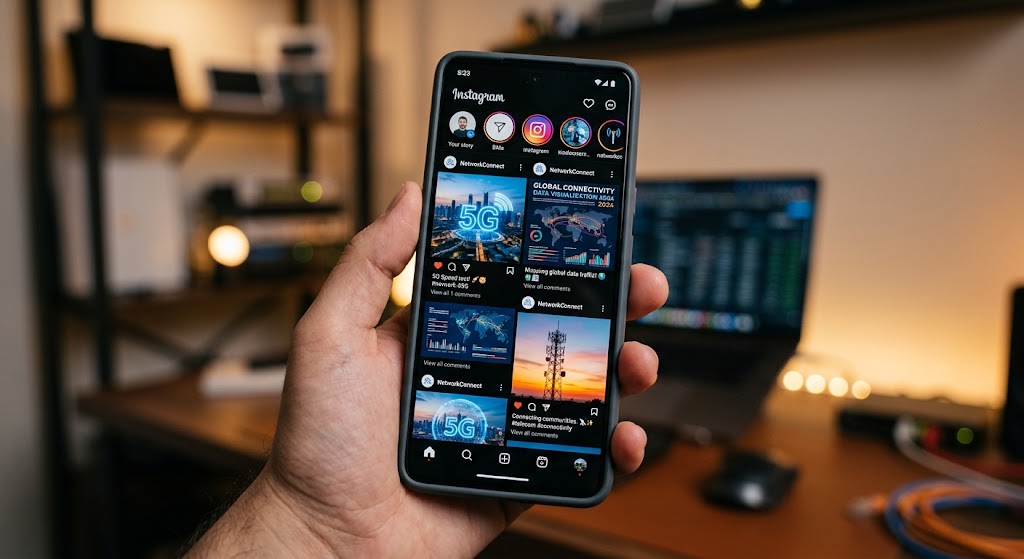
Scroll through enough telecom-related Instagram accounts and a pattern becomes obvious fairly quickly. Most of them are saying the same thing at the same time, usually a reworded press release sitting under a stock photo of a mast or a data centre corridor. The account looks active, the post looks current, and yet nothing in it actually helps you understand what’s happening in the industry. That gap between activity and usefulness is the real starting point for anyone wondering why some telecom accounts feel worth their attention and others simply take up space in a feed.
The difference between industry noise and industry insight
Telecom moves fast on the surface but slowly underneath. Spectrum auctions, infrastructure rollouts, regulatory decisions and vendor partnerships all take months or years to unfold, even though the headlines announcing them appear in a single day. A weak account treats every announcement as a standalone event. A strong one treats it as a data point in a longer story, connecting today’s news to a decision made eighteen months earlier or a trend that’s been building quietly in the background.
This is where most accounts fall short, not because they lack information but because they lack context. Reposting a press release requires no judgement. Explaining why that press release matters, who it affects, and what it signals about where a company or a market is heading requires actual understanding of the sector. Readers can usually tell the difference within a few posts, even if they can’t immediately articulate why one account feels more credible than another.
Why timing matters more than content volume
There’s a temptation to assume that posting frequently is the same as staying relevant. It isn’t. An account that posts twice a week with genuine analysis will outperform one posting daily with recycled updates, because the value telecom followers are actually looking for is interpretation, not repetition. Anyone can find out that a carrier launched a new plan or that a vendor announced a partnership. Far fewer people can explain what that move means for competitors, for pricing, or for the next eighteen months of network investment.
The accounts that get this right tend to slow down at exactly the moments when everyone else speeds up. When a major announcement drops, the rush to post first often produces the thinnest content, simply because there hasn’t been time to think it through. Waiting a day and posting something considered usually beats racing to be first with a summary that adds nothing new.
The trap of confusing enthusiasm with expertise
Genuine enthusiasm for telecom technology is common online, and it isn’t a bad thing on its own. The trouble starts when enthusiasm gets mistaken for expertise. A person who’s excited about 5G speed tests isn’t necessarily someone who understands spectrum economics, network architecture or the commercial pressures shaping how operators actually deploy infrastructure. Both perspectives have a place, but they answer different questions, and conflating them is one of the most common misjudgements people make when deciding who to follow.
A useful way to test this is to look at how an account handles a claim that turned out to be wrong. Enthusiasts tend to move on quietly. People with real domain knowledge usually address it, because their credibility depends on getting the underlying mechanics right, not just being first with exciting news.
How genuine expertise actually shows itself
Expertise rarely announces itself directly. It shows up in smaller signals: why a network upgrade in one region doesn’t translate neatly to another because of spectrum allocation differences, or a regulatory filing flagged months before it becomes a headline story. Details like these matter more than follower counts or production quality, because they show the person behind the account is actually working with the material rather than commentating on it from the outside.
That’s the real distinction between a scroll-worthy feed and background noise, and it’s why a small circle of telecom influencers on Instagram consistently hold attention that outlasts a single trending topic. They aren’t necessarily the loudest voices in the space. They’re the ones whose posts still make sense, and still hold up, months after the initial news cycle has moved on.
Watch, too, how uncertainty gets handled. Telecom involves plenty of unresolved questions, particularly around spectrum policy, infrastructure sharing and the economics of next-generation networks. Presenting every development as settled and obvious is usually a sign of oversimplification. Saying plainly that a situation is unclear, and explaining why, tends to be the more trustworthy move than offering confident answers to questions the industry itself hasn’t resolved yet.
The 5G conversation is where the imitators get exposed
Few topics separate substance from surface-level content as clearly as 5G. It’s technical enough that shallow explanations fall apart under basic scrutiny, and popular enough that almost everyone in the space feels obliged to post about it. That combination makes it a useful filter. Sticking to speed and coverage maps usually means an account is working from the same talking points as everyone else, while getting into spectrum bands, network slicing, or the practical reasons rollout speed varies so dramatically between countries suggests something closer to real technical grounding.
There’s also the gap between marketing language and deployment reality worth watching for. Coverage maps and advertised speeds rarely match everyday user experience, and pointing that out honestly, rather than simply repeating operator messaging, tends to make for a more useful source over time. That willingness to complicate a simple story is often a better sign of quality than polish or presentation ever is.
What a worthwhile account teaches you to notice
The most useful outcome of following good telecom content isn’t staying informed about individual announcements. It’s gradually learning to read the industry yourself, noticing which developments are genuinely significant and which are simply well-marketed. Over time, a strong account changes how you interpret telecom news generally, not just what you know about a specific event.
Try applying that test the next time a telecom post catches your eye. Does it still make sense once the initial excitement fades? Has it left you asking sharper questions instead of just handing you an answer to repeat? An account that manages both has earned its place in the feed — and no amount of posting frequency or polished visuals substitutes for that.