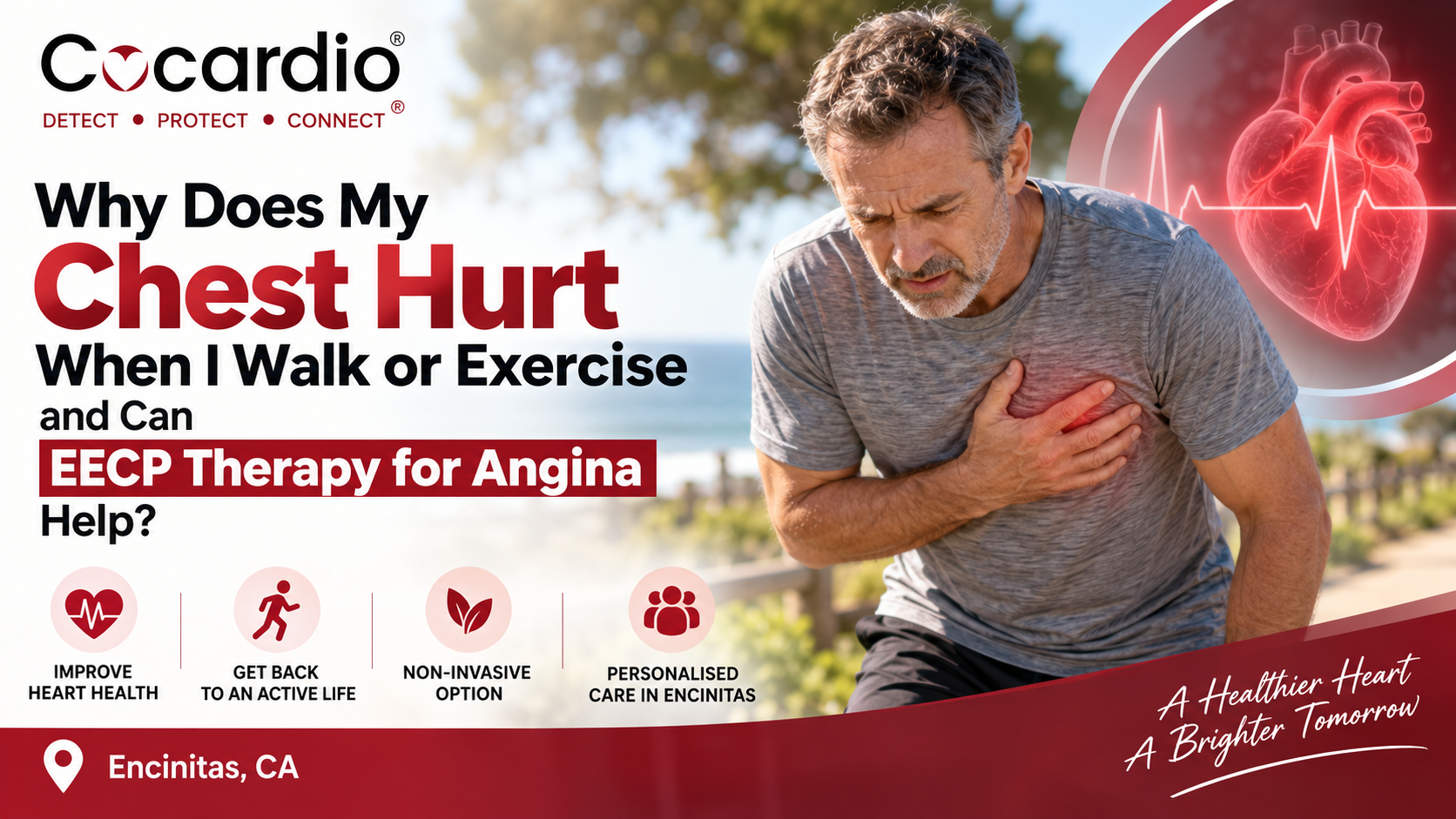
Chest discomfort that appears while walking, climbing stairs, or exercising deserves medical attention because exertion can reveal a mismatch between the heart’s workload and its blood supply. For people whose urgent causes have been ruled out and whose symptoms are consistent with stable angina, eecp therapy for angina may be one option considered after an appropriate evaluation. CoCardio® in Encinitas describes its approach as complementary to standard medical care rather than a replacement for a cardiologist.
Medical disclaimer: This article is for general educational purposes only and is not a diagnosis or a substitute for emergency services, primary care, or cardiology care. Seek immediate medical attention for sudden, severe, or worsening chest pain, especially when accompanied by shortness of breath, fainting, nausea, or pain spreading to the arm or jaw. Consult a qualified healthcare professional before starting or changing treatment.
Why Chest Pain Can Appear During Walking or Exercise
Physical activity makes the heart work harder. CoCardio® explains that angina occurs when the heart muscle does not receive enough blood flow, particularly during physical activity or stress. The discomfort may feel like pressure, tightness, or heaviness and can improve with rest. However, chest pain is not automatically angina; digestive, muscular, stress-related, structural, and other causes can overlap, so the symptom needs thoughtful evaluation rather than self-diagnosis.
A pattern matters. Recurring discomfort with exertion, reduced exercise tolerance, or symptoms that repeatedly settle with rest are reasons to discuss the problem with a qualified clinician. Sudden, severe, or worsening pain is different and should be treated as an emergency rather than a reason to wait for an outpatient appointment.
How Is Exertional Chest Pain Evaluated?
The first goal is to understand whether the heart may be involved and whether urgent conditions have already been excluded. CoCardio® states that its chest-pain pathway can include evaluation of heart structure and pumping function, consideration of circulation-related symptoms, and a consultation to explain findings in plain language. Heart function testing, described by CoCardio® as an echocardiogram, uses non-invasive ultrasound to assess pumping function, valves, structure, and possible signs of strain or dysfunction.
For someone who wants a broader discussion of contributing factors and prevention-focused next steps, a root cause consultation can provide another entry point. The aim should be clarity about the symptom and the next appropriate step, not simply choosing a therapy before candidacy is established.
Can EECP Therapy for Angina Help With Stable Symptoms?
CoCardio® states that ECP may be appropriate for selected people with stable angina and describes the therapy as non-invasive and FDA-approved. Its angina page says the treatment has been used to improve blood flow to the heart muscle, reduce angina symptoms, and increase exercise tolerance. Candidacy is determined through consultation and heart function testing, which is why treatment should follow evaluation rather than replace it.
If you are researching EECP therapy near me, look beyond proximity. Ask how eligibility is assessed, what testing is performed before treatment, how the service coordinates with existing cardiology care, and what happens if your symptoms change. You can also review the EECP therapy for angina patient eligibility checklist before discussing candidacy.
What Happens During EECP Treatment?
The practical question is not only whether a therapy exists, but whether it is suitable for your clinical situation. CoCardio® positions its circulation-focused program as an adjunct to standard care and states that patients should not discontinue prescribed medications or therapies without consulting their doctor. That distinction is important for anyone comparing non-invasive options with established medical care.
People comparing eecp treatment may also encounter the term ecp therapy. Rather than assuming every program is identical, ask what assessment precedes treatment and how progress is reviewed. For questions about EECP therapy cost, use the contact form so the clinic can respond to the specific service you are considering.
Common Mistakes to Avoid When Chest Pain Appears With Exercise
- Continuing strenuous exercise through new or worsening chest pain.
- Assuming recurring chest pressure is harmless because it settles with rest.
- Choosing a treatment before urgent causes and candidacy have been evaluated.
- Stopping prescribed medication because you are considering a non-invasive option.
- Treating online information as a personal diagnosis.
Key Takeaways
Chest pain with walking or exercise can have several causes, including heart-related causes, and the pattern should be assessed rather than guessed. For appropriate candidates with stable angina, eecp therapy for angina may be discussed as a non-invasive, circulation-focused adjunct to standard care. An individualized assessment is the practical first step.
Frequently Asked Questions
Is chest pain during walking always angina?
No. CoCardio® notes that chest pain can be cardiac or non-cardiac, and symptoms can overlap. A qualified clinician should evaluate recurring or unexplained symptoms.
Can eecp treatment replace my cardiologist or medication?
CoCardio® states that its services are adjuncts to standard medical care. Do not stop prescribed medication or therapy without consulting your doctor.
When should chest pain be treated as an emergency?
Seek emergency care for sudden, severe, or worsening chest pain, especially with shortness of breath, fainting, nausea, or pain spreading to the arm or jaw.
Take the Next Step in Encinitas
If exertional chest discomfort keeps returning after urgent causes have been addressed, a structured evaluation can help clarify what may be contributing and whether eecp treatment is appropriate for you.
To discuss your symptoms and possible next steps with CoCardio®, Complete the CoCardio® form or call +1(858) 500-1399 in Encinitas.